Swearing in of Chief Justice John G. Roberts Jr.
2005 · Washington, D.C., United States
John G. Roberts Jr. was sworn in as Chief Justice of the United States, becoming the 17th person to hold the position.
January 31, 1801
John Marshall was appointed as the Chief Justice of the United States by President John Adams. Marshall's influence on the Supreme Court, including establishing the principles of constitutional law and judicial review, became profound.
Washington D.C., United States | U.S. Supreme Court
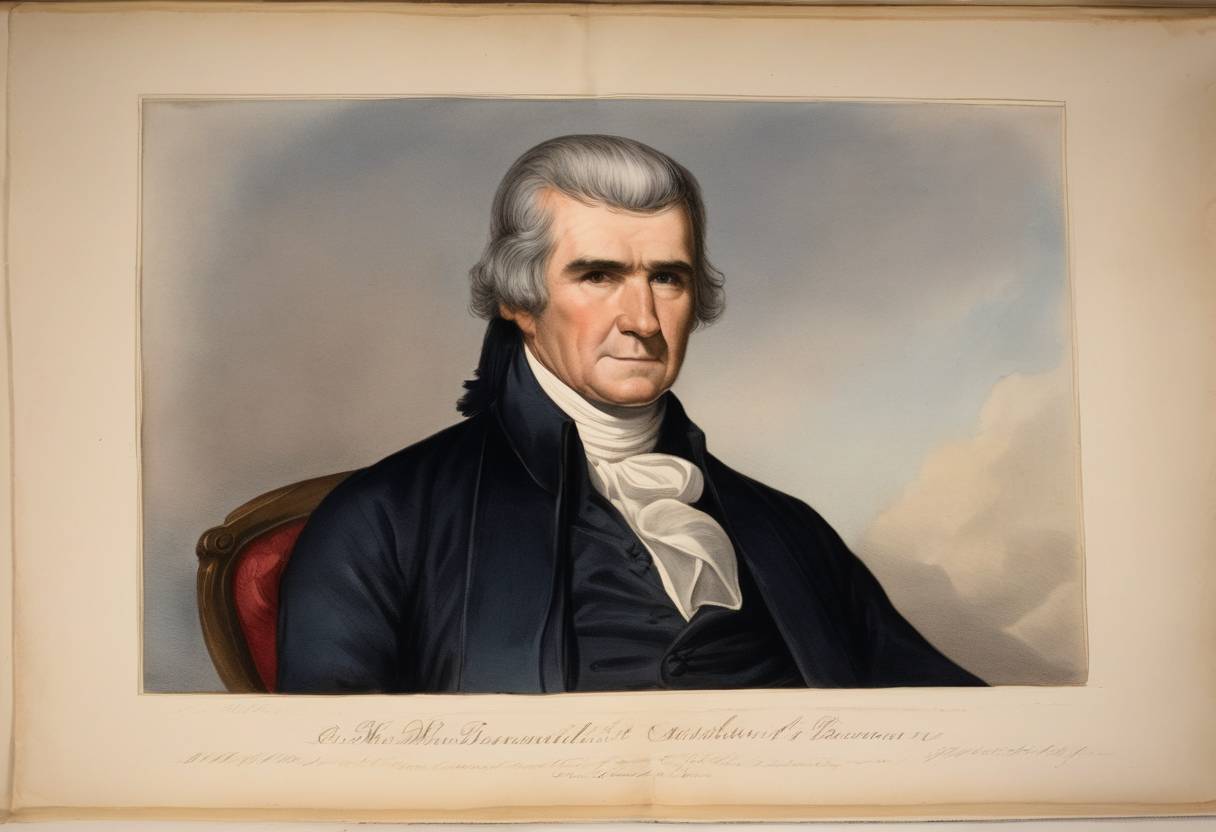
On January 31, 1801, John Adams, the second President of the United States, appointed John Marshall as the Chief Justice of the United States Supreme Court. This appointment played a crucial role in shaping the American legal system and the Supreme Court’s authority in interpreting the Constitution.
John Marshall, originally from Virginia, had served as Secretary of State under President Adams. At the time of his appointment as Chief Justice, the Supreme Court was not seen as the influential body it is today. Its role in the federal government was relatively minor, with limited power in interpreting laws or the Constitution.
Marshall’s tenure as Chief Justice, which lasted from 1801 to 1835, was marked by several landmark cases and decisions that significantly enhanced the prestige and authority of the Supreme Court. One of his most influential contributions was the establishment of the principle of judicial review.
In the 1803 case of Marbury v. Madison, the Supreme Court, under Marshall’s leadership, asserted the power of judicial review by declaring that it had the authority to strike down laws passed by Congress that it found unconstitutional. This decision firmly established the judiciary as an equal branch of government with the power to overrule both the legislative and executive branches when necessary.
Marshall’s legal acumen and leadership transformed the Supreme Court into a co-equal branch of government. His tenure laid the foundation for the role of the Supreme Court in safeguarding the constitutional framework of the United States. Besides Marbury v. Madison, other important cases during his service include McCulloch v. Maryland (1819) and Gibbons v. Ogden (1824), which further clarified the role of federal power over states and the regulation of commerce.
John Marshall’s appointment as Chief Justice was a pivotal moment in United States history, strengthening the institutional power of the Supreme Court and embedding constitutional review into the American legal system. His influence endures, as the principles he established continue to underpin the judiciary’s function in modern governance.
Source: www.britannica.com