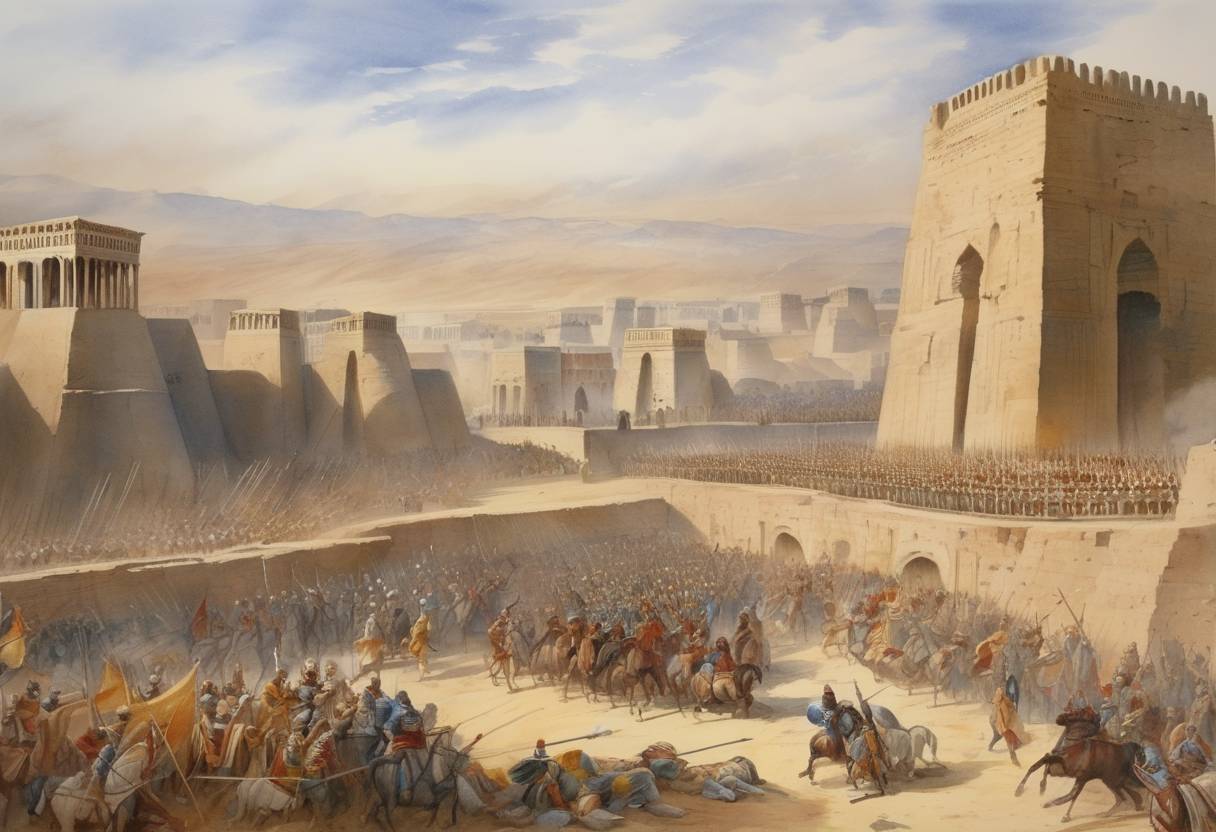
The Battle of Ctesiphon: Roman-Persian Conflict, June 16, 363
Background
The Battle of Ctesiphon, fought on June 16, 363, was a noteworthy engagement in the protracted Roman-Persian Wars. This conflict featured the Roman Emperor Julian’s audacious campaign against the Sasanian Empire and its capital, Ctesiphon, which lay near the modern city of Baghdad in Iraq. Julian, also known as Julian the Apostate due to his efforts to reverse the Christianization of the Empire, sought to capture Ctesiphon and deal a decisive blow to Persian power.
Lead-up to the Battle
In the preceding months of 363, Julian launched an ambitious campaign into Persian territory, having assembled a sizable force adept in both land and riverine operations. This move was part of a broader strategic objective to re-establish Roman supremacy in the East and perhaps seek revenge for defeats suffered by previous emperors.
Julian’s forces utilized the Euphrates River as a principal route to penetrate deep into Persian lands, demonstrating logistical ingenuity, including the transport of light vessels for river crossings.
The Battle
Upon reaching the vicinity of Ctesiphon, Julian’s army met formidable resistance. On June 16, 363, his forces engaged the Persians in a battle characterized by tactical maneuvering and intense combat. Although the Romans succeeded in breaking through some of the Persian defenses and even won a tactical victory on the battlefield near Ctesiphon, they found themselves unable to capture the city. The heavily fortified Persian capital, coupled with strategic missteps and possible shortages in supplies, hindered Julian’s ability to take Ctesiphon outright.
Aftermath
In the aftermath of the battle, Julian’s army withdrew in a challenging retreat. The Romans faced persistent Persian harassment, worsening conditions, and significant logistical challenges. Tragically, the campaign came to a halt when Emperor Julian sustained a mortal wound on June 26, 363, during a skirmish, leading to his death shortly thereafter.
Following Julian’s death, Jovian, his successor, elected to negotiate peace with the Persian King Shapur II. The resulting treaty ceding five Roman provinces and fortresses demonstrated the campaign’s ultimate failure and marked a significant territorial concession by Rome.
Historical Significance
The Battle of Ctesiphon and Julian’s subsequent death marked a decisive moment in Roman-Persian relations and underscored the challenges the Romans encountered in maintaining dominance in the Eastern provinces. Julian’s campaign had aimed at a resurgence of classical paganism but ended with his death, leading to the reaffirmation of Christian leadership in the Roman Empire. The encounter further entrenched the division and enduring conflict between the Roman and Persian empires, shaping the geopolitical landscape of the region for centuries to follow.