Establishment of the World Trade Organization
1995 · Geneva, Switzerland
The World Trade Organization (WTO) was established, taking over from the General Agreement on Tariffs and Trade (GATT), to facilitate international trade.
January 1, 1994
The North American Free Trade Agreement (NAFTA) officially came into effect, establishing a free-trade zone between the United States, Canada, and Mexico.
Washington D.C., United States | NAFTA
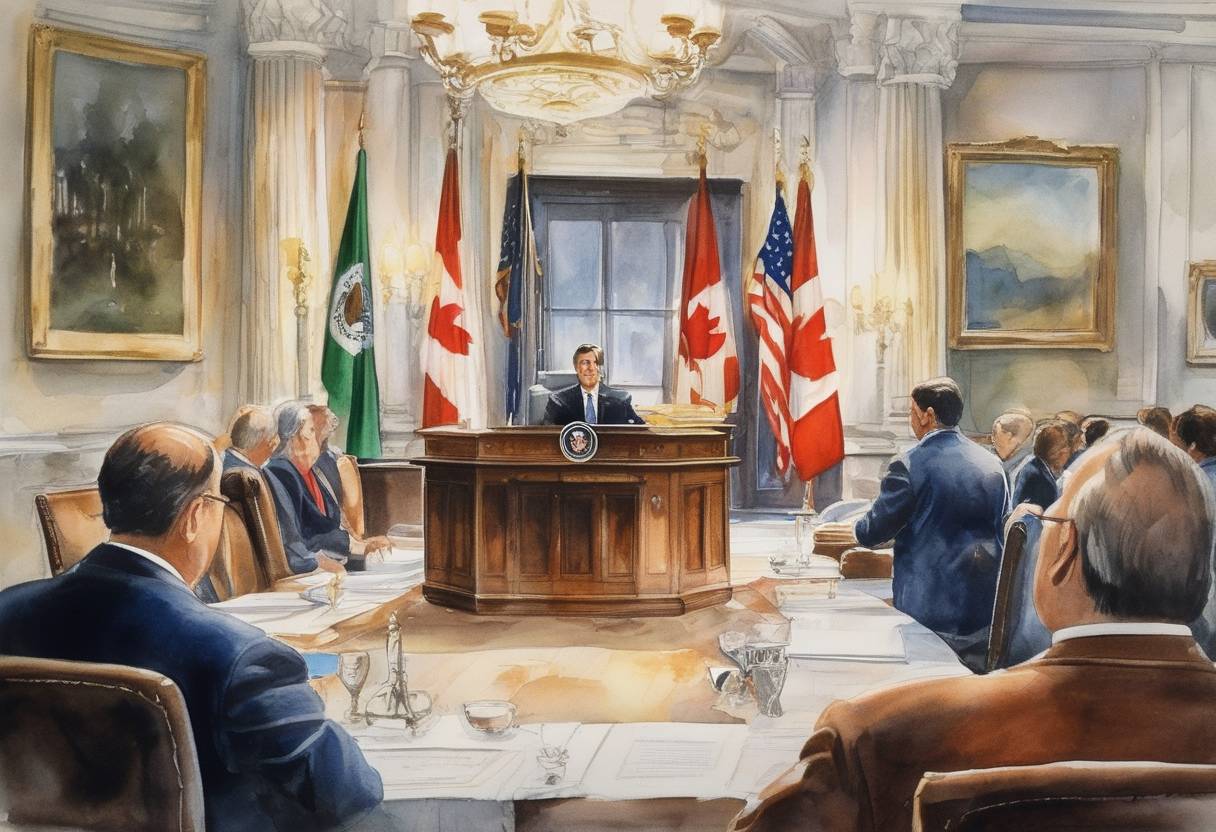
The North American Free Trade Agreement (NAFTA), a landmark accord in international trade policy, officially came into effect on January 1, 1994. This agreement established one of the world’s largest free trade zones between the United States, Canada, and Mexico. NAFTA aimed to eliminate barriers to trade and investment among the three countries, aiming to advance economic integration and growth across North America.
NAFTA was the result of years of careful negotiations among the member countries, motivated by a desire to enhance economic cooperation and competitiveness in the global market. It was signed on December 17, 1992, by U.S. President George H.W. Bush, Canadian Prime Minister Brian Mulroney, and Mexican President Carlos Salinas de Gortari. Each country underwent a ratification process, which included legislative approval.
The trade agreement built upon the Canada-United States Free Trade Agreement of 1988, seeking to extend similar principles to Mexico and creating a trilateral framework for economic interaction.
NAFTA encompassed several significant provisions designed to facilitate increased trade and economic cooperation:
NAFTA significantly altered the economic landscape of North America. It contributed to a substantial increase in trade and investment flows among the three countries, spurring economic growth and integration. However, the agreement also faced criticism related to job displacement, wage impacts, and environmental concerns, leading to ongoing policy debates.
NAFTA remained in effect until July 1, 2020, when it was superseded by the United States-Mexico-Canada Agreement (USMCA). The USMCA built upon the foundations of NAFTA, addressing criticisms and updating provisions to better reflect the modern economic environment. Despite its controversies and challenges, NAFTA’s implementation on January 1, 1994, marked a pivotal moment in the history of North American trade.
Source: history.state.gov