Vasco da Gama's Second Voyage to India - February 12, 1502
1502 · Lisbon, Portugal
Vasco da Gama sets sail from Lisbon, Portugal, on his second voyage to India, further establishing the sea route around the Cape of Good Hope.
May 18, 1498
Portuguese explorer Vasco da Gama reaches the port of Calicut (now Kozhikode) in India, marking the first time a European reached India by sea. This event established a sea route from Europe to Asia, which had profound effects on global trade and the expansion of European empires.
Calicut, India
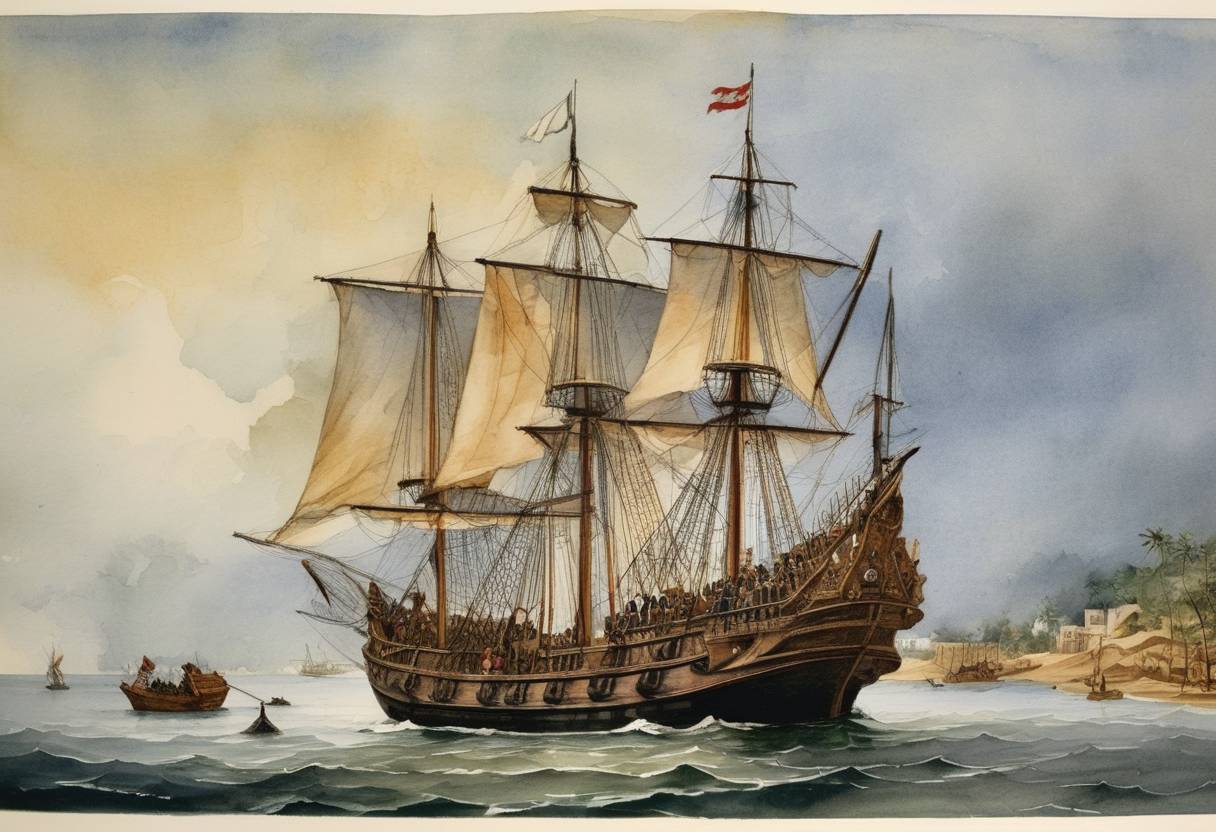
On May 18, 1498, Portuguese explorer Vasco da Gama arrived at the port of Calicut (modern-day Kozhikode) on the southwestern coast of India. This landmark event marked the first time a European had reached India by sea, effectively establishing a maritime link between Europe and Asia. This event was pivotal for several reasons and had wide-reaching consequences for global trade, the expansion of European empires, and intercultural exchanges.
The quest for a direct sea route to India was driven by Europe’s desire to participate in the lucrative spice trade, which until then was dominated by middlemen such as the Ottoman Empire and other Arab powers. Spices like pepper, cinnamon, and cloves were highly valued in Europe for their use in food preservation and flavoring. The overland trade routes were not only long and perilous but also controlled by competing powers, making spices expensive and sometimes scarce.
In 1497, under the commission of King Manuel I of Portugal, Vasco da Gama set out from Lisbon with a fleet of four ships. His mission followed initial explorations by Bartolomeu Dias, who had rounded the Cape of Good Hope at the southern tip of Africa in 1488, opening the possibility of a sea route to India.
Da Gama’s fleet made several stops along the eastern coast of Africa, including modern-day Mozambique and Mombasa, before reaching Malindi, Kenya. There, he secured the expertise of an Arab navigator, whose knowledge of the monsoon winds was invaluable for the successful crossing of the Indian Ocean.
After a challenging journey, da Gama’s expedition reached the Indian subcontinent, landing in Calicut on May 18, 1498. Upon arrival, da Gama was initially received by the Zamorin, the local ruler, with whom he hoped to establish trade relations.
Vasco da Gama’s successful voyage had significant implications:
Establishment of a Sea Route to India: The direct maritime route circumvented traditional overland trading paths and altered the dynamics of global trade, allowing Portugal to dominate the spice trade and significantly reduce the costs involved.
Foundation for Portuguese Colonial Empire: The success of this expedition set the stage for the expansion of Portugal’s colonial empire along the Indian Ocean, with the establishment of trading posts and colonies.
Shift in Power Dynamics: European access to the East Indies directly impacted the traditional trade routes controlled by Middle Eastern and North African traders, leading to a shift in economic power towards European nations.
Cultural Exchanges and Confrontations: The arrival of Europeans in India introduced new cultural exchanges; however, it also led to tensions and confrontations, as European powers often imposed their influence through military and economic means.
The opening of the sea route to India by Vasco da Gama marked the beginning of an era of European exploration and expansion that would have lasting impacts on world history, shaping global commerce, politics, and culture for centuries.
Source: en.wikipedia.org