Elvis Presley's First Appearance on 'The Ed Sullivan Show'
1956 · New York City, United States
Elvis Presley made his first appearance on 'The Ed Sullivan Show', drawing an audience of over 60 million viewers.
April 6, 1957
New York City Philharmonic conductor Leonard Bernstein presented a series of 53 televised music-appreciation concerts for children over CBS-TV beginning with the first episode titled 'What Does Music Mean?'
New York City, United States | CBS
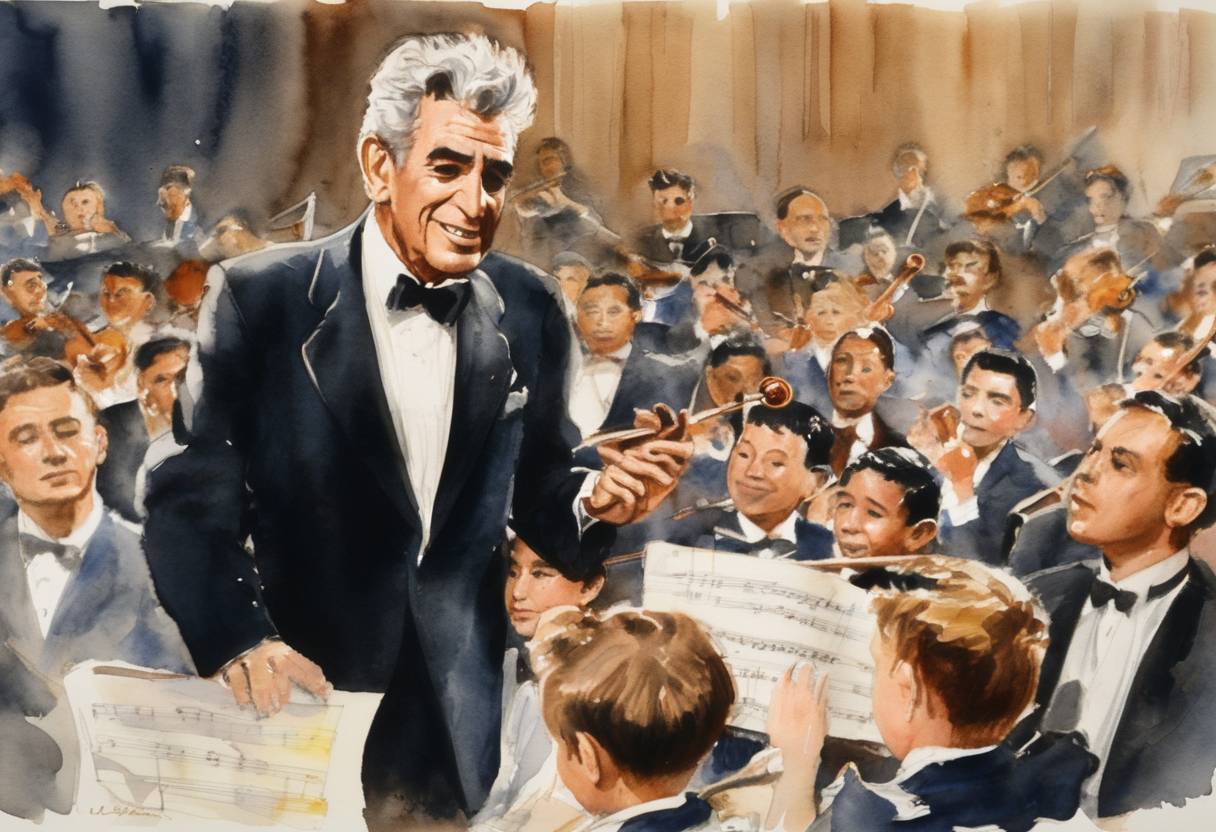
On April 6, 1957, the New York Philharmonic conducted by Leonard Bernstein introduced a groundbreaking music appreciation series for children through CBS Television. This series, known as the “Young People’s Concerts,” began with the inaugural episode titled “What Does Music Mean?”
The “Young People’s Concerts” were a novel educational initiative designed to introduce young audiences to the world of classical music. Bernstein, who was renowned for his charismatic presence and educational prowess, aimed to make music accessible and engaging to children and families. The series was both a reflection of Bernstein’s passion for education and an effort to foster a lifelong love for music among younger generations.
In the first concert, “What Does Music Mean?”, Bernstein tackled a fundamental question often posed by audiences and music students alike. Through this episode, Bernstein endeavored to explore the emotional and narrative aspects of music. He demonstrated how compositions can convey various meanings and feelings without the need for words, thus inviting young viewers to perceive music as both an art form and a universal language.
The format of the concerts was innovative for its time, combining live performances with engaging commentary. Bernstein broke down complex musical concepts into understandable segments, using the orchestra to illustrate his points vividly. The concerts often included performances of complete symphonies and excerpts from various musical works spanning different periods and styles.
The “Young People’s Concerts” series ran until 1972 and consisted of 53 televised programs. It played a critical role in music education, reaching a vast audience both in the United States and internationally. The success of these broadcasts not only boosted Bernstein’s profile as a conductor and educator but also set a precedent for how television could be effectively used as an educational tool in the arts. The episodes were eventually rebroadcast and distributed, ensuring their influence on successive generations of music lovers.
This series is considered a pioneering effort in the realm of televised music education and remains a significant cultural touchstone in both Bernstein’s career and the history of public music education.
Source: www.pbs.org