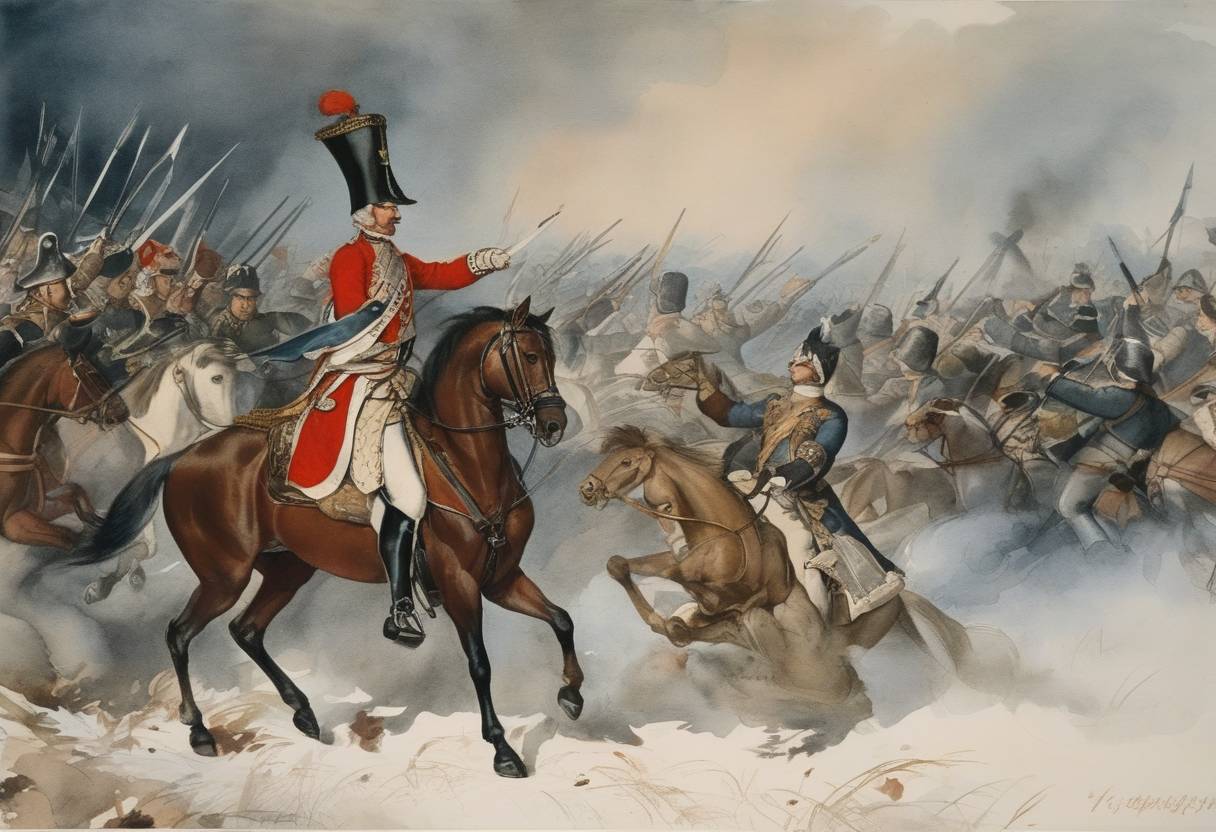
Battle of Mollwitz - April 10, 1741
On April 10, 1741, Frederick II of Prussia, known as Frederick the Great, achieved a notable victory over the Austrian army in the Battle of Mollwitz, during the early stages of the War of the Austrian Succession. This clash marked Frederick’s first battle command and set the stage for the Prussian military dominance of the 18th century.
Context and Lead-up to the Battle
The War of the Austrian Succession (1740-1748) was triggered by the death of Emperor Charles VI in 1740, and the subsequent contest over the Habsburg succession. His daughter, Maria Theresa, faced challenges from several European powers, questioning the legitimacy of her inheritance of the Habsburg territories. Frederick II saw this period of instability as an opportunity to expand Prussia’s territory and prestige by seizing the resource-rich region of Silesia, which was under Austrian control.
Battle Engagement
The Battle of Mollwitz occurred near the village of Mollwitz (now Małujowice, Poland) in Silesia. Frederick led a Prussian army of approximately 21,000 men against a slightly smaller Austrian force commanded by Field Marshal Wilhelm Reinhard von Neipperg. The Austrians were better equipped with cavalry, which played a crucial role in 18th-century warfare.
The battle commenced with an Austrian cavalry charge that initially forced back the Prussian right flank. In what seemed a potential defeat, Frederick temporarily retreated from the battlefield upon advice from his general staff. However, Prussian infantry, renowned for their discipline and firepower, maintained their ground. Under the command of Field Marshal Kurt Christoph von Schwerin, the Prussian infantry executed devastating volleys that wore down the Austrian forces.
Outcome
Despite initial setbacks, the orderly and disciplined Prussian infantry overwhelmed the Austrians, leading to a decisive Prussian victory. The Austrian army was forced to retreat, suffering significant casualties, with estimates suggesting around 4,550 Austrian soldiers killed or captured compared to approximately 5,500 Prussian casualties.
Significance and Aftermath
The victory at Mollwitz had several key implications:
- Validation of Prussian Military Reforms: It validated Frederick’s military reforms, highlighting the effectiveness of drilled infantry and linear tactics.
- Boost to Prussian Morale: It bolstered the prestige of Frederick and invigorated the Prussian forces for future engagements.
- Political Repercussions: Prussia’s success at Mollwitz complicated the European political landscape and invited other powers to question the status quo, leading several to form alliances against Austria.
This battle set the tone for Frederick the Great’s military strategies and solidified Prussia’s role as a European power, influencing the subsequent course of the War of the Austrian Succession and European geopolitics.