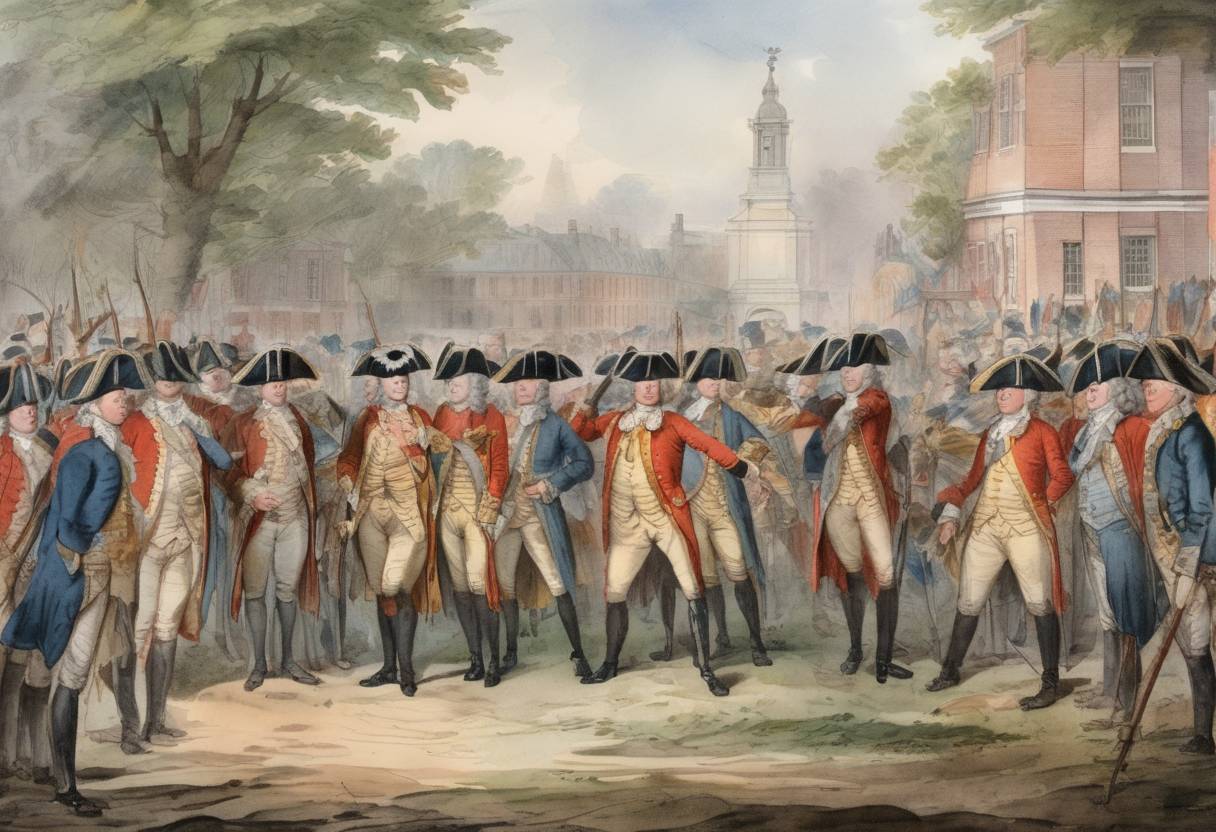
King George III Declares the American Colonies in Open Rebellion
On August 23, 1775, King George III of Great Britain issued a formal proclamation declaring that the American colonies were in a state of open rebellion. This significant declaration marked a pivotal moment in the escalating tensions between Britain and its American colonies, setting the stage for the Revolutionary War.
Context Leading to the Declaration
The relationship between Britain and its American colonies had been deteriorating for several years due to a series of legislative acts imposed by the British Parliament. These acts, including the Stamp Act of 1765 and the Townshend Acts of 1767, were designed to exert greater control over the colonies and raise revenue. The colonists, however, viewed these measures as violations of their rights, leading to widespread protests and acts of defiance.
The situation further escalated with the Boston Tea Party in December 1773, where American colonists, protesting the Tea Act, dumped an entire shipment of tea into Boston Harbor. In response, the British government enacted the Coercive Acts (also known as the Intolerable Acts) in 1774, which further inflamed colonial resistance.
Key Events Leading to the Proclamation
April 1775: The Battles of Lexington and Concord marked the outbreak of armed conflict between British troops and colonial militia. These skirmishes demonstrated the colonies’ willingness to resist British authority by force.
June 1775: The Battle of Bunker Hill further intensified the conflict, with significant casualties on both sides. Although technically a British victory, it proved the colonists’ resolve and capability to stand against the British army.
July 1775: The Continental Congress adopted the Olive Branch Petition, a final attempt to avoid a full-scale war by appealing directly to King George III for reconciliation. However, the petition was rejected, and the king refused to negotiate with what he considered rebellious subjects.
The Proclamation of Rebellion
In his proclamation, King George III declared that the colonies were “in a state of open and avowed rebellion” and called upon loyal subjects to suppress the uprising. The proclamation justified the use of military force to restore order and emphasized the king’s determination to maintain British sovereignty over the colonies.
The declaration effectively ended any hopes for a peaceful resolution and solidified the divide between Britain and the colonies. It also served to rally support for the colonial cause, as many colonists who were previously undecided or loyal to the crown began to support independence.
Aftermath and Historical Significance
The proclamation of rebellion was a crucial step towards the full-scale war that would become the American Revolutionary War. It underscored the British government’s commitment to quelling the rebellion and reinforced the colonists’ resolve to fight for their rights and independence.
The conflict continued to escalate, leading to the Declaration of Independence on July 4, 1776, where the colonies formally severed ties with Britain. The war would last until 1783, culminating in the Treaty of Paris, which recognized the sovereignty of the United States.
King George III’s declaration remains a significant moment in history, symbolizing the point of no return in the struggle for American independence and the birth of a new nation.