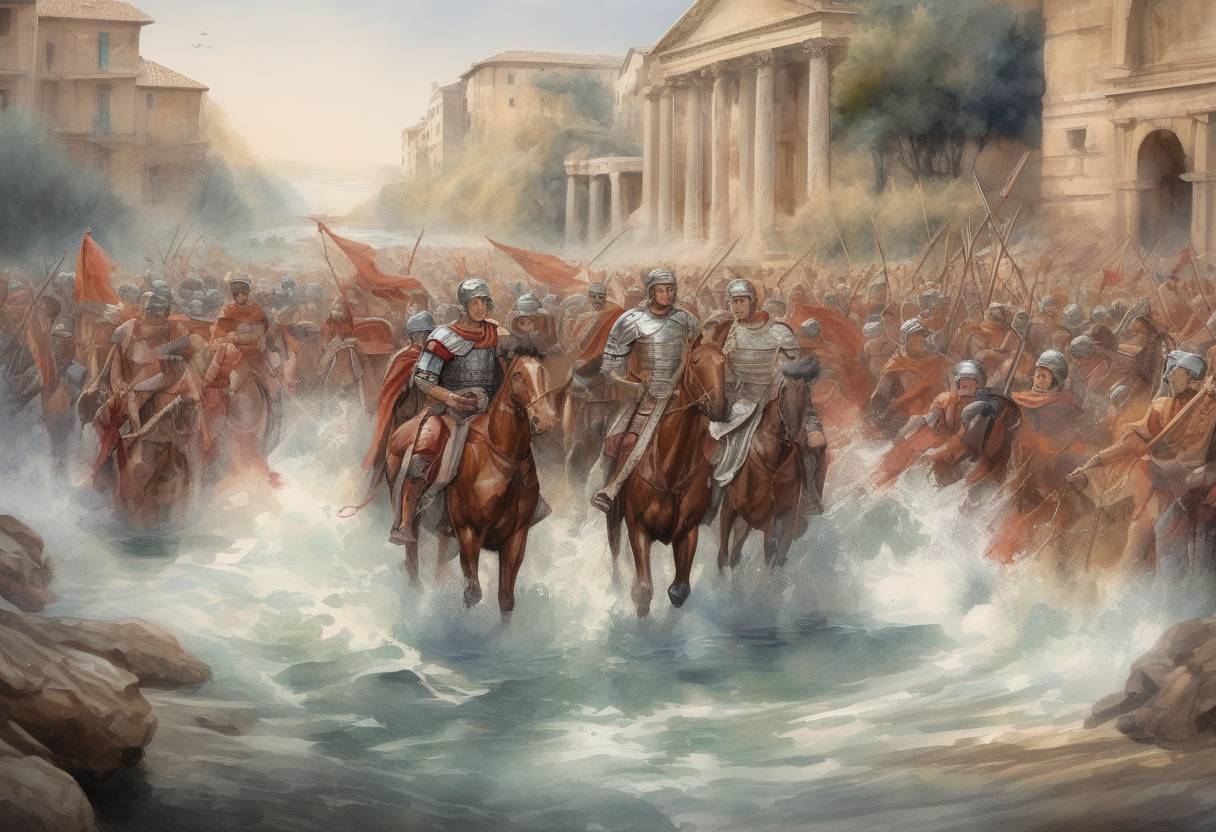
Julius Caesar Crosses the Rubicon River: January 10, 49 BCE
On January 10, 49 BCE, Julius Caesar made a fateful decision that would alter the course of Roman history: he crossed the Rubicon River with his army, an act that precipitated the Roman Civil War. This moment is often encapsulated by the phrase “alea iacta est” or “the die is cast,” attributed to Caesar as he led his troops across the river.
Context and Background
Political Tensions: The late Roman Republic was marked by intense political rivalries and power struggles. Julius Caesar, a prominent military general and politician, had formed the First Triumvirate with Pompey the Great and Crassus. However, after Crassus’s death and growing tensions between Caesar and Pompey, the alliance deteriorated.
Caesar’s Conquests: Caesar had spent years expanding Roman territories in Gaul, gaining immense popularity and military strength. His successes, however, threatened the Senate and Pompey, who feared his rising power.
Senate’s Ultimatum: The Roman Senate, influenced by Pompey, ordered Caesar to disband his army and return to Rome as a private citizen. This ultimatum was a direct challenge to Caesar’s authority and ambitions.
The Crossing of the Rubicon
The Rubicon River: The Rubicon was a small river in northern Italy that marked the boundary between the Roman province of Cisalpine Gaul and Italy proper. Roman law forbade generals from crossing it with an army, as doing so was considered an act of war against the Senate and the Roman state.
Caesar’s Decision: On January 10, 49 BCE, Caesar crossed the Rubicon with the 13th Legion, effectively declaring war on the Roman Senate. This bold move was a calculated risk, as it meant defying the Senate’s authority and initiating a civil conflict.
Consequences and Significance
Outbreak of Civil War: Caesar’s crossing of the Rubicon ignited a civil war between his forces and those loyal to the Senate, led by Pompey. This conflict would last until 45 BCE, culminating in Caesar’s victory and his eventual appointment as dictator for life.
End of the Roman Republic: The civil war and Caesar’s subsequent rise to power marked the decline of the Roman Republic and set the stage for the transition to the Roman Empire under Augustus.
Legacy: The phrase “crossing the Rubicon” has since become synonymous with making an irreversible decision that commits one to a specific course of action, often with significant consequences.
Julius Caesar’s crossing of the Rubicon remains a pivotal moment in history, symbolizing the end of the Roman Republic and the beginning of a new era in Roman governance.