Launch of the Ford Model A - December 2, 1927
1927 · Dearborn, United States
The Ford Model A was launched, marking a significant advancement in automobile design and manufacturing after the success of the Model T.
October 1, 1908
The Ford Model T, the first affordable automobile, was introduced to the market, revolutionizing transportation and American industry.
Detroit, United States | Ford Motor Company
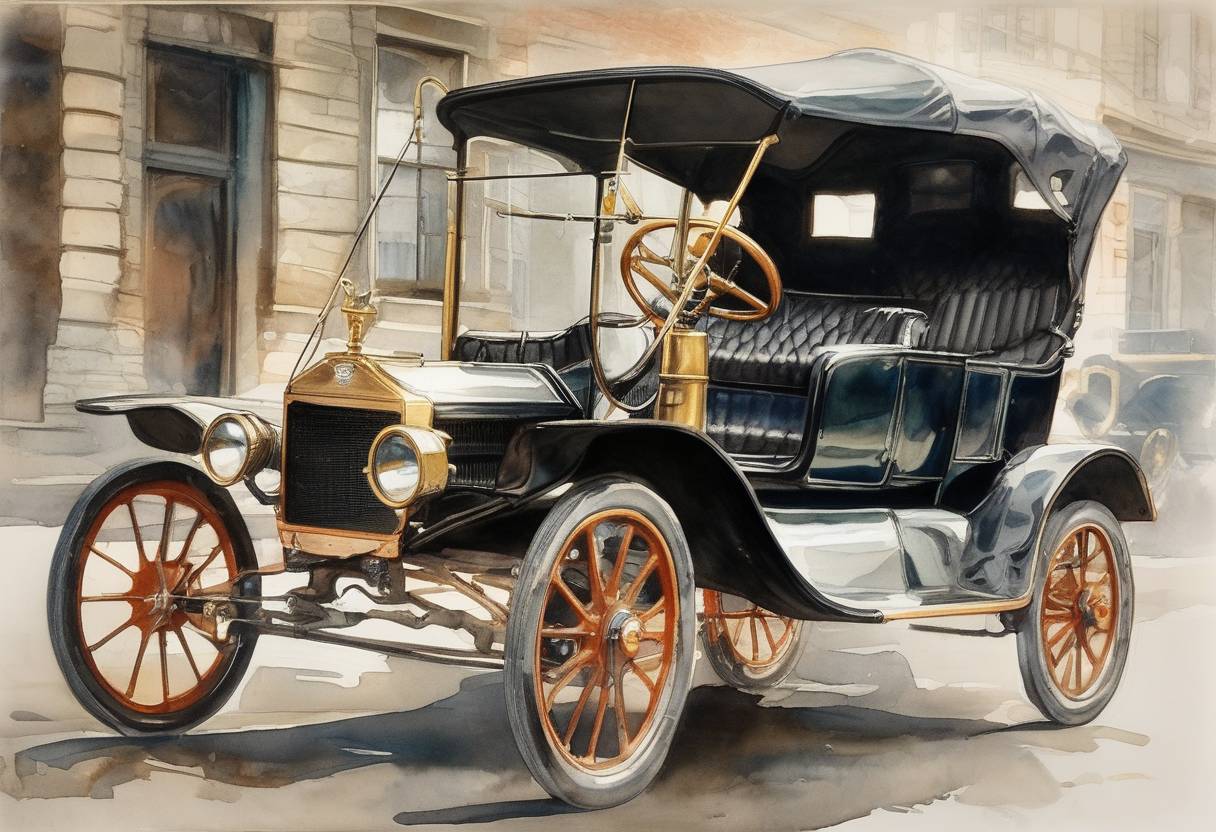
On October 1, 1908, the Ford Motor Company introduced the Model T, a vehicle that would revolutionize transportation and have a profound impact on American industry and society. Often referred to as the “Tin Lizzie,” the Model T was the first automobile mass-produced on moving assembly lines with completely interchangeable parts, marketed to the middle class.
Henry Ford and the Ford Motor Company: Founded in 1903 by Henry Ford and a group of investors, the Ford Motor Company aimed to create affordable and reliable vehicles for the average American. Prior to the Model T, automobiles were largely luxury items, accessible only to the wealthy.
Industrial Innovations: The introduction of the assembly line in 1913, although not immediately implemented at the Model T’s launch, was a significant innovation that allowed Ford to drastically reduce production costs and time. This method of production would later become a standard in manufacturing industries worldwide.
Affordability: Priced initially at \(850, the Model T's cost continued to decrease over the years, reaching as low as \)260 by the 1920s due to efficiencies in production.
Durability and Simplicity: The Model T was designed to be durable and easy to maintain, with a simple design that made it accessible to a wide range of consumers, including those in rural areas.
Versatility: It was adaptable to various terrains and conditions, making it popular in both urban and rural settings. Its high ground clearance and robust construction were particularly suited to the less developed road infrastructure of the time.
Mass Production and the Assembly Line: The Model T’s production process revolutionized manufacturing, introducing the moving assembly line, which significantly increased production speed and efficiency. This innovation not only transformed the automotive industry but also influenced manufacturing processes across various sectors.
Economic and Social Impact: The affordability of the Model T made car ownership accessible to millions of Americans, contributing to the growth of suburbs and the expansion of road infrastructure. It also stimulated industries such as steel, rubber, and oil, creating numerous jobs and boosting the economy.
Cultural Influence: The Model T became a symbol of innovation and progress, embodying the spirit of the early 20th century. It played a crucial role in shaping American culture, influencing everything from family dynamics to leisure activities.
End of Production: The Model T was produced until 1927, with over 15 million units sold. Its success paved the way for future models and solidified Ford’s place as a leader in the automotive industry.
Long-term Influence: The principles of mass production and affordability established by the Model T continue to influence automotive manufacturing and consumer culture to this day.
In summary, the introduction of the Ford Model T on October 1, 1908, marked a pivotal moment in industrial history, transforming transportation and setting new standards for manufacturing and consumer accessibility. Its legacy is evident in the continued evolution of the automotive industry and its lasting impact on society.
Source: en.wikipedia.org