Exile of Leon Trotsky: A Turning Point in Soviet History
1929 · Moscow, Soviet Union
The Soviet Union exiled Leon Trotsky, a key figure in the Russian Revolution, marking a critical point in Joseph Stalin's consolidation of power.
January 27, 1924
Lenin's body is placed in a mausoleum in Red Square, Moscow, following his death on January 21.
Moscow, Soviet Union | Soviet Government
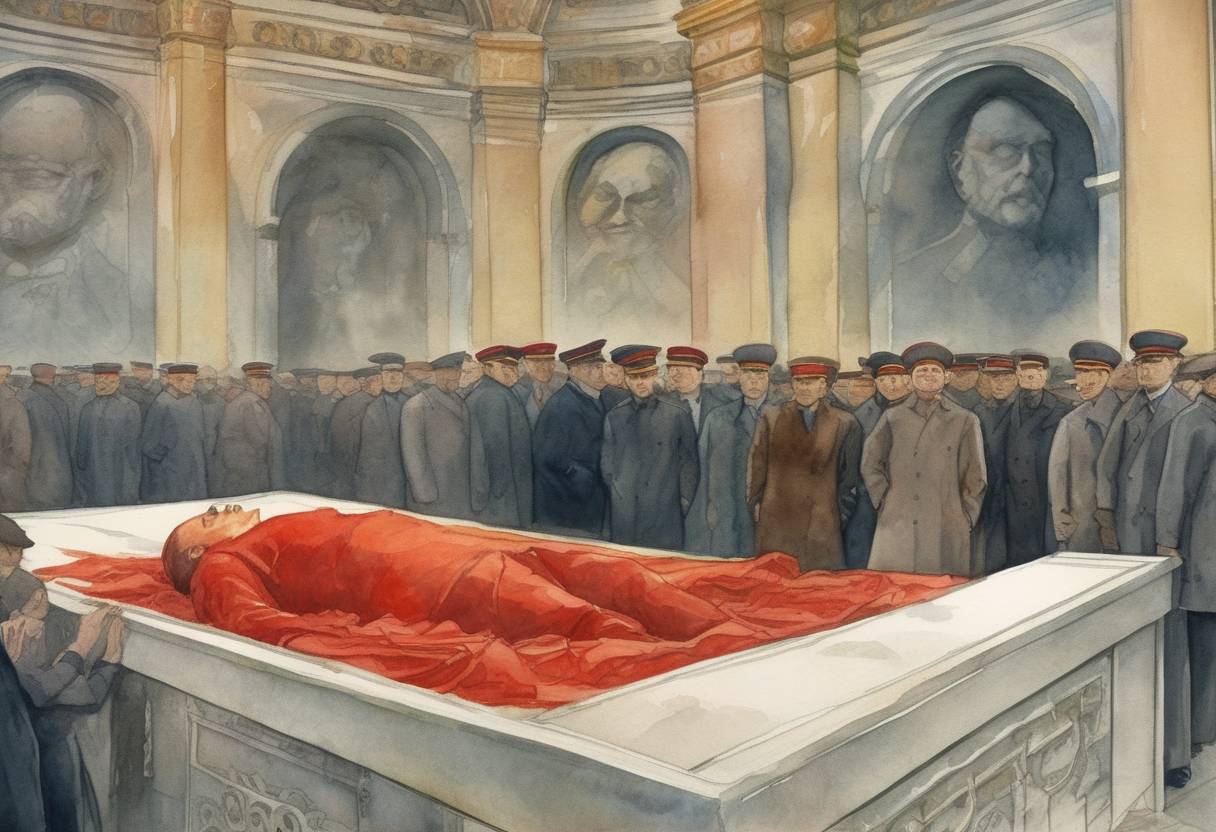
On January 27, 1924, the body of Vladimir Ilyich Lenin, the leader of the Bolshevik Revolution and the first head of the Soviet state, was placed in a mausoleum in Red Square, Moscow. This event marked a significant moment in Soviet history, reflecting both the reverence for Lenin as a revolutionary leader and the political symbolism his embalmed body would come to represent.
Lenin’s Death: Lenin passed away on January 21, 1924, after suffering a series of strokes that left him incapacitated in the final years of his life. His death marked the end of an era for the Soviet Union, which he had helped to establish following the October Revolution of 1917.
Immediate Aftermath: Lenin’s death prompted an outpouring of grief across the Soviet Union. The government, led by Joseph Stalin and other prominent Bolsheviks, sought to immortalize Lenin’s legacy and maintain his ideological influence over the Soviet state.
Public Display: The decision to embalm Lenin’s body and place it on public display was both a practical and symbolic choice. It allowed the Soviet leadership to maintain Lenin’s presence as a guiding figure for the Communist Party and the Soviet people.
Construction of the Mausoleum: Initially, a temporary wooden structure was erected to house Lenin’s body. This was later replaced by the more permanent granite and marble mausoleum that stands today. The mausoleum was designed by architect Alexey Shchusev and became a focal point of Red Square.
Cult of Personality: The preservation of Lenin’s body contributed to the development of a cult of personality around him, which was later emulated by Stalin. This practice underscored the centralization of power and the use of symbolic figures to unify and control the populace.
Tourist Attraction and Political Symbol: Over the years, Lenin’s Mausoleum has become both a tourist attraction and a potent symbol of Soviet ideology. It has been a site of pilgrimage for communists worldwide and remains a significant historical landmark.
Ongoing Debate: The presence of Lenin’s body in the mausoleum has been a subject of debate in post-Soviet Russia, with discussions about whether it should be buried in accordance with Lenin’s own wishes. However, as of now, the body remains on display, continuing to evoke the complex legacy of Lenin and the Soviet era.
In summary, the placement of Lenin’s body in a mausoleum on January 27, 1924, was a pivotal event that not only honored a key figure in Soviet history but also served as a tool for political continuity and ideological reinforcement in the nascent Soviet Union.
Source: en.wikipedia.org