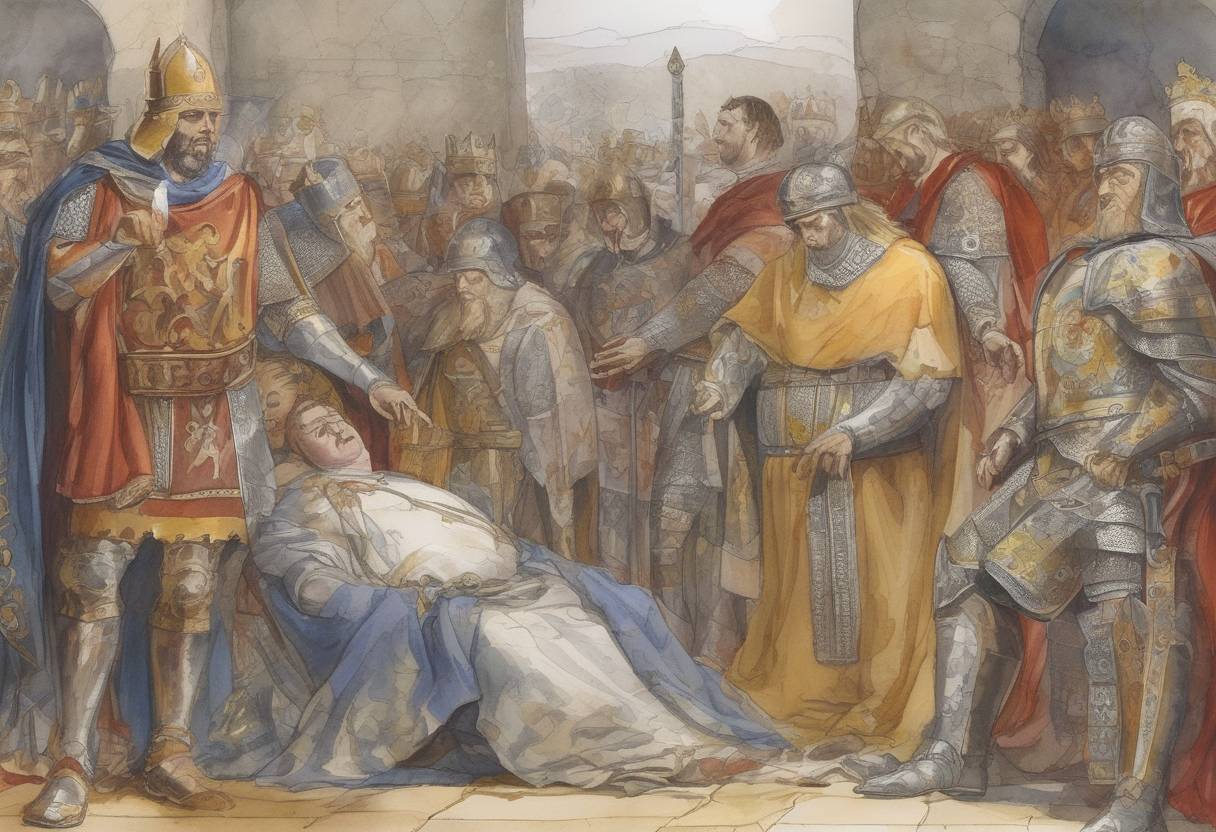
The Death of Emperor Charles the Fat
On August 26, 887, Emperor Charles the Fat, the last Carolingian emperor to rule over a united Carolingian Empire, passed away. His death marked a significant turning point in the history of the Carolingian dynasty and the broader political landscape of medieval Europe.
Background
Charles the Fat was born in 839, the youngest son of Louis the German, who was the grandson of Charlemagne. Charles ascended to power during a period of considerable instability and fragmentation within the Carolingian Empire. He became King of West Francia in 884, after the death of his cousin, Carloman II, and was crowned Emperor in 881. His reign was characterized by attempts to maintain the unity of the empire amidst growing internal and external pressures.
Reign and Challenges
Charles’s reign was fraught with challenges:
Viking Raids: The empire faced persistent Viking incursions, which Charles struggled to repel effectively. His decision to pay off the Vikings rather than confront them militarily was seen as a sign of weakness.
Internal Fragmentation: The empire was increasingly divided among regional powers and local nobility, who were gaining autonomy and influence. This decentralization weakened imperial authority and made governance more challenging.
Health Issues: Charles suffered from health problems, which affected his ability to govern effectively. His bouts of illness often left him incapacitated, further destabilizing his rule.
The Fall of the Carolingian Empire
Charles’s inability to manage these challenges led to the fragmentation of the empire. In 887, a rebellion led by his nephew, Arnulf of Carinthia, resulted in Charles being deposed. This marked the end of a united Carolingian Empire, as regional leaders began to assert their independence, leading to the rise of distinct kingdoms such as East Francia, West Francia, and Italy.
Aftermath and Historical Significance
The death of Charles the Fat signaled the definitive end of the Carolingian Empire as a unified entity. The power vacuum left by his deposition and subsequent death facilitated the emergence of new political entities and the eventual formation of the Holy Roman Empire. The fragmentation also set the stage for the development of the feudal system, which would dominate European politics and society in the centuries to follow.
Charles’s reign is often viewed as a period of decline for the Carolingian dynasty, highlighting the challenges of maintaining a vast empire in the face of external threats and internal divisions. His death underscored the shifting dynamics of power in medieval Europe, paving the way for the rise of regional powers and the eventual transformation of the political landscape.