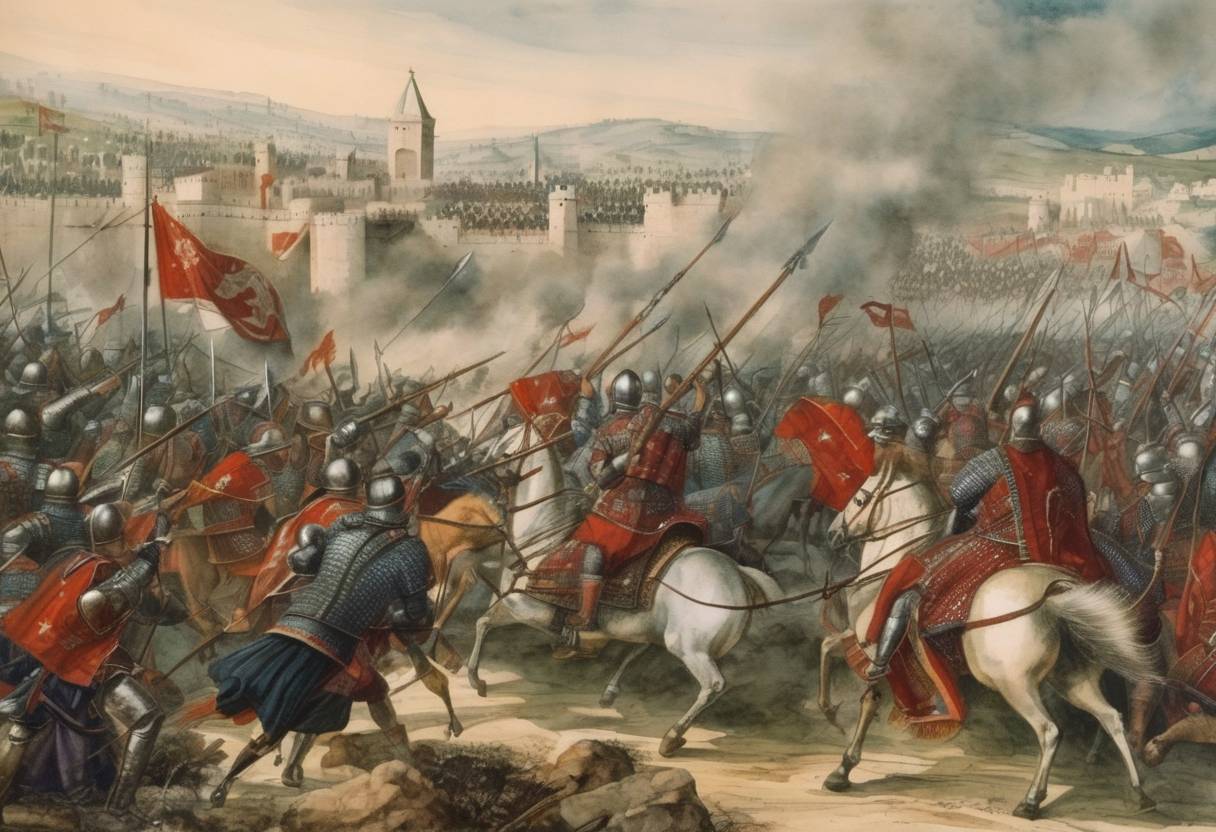
The Battle of Nicopolis: September 25, 1396
The Battle of Nicopolis, occurring on September 25, 1396, stands as a pivotal clash during the later Crusades, marking a significant defeat for the Christian coalition forces at the hands of the Ottoman Empire. This engagement was the climax of a crusading effort organized to halt Ottoman expansion in Europe and defend the remaining Christian lands in the Balkans from Turkish encroachment.
Prelude to Battle
The late 14th century saw the Ottoman Empire, under Sultan Bayezid I, expanding deeper into the Balkans, threatening Christian dominions in Eastern Europe. In response, King Sigismund of Hungary appealed for a crusade, which was met with enthusiasm across European nobility. Prominent figures, including John the Fearless of Burgundy, Count John VI of Nevers, and a host of knights and nobles from France, Germany, and other European regions, formed a formidable yet disparate force. Such was the diversity and size of the army that it numbered around 16,000 to 20,000 troops, reflecting a significant military mobilization against the Ottoman threat.
The Battle
The Christian forces laid siege to Nicopolis, a key Ottoman stronghold located in present-day Bulgaria. Despite initial successes, the crusaders suffered from poor coordination and overconfidence. On the day of the battle, a complex unfolding saw the heavily armored knights launch an impromptu attack without the full deployment of their forces. This aggression, driven by a combination of impetuosity and misjudgment of Durnaghs (Ottoman troops), left them exposed and fatigued.
The Ottomans, familiar with the terrain and employing better strategic depth, counterattacked under the command of Bayezid I. They effectively used archers to weaken the knight’s charge and then launched their cavalry and infantry against the exhausted crusaders. What ensued was a crushing defeat for the Christian forces, with many being killed or captured, including the Duke of Burgundy.
Aftermath and Consequences
The defeat at Nicopolis not only showcased the rising Ottoman military prowess but also highlighted the fragmentation and lack of unity among European powers. Sultan Bayezid I’s victory cemented Ottoman control in the Balkans, accelerating their advance into Europe.
The battle’s outcome had lasting repercussions. It diminished the morale and political cohesion of European states toward future crusading ventures, severely setting back the Christian effort to contain Ottoman advances. Furthermore, it underscored the need for improved diplomatic and martial alliances among European powers to effectively counterbalance the Ottoman Empire, a realization that would shape future coalitions against the Ottomans in subsequent centuries.