The Opening of the Verrazano-Narrows Bridge
1964 · New York City, United States
The Verrazano-Narrows Bridge, connecting Staten Island and Brooklyn in New York City, opened to traffic.
December 31, 1909
The Manhattan Bridge, a suspension bridge connecting Manhattan and Brooklyn in New York City, officially opened to traffic.
New York City, United States | New York City Department of Bridges
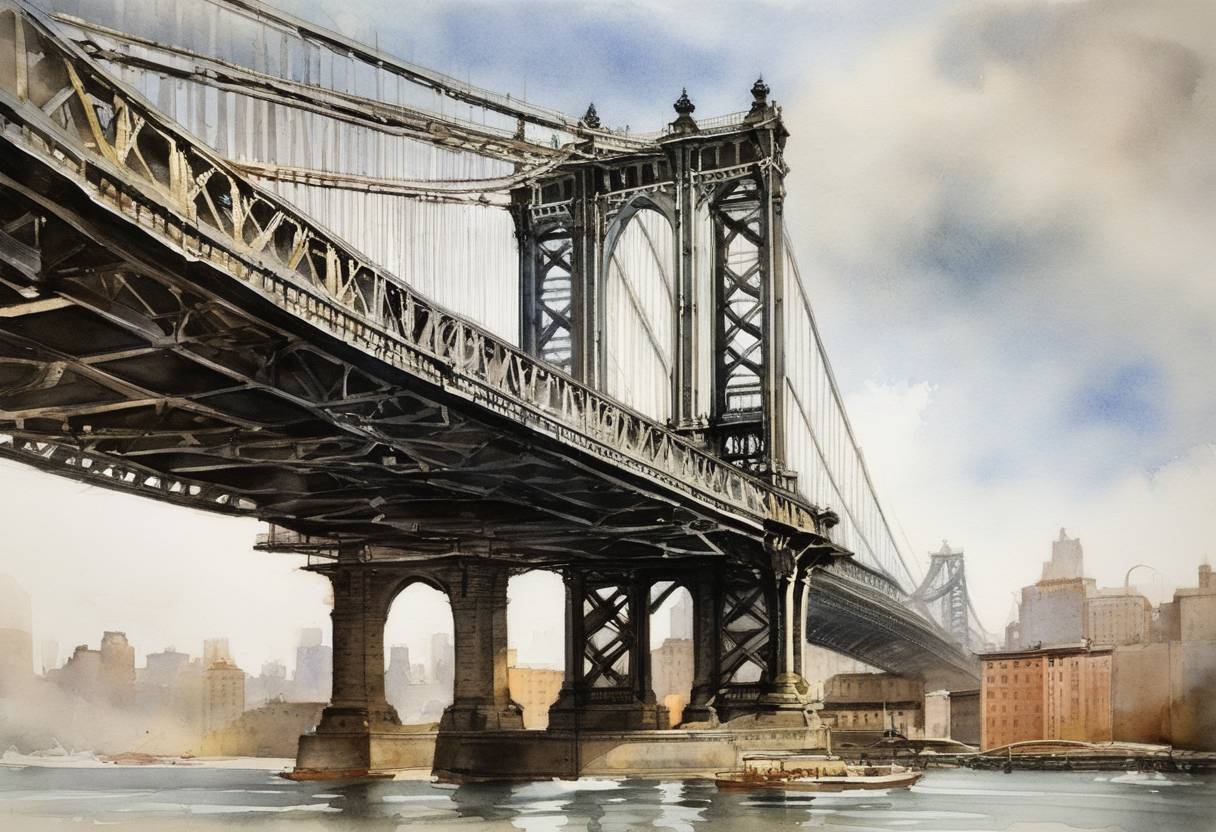
The Manhattan Bridge, a vital suspension bridge, officially opened to traffic on December 31, 1909. This engineering marvel connects two significant boroughs of New York City, Manhattan and Brooklyn, across the East River. The bridge is the youngest of the three major East River suspension bridges, following the Brooklyn and Williamsburg Bridges.
Designed by Leon Moisseiff, an influential bridge designer, the Manhattan Bridge was a pioneering structure in suspension bridge design. It introduced deflection theory principles, which enabled the use of lighter materials and longer spans — concepts that later influenced the design of future bridges.
Construction of the bridge began in 1901 under chief engineer Gustav Lindenthal. However, after political disagreements, Lindenthal was replaced by Othniel Foster Nichols, and the bridge was ultimately completed under Moisseiff’s supervision.
The Manhattan Bridge features a main span length of 1,470 feet (448 meters) and is supported by massive concrete and stone anchorages. Its design includes:
Upon its opening, the Manhattan Bridge significantly eased traffic congestion caused by its predecessors, the Brooklyn and Williamsburg Bridges. It played a crucial role in supporting the expansion of Brooklyn as a residential district, as well as enabling commerce and connectivity between the boroughs.
Beyond its functionality, the bridge has aesthetic significance, showcasing an impressive Beaux-Arts triumphal arch and colonnade at its Manhattan entrance designed by architect Carrère and Hastings. This feature accentuates its dual role as both a utilitarian structure and a work of monumental public art.
The bridge continues to be a vital transport artery and an iconic New York City landmark, representing early 20th-century architectural and engineering advancements. Its role in facilitating urban growth and its influence on future bridge designs underscore its historical importance.
Source: en.wikipedia.org