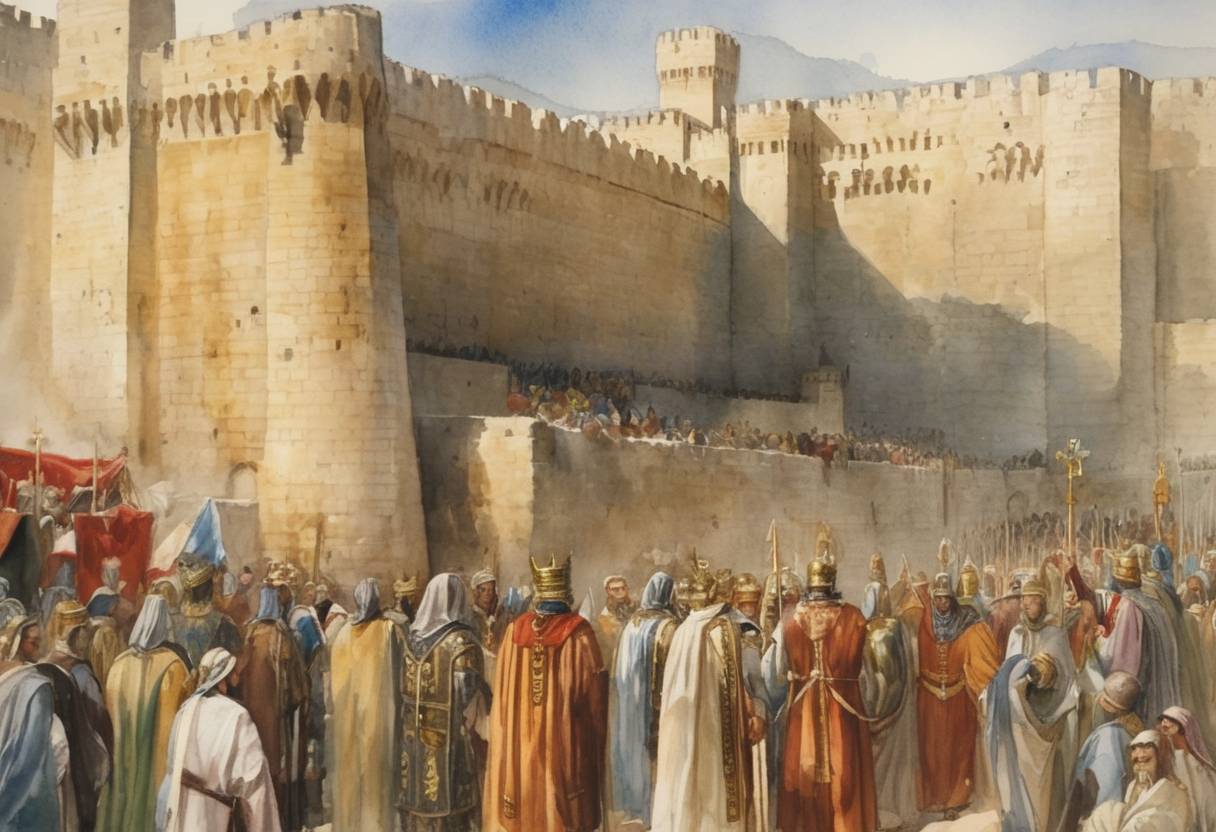
Baldwin I Crowned as the First King of Jerusalem on December 18, 1100
On December 18, 1100, Baldwin I was crowned as the first King of Jerusalem, marking a pivotal moment in the history of the Crusader States. His ascent to the throne represented the consolidation of power among the Crusaders following the successful conclusion of the First Crusade, which aimed to capture the Holy Land from Muslim rule.
Background
The First Crusade (1096-1099) was a monumental military expedition promoted by Pope Urban II with the primary objective of reclaiming Jerusalem for Christianity. The crusader forces, made up of European nobles and knights, succeeded in capturing Jerusalem in July 1099, an event marked by significant bloodshed and the establishment of several crusader states.
Prior to Baldwin’s coronation, the ruling system in Jerusalem was more of a collective effort under Godfrey of Bouillon, who took the title of “Advocate of the Holy Sepulchre” rather than king, out of respect for the religious significance of Jerusalem. Godfrey did not intend to rule as a monarch and maintained this title until his death in July 1100.
Ascension and Coronation
Upon Godfrey’s death, Baldwin of Boulogne, Godfrey’s brother, swiftly moved from his position as Count of Edessa to claim leadership in Jerusalem. His journey to power was not without challenges, as some factions within and outside the crusader states had reservations about establishing a monarchy and Baldwin’s leadership prowess.
Baldwin was ultimately successful in securing his position, largely due to his military acumen and support from key noble figures within the Crusader states. On December 18, 1100, he was crowned King of Jerusalem in the Church of the Nativity in Bethlehem, forgoing a Jerusalem coronation to avoid further tensions related to the city’s religious sanctity.
Significance
Baldwin’s reign as king marked the formal establishment of the Kingdom of Jerusalem as a feudal monarchy, an important development for the stability and governance of the Crusader territories in the Levant. His leadership laid the groundwork for further territorial expansion and fortification efforts necessary to sustain the kingdom amidst continual military threats.
Baldwin’s rule lasted until his death in 1118, and throughout his reign, he proved to be an effective military leader and strategic ruler, helping to consolidate and expand the nascent kingdom’s borders despite the inherent challenges of ruling in a region fraught with conflict.
Legacy
Baldwin I’s establishment of the Kingdom of Jerusalem symbolized the crusading spirit that had defined European ambitions in the Holy Land. His coronation as king set a precedent for the political structure that would dictate the organization of the Crusader states throughout the 12th century. Baldwin’s reign is often viewed as foundational in the creation of a lasting European presence in the region, which continued to influence interactions between Europe and the Near East for centuries.