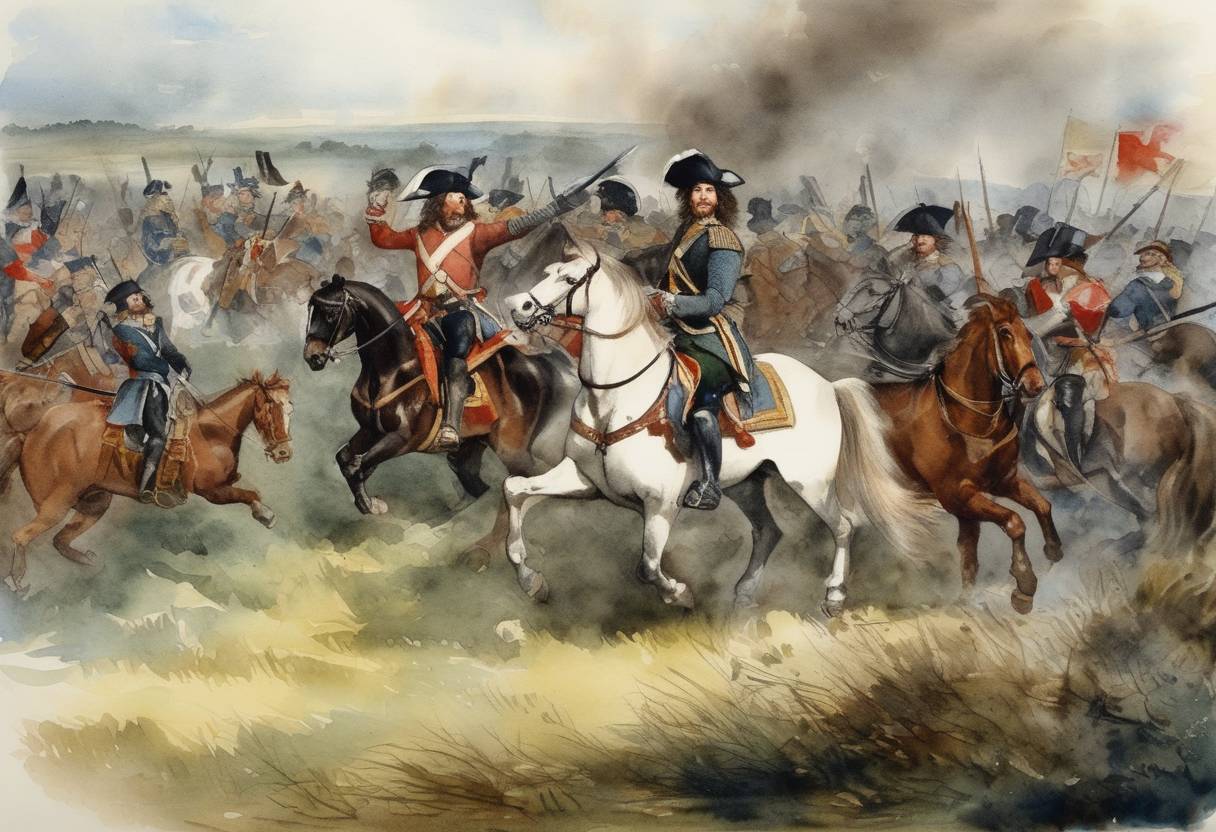
The Battle of Naseby: June 14, 1645
The Battle of Naseby, fought on June 14, 1645, stands as a pivotal engagement during the first English Civil War. This battle was marked by the strategic prowess of the Parliamentarian New Model Army under the command of Sir Thomas Fairfax and Oliver Cromwell, against the Royalist forces led by King Charles I and his principal commander, Prince Rupert of the Rhine.
Context and Prelude
By 1645, the English Civil War, which erupted in 1642, had entered a critical phase. The Parliamentarians had reformed their military structure, creating the New Model Army, a centralized and professional force. This reformation aimed to enhance efficiency, discipline, and effectiveness, contrasting with the traditionally aristocratic methods employed by the Royalists.
Leading up to the battle, King Charles I sought to consolidate his power and gather support in the Midlands. The Royalists were positioned in the town of Leicester before they moved south to confront the Parliamentarian forces. The New Model Army, recognizing the strategic advantage of engaging the Royalist forces, maneuvered to intercept them near the village of Naseby in Northamptonshire.
Key Events of the Battle
Initial Engagement: The battle began with the Royalist cavalry, led by Prince Rupert, charging against the Parliamentarian left wing. Initially gaining ground, they were soon countered by Cromwell’s disciplined cavalry on the right, which maintained cohesion and repulsed the Royalist advance.
Parliamentarian Counterattack: The New Model Army, leveraging their superior numbers and the effective leadership of Fairfax and Cromwell, coordinated infantry and cavalry assaults. Cromwell’s cavalry decisively returned from pursuit to smash the Royalist infantry center.
Decisive Turn: By early afternoon, the coordinated assaults of the New Model Army overwhelmed the Royalist lines. A significant portion of the Royalist infantry was captured, and the Royalist army was effectively decimated.
Aftermath and Significance
The Battle of Naseby was a devastating blow to King Charles I and his supporters. It evidenced the effectiveness of the New Model Army and underscored the diminishing capacity of the Royalists to sustain the war effort. The defeat resulted in the capture of the Royalist baggage train and critical documentation, revealing Charles I’s attempts to solicit foreign support.
The victory at Naseby shifted the momentum decisively in favor of the Parliamentarians. It marked the beginning of the end for Royalist opposition in the war, leading to the subsequent capture and execution of Charles I, and established a precedent for Parliamentary sovereignty in England. The battle exemplified the efficacy of a professional standing army, influencing future military developments in Britain and beyond.