The Capture of Rangoon by Japanese Forces: March 8, 1942
1942 · Rangoon, Burma (now Myanmar)
The Japanese captured Rangoon, Burma, during World War II.
January 19, 1942
During World War II, Japanese forces invaded Burma's Southern Shan States, advancing further into Southeast Asia.
Southern Shan States, Burma | Imperial Japanese Army
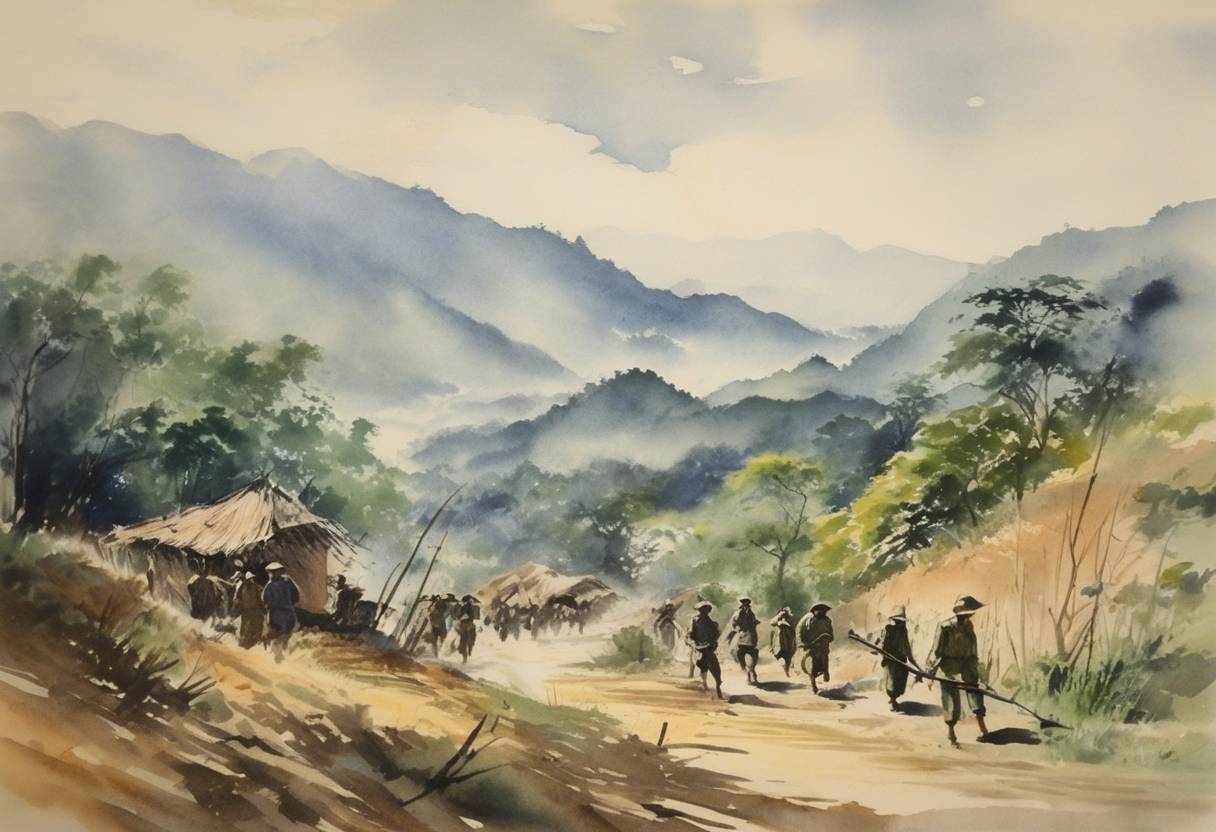
On January 19, 1942, the Japanese military launched an invasion into Burma’s Southern Shan States, as part of their broader campaign to expand their empire throughout Southeast Asia during World War II. This military operation marked a significant phase in Japan’s strategic objectives to secure resources and strengthen their southern front against Allied forces.
Burma, at the time a British colony, was strategically important due to its geographical position and resources. The Japanese aimed to cut off the Burma Road, a critical supply route to China, and to access the rich resources in the region, including rice, oil, and minerals. The invasion was also part of a larger goal to advance towards India and open another front against the British.
Japanese Strategy and Movements: The Japanese forces, having commenced their move from Thailand, targeted the Southern Shan States as a stepping stone to the central heart of Burma. Their superior planning and coordination enabled rapid advancement through the terrain.
Resistance and Challenges: The British, along with Chinese forces, attempted to mount a defense against the Japanese advance. However, they were largely outmatched due to the coordination and efficiency of the Japanese troops and faced difficulties due to the challenging terrain and lack of adequate reinforcements.
Role of Local and Allied Forces: Despite the challenging situation, local Burmese forces and Chinese divisions, under the command of Allied leadership, did play a role in attempting to slow down the progression of Japanese troops, though often with limited success.
Fall of Major Cities: Following this strategic invasion into the Shan States, the Japanese continued their advancement, eventually capturing key cities such as Rangoon by March 1942.
Disruption of Allied Supply Lines: The invasion severely disrupted the Allied supply route to China via the Burma Road, a significant blow to Chinese forces fighting the Japanese in the Sino-Japanese War.
Implications for British Colonial Authority: The rapid success of Japan in the region undermined British colonial authority and demonstrated the vulnerability of European powers in Asia, signaling a shift in regional power dynamics.
Long-term Consequences: The occupation of Burma by Japanese forces lasted until 1945 and set the stage for further monumental battles in Southeast Asia, profoundly impacting the course of World War II in the Pacific theatre.
In conclusion, the Japanese invasion of Burma on January 19, 1942, was a pivotal moment in Southeast Asian history, showcasing Japan’s military capabilities and significantly influencing the strategic landscape of World War II.
Source: www.britannica.com