The Death of Saint Francis of Assisi
1226 · Assisi, Italy
Saint Francis of Assisi, the founder of the Franciscan Order, died. He was canonized as a saint by Pope Gregory IX in 1228 and is one of the most venerated religious figures in Christianity.
June 13, 1798
Mission San Luis Rey de Francia, the 18th Spanish mission in California, is founded.
Oceanside, Spanish California | Franciscan Order
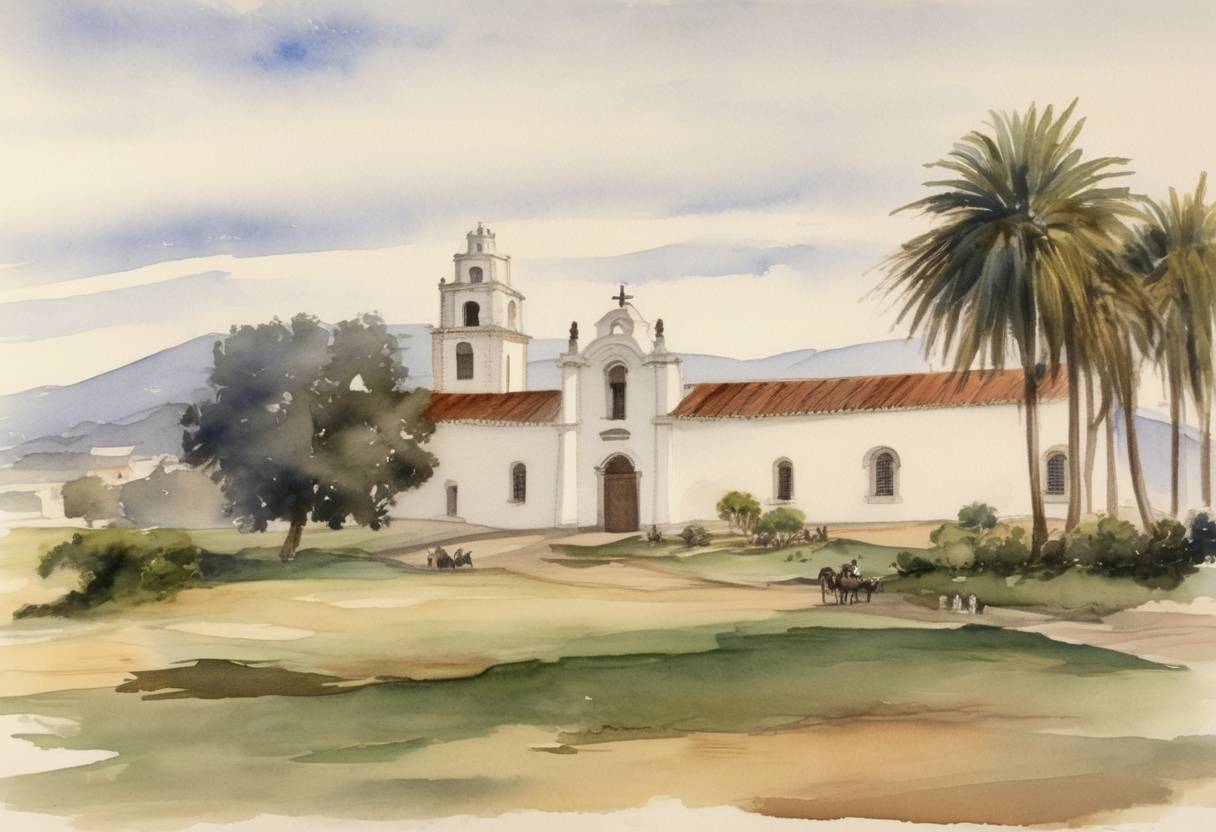
On June 13, 1798, Mission San Luis Rey de Francia was officially founded, marking the establishment of the 18th Spanish mission in the series of 21 that were built in what is now California. Situated in present-day Oceanside, the mission was named after Saint Louis IX, King of France, reflecting the Catholic traditions of the Spanish missionaries who were keen to spread Christianity among the indigenous populations.
The Spanish mission system was a network of religious and military outposts intended to expand Spain’s influence in the New World, establish a Catholic presence, and assimilate Native American peoples into European culture. These missions were founded primarily in the late 18th and early 19th centuries when California was part of the Spanish colonial empire.
Mission San Luis Rey de Francia was established by Father Fermín Lasuén, who succeeded Father Junípero Serra as the President of the California mission chain. It was built on a site that was part of the Luiseño Native American territory, whose people became the primary focus of the mission’s conversion efforts. The mission quickly became one of the largest and most successful in California due to its abundant land and productive agricultural operations.
The mission complex was noted for its impressive church building, with a façade that incorporated elements of Spanish and local architectural styles. The site featured extensive agricultural grounds, orchards, and workshops, which helped support the mission’s self-sustaining community. Moreover, it played a central role in spreading European agricultural practices and livestock breeding to the region.
Following Mexico’s secularization decree in the 1830s, the mission lands were divided and sold, leading to a decline in its physical structure and influence. During this period, many original buildings fell into disrepair. In the late 19th and 20th centuries, efforts were made to restore and preserve the mission, reflecting its historical and cultural importance.
Today, Mission San Luis Rey de Francia is preserved as a historic landmark and still serves as an active church and cultural heritage site. It stands as a powerful symbol of the complex interactions between European settlers and indigenous communities, offering insights into the colonial history of California and the broader context of Spanish missionary works in the Americas.