Opening of the Lincoln Tunnel – December 22, 1937
1937 · New York City, United States
The Lincoln Tunnel in New York City was opened to traffic, providing a crucial connection between Manhattan and New Jersey under the Hudson River.
February 3, 1924
The Woodbridge Cloverleaf, the first cloverleaf interchange in the United States, opens in Woodbridge Township, New Jersey.
Woodbridge Township, United States | New Jersey Highway Department
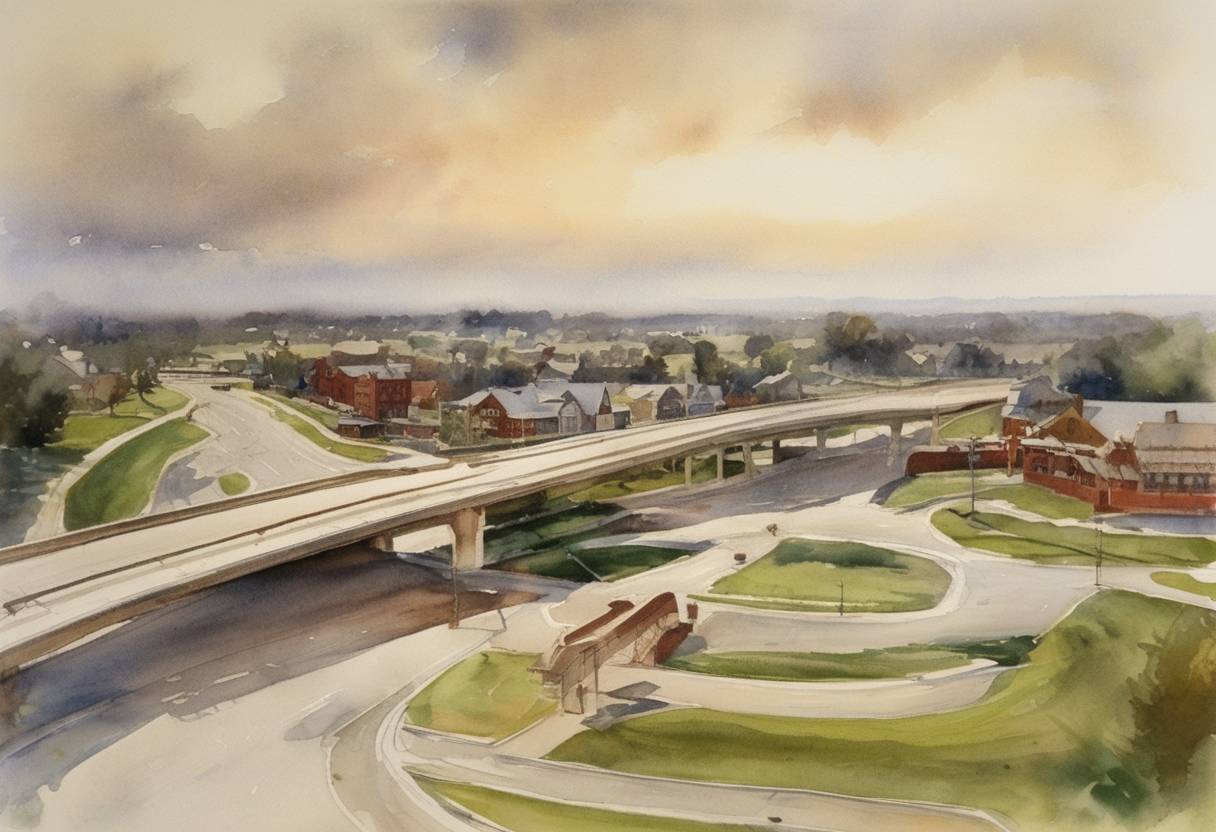
On February 3, 1924, the United States witnessed a milestone in transportation infrastructure with the opening of its first cloverleaf interchange, located in Woodbridge Township, New Jersey. This innovative roadway design was a significant development in the evolution of the country’s burgeoning automotive network, addressing the increasing demand for efficient and safer traffic flow.
The early 20th century marked a period of rapid automobile proliferation, which highlighted the limitations and dangers of traditional at-grade intersections. These intersections often led to increased congestion and accidents, particularly with the rise in vehicle speeds and volumes. There was a pressing need for a solution that could accommodate higher traffic demands while minimizing conflict points between vehicles.
The cloverleaf interchange, inspired by designs used in Germany, provided a method for complete separation of turning and through-traffic, thereby reducing collision points and improving traffic movement efficiency. The design allows vehicles to transition between intersecting roads without the need to stop or cross traffic lanes directly.
Located at the intersection of Routes 9 and 35, the Woodbridge Cloverleaf was engineered as a two-level interchange, where the traffic flows at two intersecting roads were separated by a series of ramps that formed a four-leaf clover pattern. This setup facilitated continuous and non-conflicting movements, with vehicles using loop ramps to execute left and right turns onto intersecting highways.
The successful implementation of the Woodbridge Cloverleaf marked a pivotal moment in highway design, providing a template for future interchanges that would become widespread across the United States. Its adoption facilitated the smooth handling of increasing vehicular traffic, contributing significantly to the expansion of the national highway system in subsequent decades.
The cloverleaf design has since evolved, with modern variants addressing some of its limitations, such as weaving issues and large land footprints. Nevertheless, its introduction on February 3, 1924, remains a testament to early 20th-century engineering ingenuity and foresight in addressing the challenges posed by rapid increases in automotive transportation.
Source: en.wikipedia.org