1214 · Alarcos, Spain
Alfonso VIII of Castile and the forces of the Almohad Caliphate clash in the Battle of Alarcos. This battle establishes Almohad dominance in southern Iberia for a period.
November 8, 1158
The Treaty of Sahagún is signed between King Ferdinand II of León and King Alfonso VIII of Castile, establishing peace and defining territorial borders between their kingdoms in the Iberian Peninsula.
Sahagún, Spain | Kingdoms of León and Castile
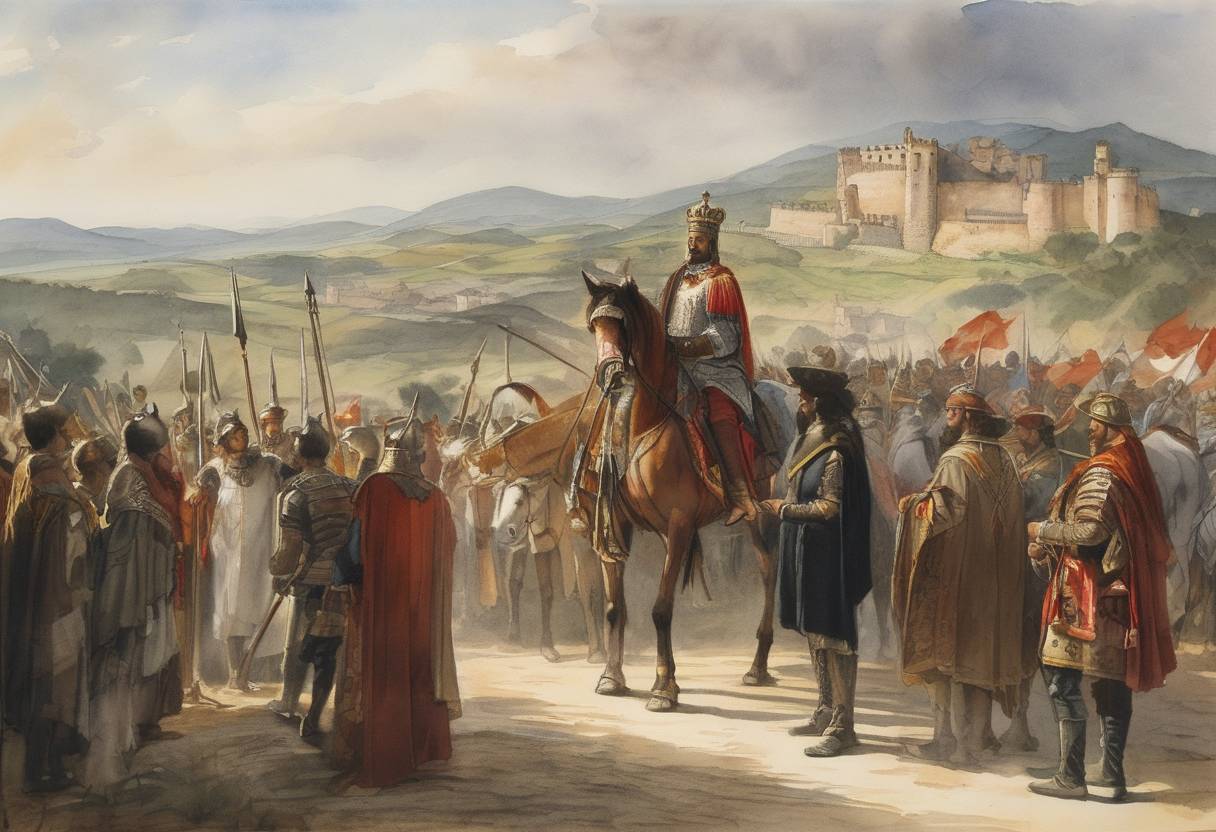
On November 8, 1158, the Treaty of Sahagún was signed between King Ferdinand II of León and King Alfonso VIII of Castile, marking a significant moment in the history of the Iberian Peninsula. The treaty served to establish peace and define the territorial borders between the Kingdoms of León and Castile, two dominant Christian realms struggling for power and territory during the Reconquista, the period of history characterized by the Christian reconquest of Iberia from Muslim rule.
León and Castile: By the mid-12th century, the kingdoms of León and Castile were engaged in recurring conflicts over territory and influence. The death of prominent rulers like Alfonso VII led to a fragmentation and redefinition of boundaries. Alfonso VII’s territories were divided between his sons, giving rise to the individual reigns of Ferdinand II in León and his nephew Alfonso VIII in Castile.
The Reconquista: The broader landscape of the Iberian Peninsula was also greatly influenced by the Reconquista. Christian kingdoms endeavored to reclaim lands from Muslim-ruled territories, often leading to temporary alliances and agreements such as the Treaty of Sahagún.
The agreement was necessary to halt conflict and promote stability, allowing both monarchs to focus on external threats. Ferdinand II ascended to the Lionese throne in 1157, while Alfonso VIII, being a minor, ruled Castile under a regency until he could independently exercise power. Mutual interests demanded a solution to end periodic clashes and ensure cooperation against Muslim-controlled regions to their south.
Peace Agreement: The treaty facilitated peace between the two kingdoms, establishing a framework for preventing future conflicts and fostering a cooperative spirit.
Territorial Borders: It carefully delineated the boundaries between León and Castile, providing clarity and reducing territorial disputes. The establishment of clear borders helped solidify claims and maintain order vis-à-vis the surrounding threats.
Family Ties and Alliances: To cement the alliance, their kingdoms arranged family interconnections which were a common diplomatic strategy of the period, ensuring the bond between León and Castile was respected by their respective courts and vassals.
Temporary Peace: While the treaty temporarily eased tensions, the subsequent political landscape saw renewed challenges. The internal dynamics of both kingdoms continued to evolve, influenced by concerns over succession and external threats.
Influence on the Reconquista: The alliance fortified the Christian front during pivotal Reconquista battles. Cooperation through diplomacy such as this treaty was instrumental in advancing Christian control over the Iberian Peninsula.
Long-term Impact: Despite the treaty’s immediate effects, it laid the groundwork for longer-lasting diplomatic relations and strategies among the Christian kingdoms during the tumultuous periods of the 12th and 13th centuries.
The Treaty of Sahagún stands as a testament to the blend of conflict and cooperation shaping medieval Iberian politics, highlighting the complex interplay of regional powerhouses during an era defined by conquest and colonization.
Source: en.wikipedia.org