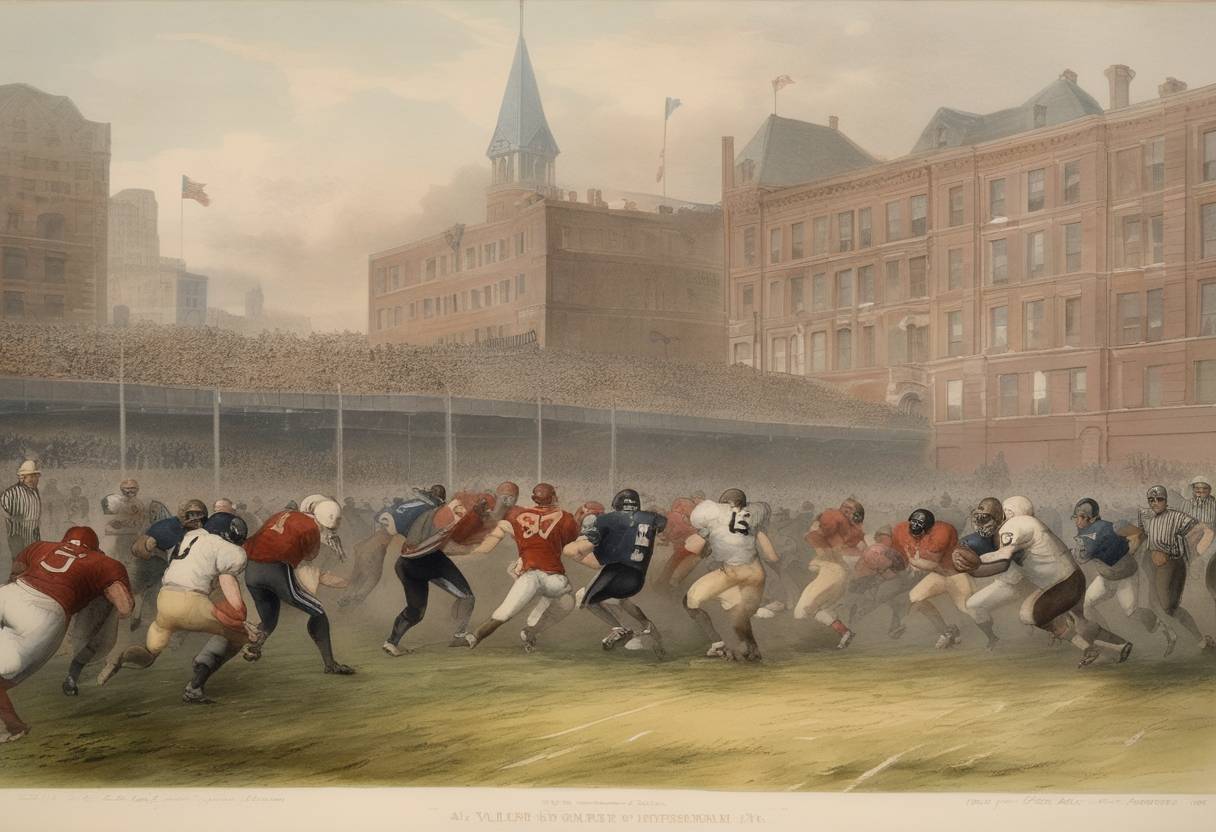
On October 19, 1873, representatives from four universities—Yale, Princeton, Columbia, and Rutgers—gathered for a crucial meeting in New York City. This assembly marked a pivotal moment in the history of American sports, as these institutions collaborated to draft the first formalized rules for what would become American football. This event laid the groundwork for American football as a recognized collegiate sport in the United States.
Background
During the late 19th century, college sports were burgeoning as a significant aspect of university life in America, yet there was a lack of standardization in rules, which varied significantly from one institution to another. Games typically resembled rugby more closely than the modern version of American football. The need to establish a unified set of rules was increasingly apparent, given the contentious atmosphere surrounding intercollegiate matches, where disputes over the rules frequently disrupted games.
The Meeting and Its Outcome
The meeting on October 19 was convened at the Massasoit House hotel in Springfield, Massachusetts. The primary goal was to establish a consistent framework that the participating universities could adhere to, creating a level playing field and facilitating organized competition. The representatives agreed to adopt a modified version of England’s Football Association’s rules, leaning towards a rugby-style interpretation, but with unique adaptations that would eventually evolve into American football.
These initial rules focused on several key aspects:
- The size and shape of the field.
- The structure and number of players on each team.
- Basic gameplay rules, such as how the ball could be advanced.
Notably, the meeting marked the first organized effort to define a set standard for college football, which would become increasingly distinct from its rugby and soccer counterparts over the next few decades.
Significance
The drafting of these rules represented the birth of formalized American football in university sports, setting a foundation that would grow into the modern NCAA framework. The collaboration among these four universities was instrumental in shaping the sport’s early trajectory and fostering its development as a quintessentially American pastime.
This unification effort also signaled the beginning of the various rule adaptations and innovations that distinguished American football from other forms of football. Over time, through additional modifications and restructuring, American football would evolve into the sport celebrated across the nation today.
Conclusion
The October 19, 1873, meeting was a landmark in sports history, establishing a legacy that continues to influence American athletics. By agreeing on these foundational rules, Yale, Princeton, Columbia, and Rutgers helped catalyze the creation of an organized collegiate sport, paving the way for the development of today’s dynamic and vastly popular American football.