The Nanchang Uprising: August 1, 1927
1927 · Nanchang, China
The Nanchang Uprising was initiated, marking the beginning of the Chinese Civil War.
October 20, 1935
The Long March, a major event in Chinese history, ends as the Communist Army reaches Yan'an, having successfully evaded the Chinese Nationalist forces.
Yan'an, China | Chinese Communist Party
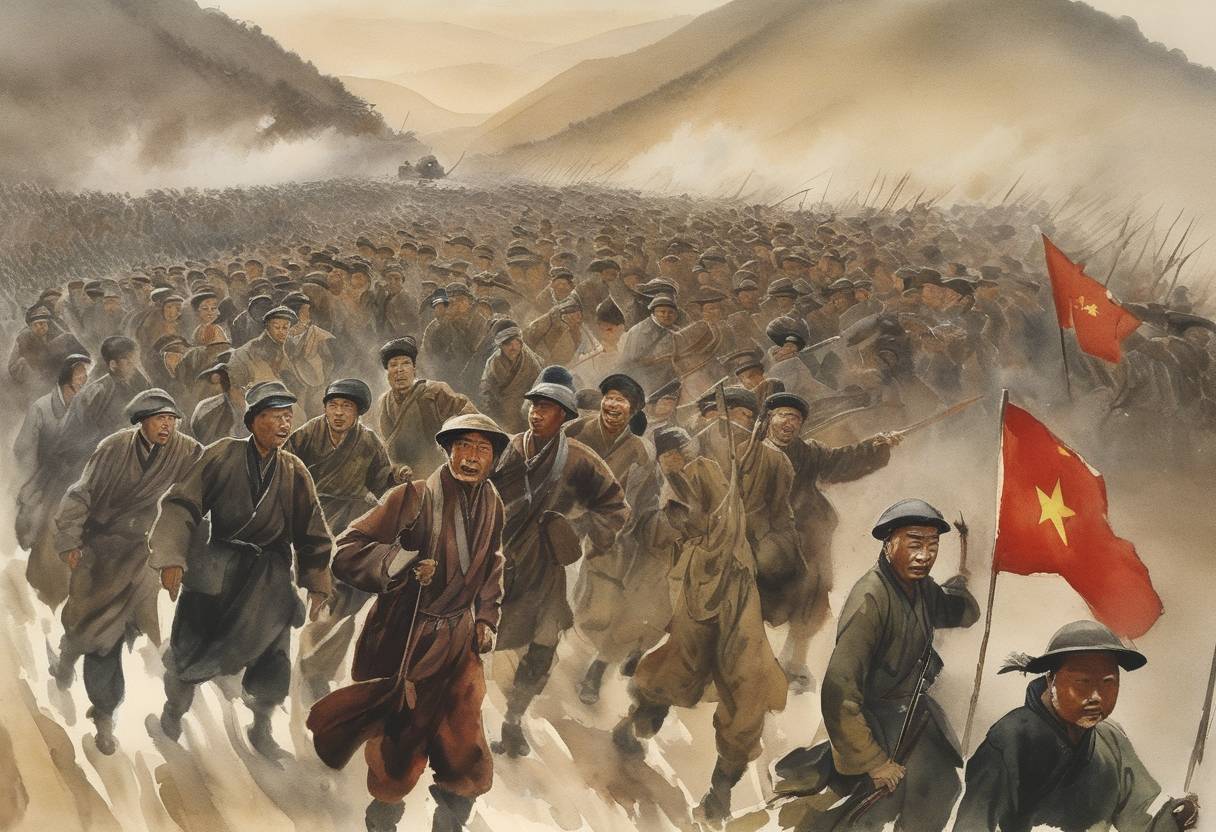
On October 20, 1935, the Long March, a pivotal event in Chinese history, concluded when the Chinese Communist Army, led by the Chinese Communist Party (CCP), successfully reached the town of Yan’an in northern Shaanxi province. This marked the end of a grueling year-long retreat from the encircling Nationalist forces commanded by Chiang Kai-shek.
The Long March was initiated in October 1934 as a strategic retreat by the Chinese Red Army to evade the pursuit of the Chinese Nationalist Party (Kuomintang, KMT). The Communist base at Jiangxi was under intense military pressure during Chiang Kai-shek’s Fifth Encirclement Campaign, which utilized blockhouse warfare to isolate and destroy the Communist forces.
The Communists, recognizing the strategic impossibility of holding their position, broke through Nationalist lines. Led by several key military figures, including Mao Zedong and Zhou Enlai, approximately 100,000 soldiers embarked on the march.
The march spanned over 9,000 kilometers (approximately 5,600 miles) and lasted for 370 days. During this period, the Red Army crossed high mountains, formidable rivers, and various treacherous terrains while facing constant harassment from Nationalist troops.
The journey included numerous battles and skirmishes, severe shortages of food and supplies, and harsh environmental conditions. The route taken traversed through some of China’s most rugged regions, including western Hunan and Guizhou provinces, and the treacherous Dadu River crossing, which became legendary for its peril and bravery.
By the time the Red Army reached Yan’an, the forces had dwindled significantly, with estimates suggesting fewer than 10,000 soldiers remained—a stark contrast to the numbers that had embarked on the march. However, the successful completion of the Long March was a monumental victory for the CCP.
The retreat not only demonstrated the resilience and tactical acumen of the Communist leadership but also provided a time for ideological consolidation and reorganization. Moreover, Mao Zedong emerged from the march as the paramount leader of the CCP, solidifying his influence over the party’s direction and strategy.
Yan’an became the new center of Communist activity and the headquarters from which the CCP would rebuild and expand its influence. It served as a base for revolutionary ideas and practices until the eventual victory over the Nationalist forces in 1949.
The Long March has since become an emblematic event of Chinese Communist resilience and determination, often celebrated in Chinese history and propaganda as an embodiment of the revolutionary spirit. It played a crucial role in cementing the mythology of Communist leadership and establishing Mao Zedong’s status as a revolutionary leader.
By successfully reaching Yan’an on October 20, 1935, the Long March not only marked a turning point in the Chinese Communist Party’s fortunes but also laid the groundwork for future victories and the eventual founding of the People’s Republic of China.
Source: en.wikipedia.org