Liberation of Rome: June 5, 1944
1944 · Rome, Italy
Allied forces liberate Rome during World War II, marking the first Axis capital to fall to the Allies.
January 22, 1944
Operation Shingle, the Allied amphibious landing at Anzio, Italy, begins during World War II.
Anzio, Italy | Allied Forces
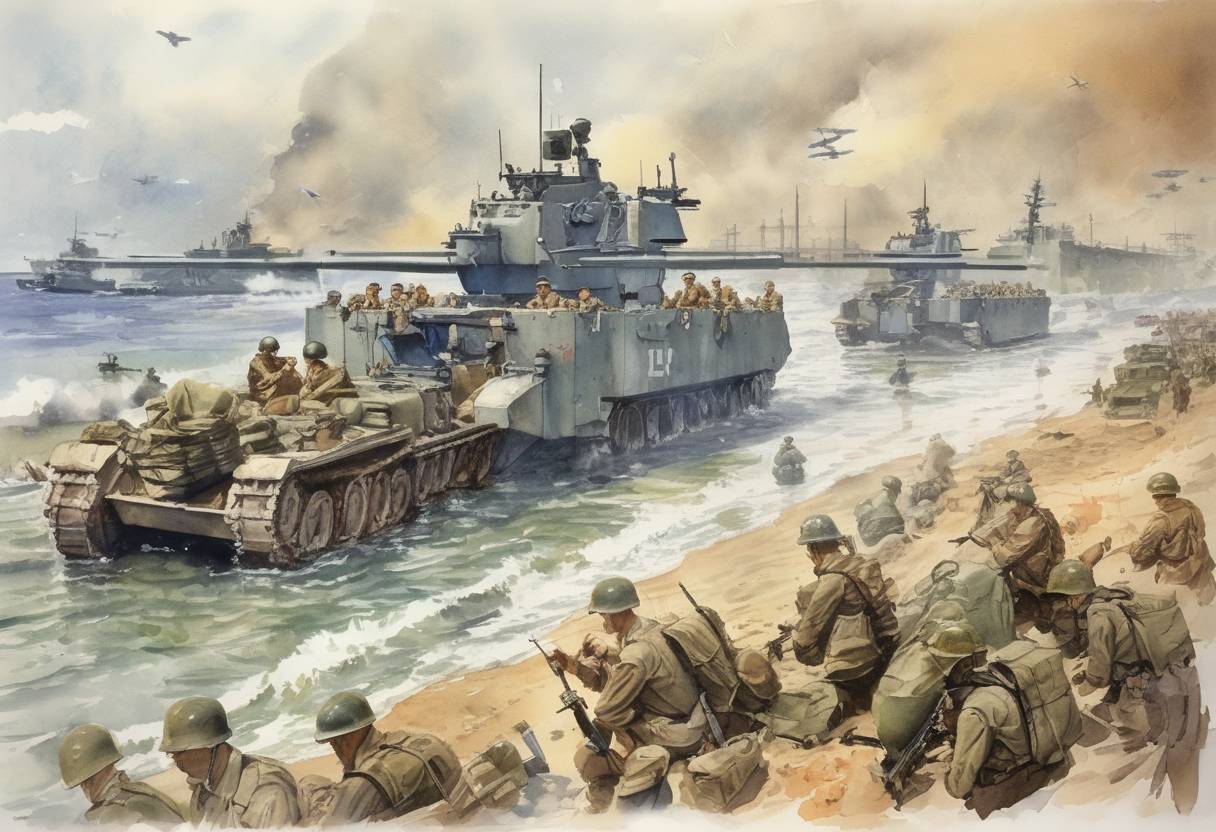
Operation Shingle was a significant Allied military operation during World War II, involving an amphibious landing at Anzio, Italy, on January 22, 1944. The operation aimed to outflank German defensive positions known as the Gustav Line and facilitate the capture of Rome.
Strategic Importance: By late 1943, the Allied forces had been advancing through Italy but faced stiff resistance from German forces entrenched along the Gustav Line, a series of fortifications stretching across the Italian peninsula. Capturing Rome was seen as a crucial objective to boost Allied morale and disrupt German operations in Italy.
Planning: The operation was conceived by British Prime Minister Winston Churchill, who advocated for an amphibious assault to bypass the Gustav Line. The plan involved landing forces at Anzio, approximately 30 miles south of Rome, to establish a beachhead and threaten the German rear.
The Landing: On January 22, 1944, the VI Corps, led by Major General John P. Lucas, landed at Anzio and Nettuno. The initial landings were largely unopposed, allowing the Allies to establish a beachhead.
Initial Success and Stalemate: Despite the successful landing, General Lucas hesitated to advance rapidly inland, opting to consolidate the beachhead. This delay allowed German Field Marshal Albert Kesselring to reinforce his positions and encircle the Allied forces, leading to a prolonged stalemate.
German Counterattacks: The Germans launched several counterattacks in February 1944, aiming to push the Allies back into the sea. These attacks resulted in heavy casualties on both sides but ultimately failed to dislodge the Allied forces.
Breakout and Advance: The stalemate at Anzio persisted until May 1944, when the Allies launched Operation Diadem, a coordinated offensive along the Gustav Line. This offensive, combined with a breakout from the Anzio beachhead, eventually led to the liberation of Rome on June 4, 1944.
Strategic Impact: Although initially criticized for its execution, Operation Shingle played a crucial role in the Italian Campaign by diverting German resources and contributing to the eventual Allied victory in Italy.
Legacy: The operation highlighted the challenges of amphibious warfare and the importance of decisive leadership and rapid exploitation of initial successes.
Operation Shingle was a complex and controversial operation that underscored the difficulties of the Italian Campaign. Despite its initial setbacks, the operation ultimately contributed to the Allied advance in Italy and the liberation of Rome, marking a significant milestone in the broader context of World War II.
Source: www.britannica.com