The Battle of Gravelines: July 13, 1558
1558 · Gravelines, France
The Battle of Gravelines took place during the Italian War of 1551–1559, where the Spanish forces defeated the French.
February 24, 1525
The Battle of Pavia took place, resulting in a decisive victory for the Spanish-Imperial forces over the French army. King Francis I of France was captured, marking a significant turning point in the Italian Wars.
Pavia, Italy | Spanish Empire and Holy Roman Empire
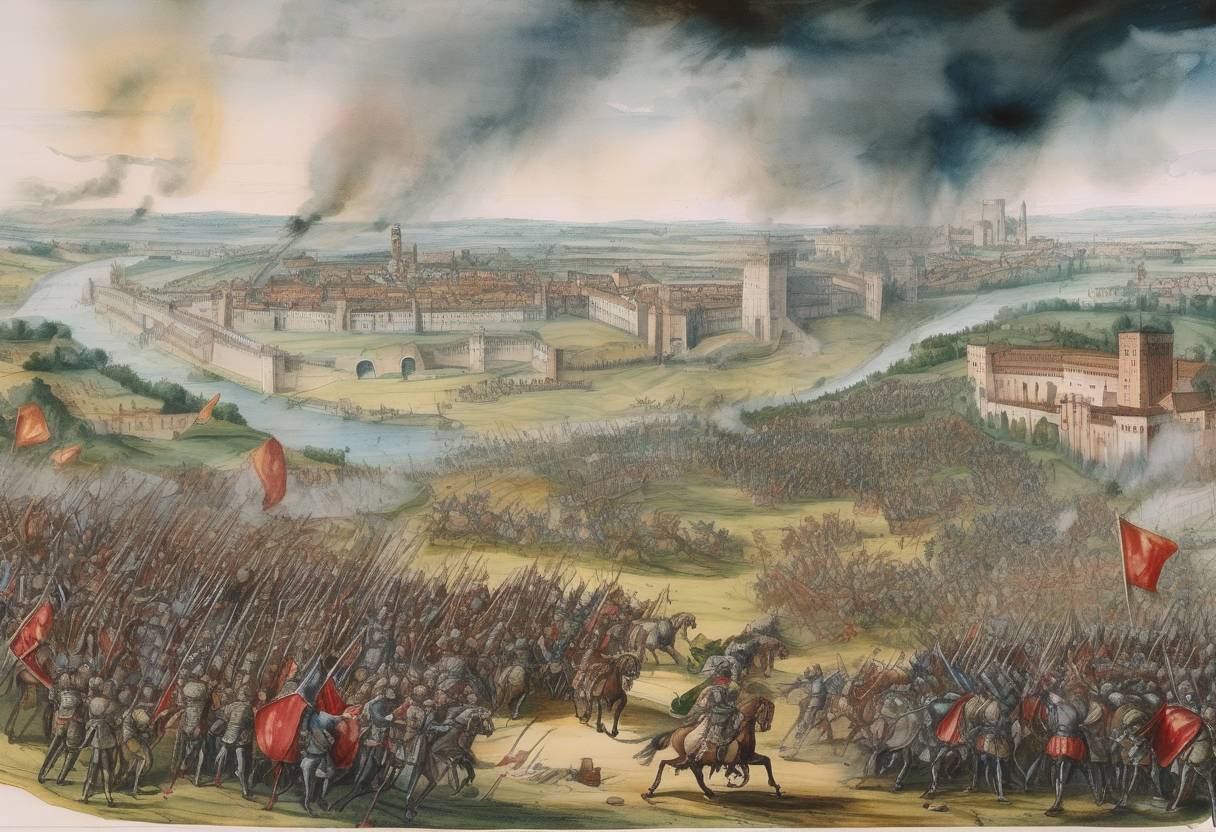
The Battle of Pavia, fought on February 24, 1525, was a pivotal engagement during the Italian Wars, marking a decisive victory for the Spanish-Imperial forces over the French army. This battle had profound implications for the power dynamics in Europe and significantly influenced the course of the Italian Wars.
The Italian Wars (1494–1559) were a series of conflicts involving major European powers, primarily France and the Habsburgs, over control of territories in Italy. By the early 16th century, the rivalry between King Francis I of France and Emperor Charles V of the Holy Roman Empire had intensified, with both seeking dominance in Italy.
In 1524, Francis I launched an invasion of the Duchy of Milan, a key strategic region in northern Italy. Initially successful, the French forces captured Milan, but their position soon became precarious as the Spanish-Imperial army, commanded by Charles de Lannoy and the Marquis of Pescara, regrouped and prepared to counterattack.
The battle took place near the city of Pavia, south of Milan. The French army, numbering around 28,000 troops, was well-equipped and included a contingent of Swiss mercenaries and heavy cavalry. However, the Spanish-Imperial forces, though slightly smaller, were highly disciplined and benefited from superior tactics and leadership.
On the morning of February 24, the Spanish-Imperial forces launched a surprise attack on the French encampment. Utilizing a combination of infantry, artillery, and the innovative use of arquebusiers (early firearms), they effectively neutralized the French cavalry, which had been a formidable component of Francis I’s army.
The battle quickly turned into a rout for the French. The Spanish-Imperial forces’ tactical advantage and the element of surprise led to a crushing defeat for the French army. King Francis I himself was captured during the battle, famously writing to his mother, “All is lost save honor.”
The capture of Francis I was a monumental event, leading to a significant shift in the balance of power in Europe. The French king was taken to Madrid, where he was held captive until 1526. His imprisonment forced France to sign the Treaty of Madrid, which included harsh terms such as the cession of Burgundy to the Habsburgs and the renunciation of claims in Italy.
The Battle of Pavia marked the decline of French influence in Italy and solidified the Habsburgs’ dominance in the region. It also underscored the effectiveness of new military tactics and technologies, such as the use of firearms, which would shape future European warfare.
In the broader context of the Italian Wars, the battle highlighted the intense rivalry between France and the Habsburgs, a conflict that would continue to shape European politics for decades. The outcome of the Battle of Pavia thus had lasting repercussions, influencing the political landscape of Europe well into the 16th century.
Source: en.wikipedia.org