Allied Bombing Raid on Rome - July 19, 1943
1943 · Rome, Italy
The Allies launch the first large-scale bombing raid from Sicily's airfields against Rome, aiming to disrupt Axis communications and military infrastructure.
June 5, 1944
Allied forces liberate Rome during World War II, marking the first Axis capital to fall to the Allies.
Rome, Italy | Allied Forces
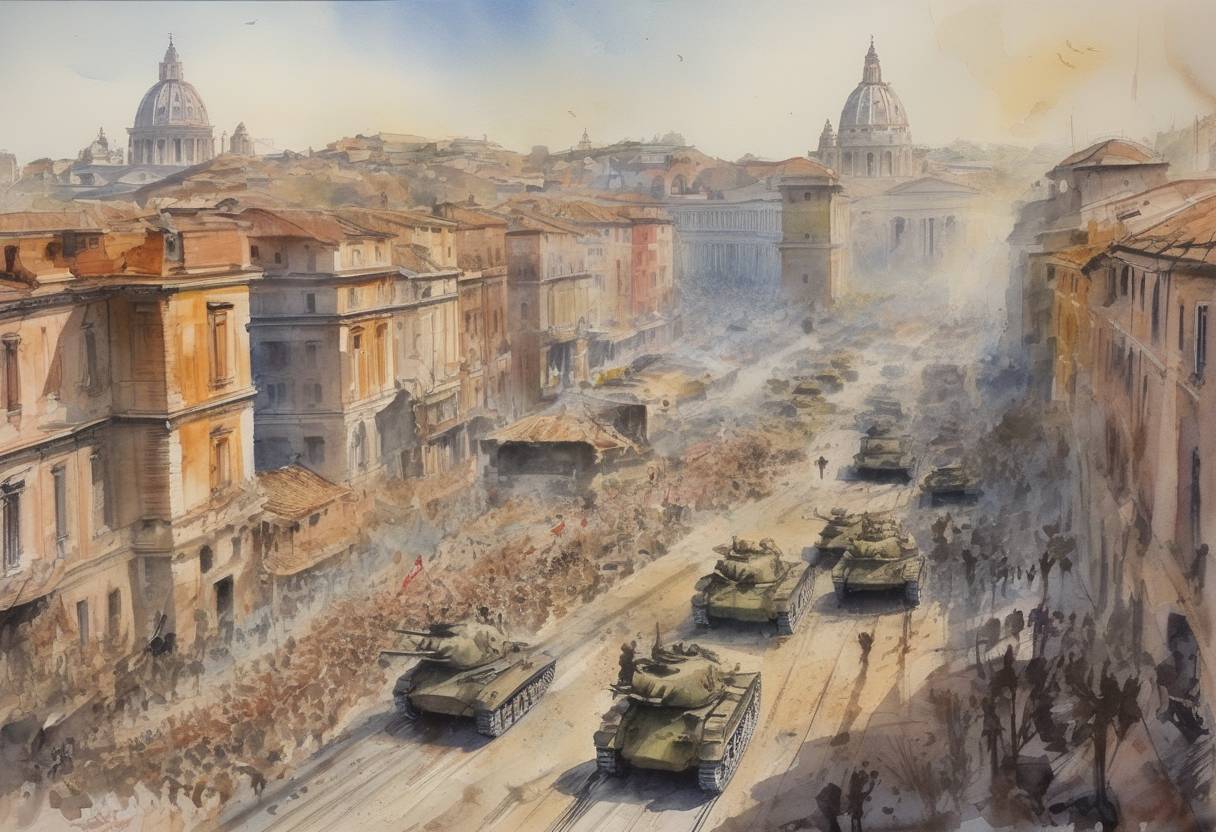
On June 5, 1944, Rome became the first Axis capital to fall to the Allied forces during World War II. This significant event marked a crucial turning point in the Italian Campaign and had profound implications for the course of the war in Europe.
The Italian Campaign began with the Allied invasion of Sicily in July 1943, followed by the mainland invasion in September 1943. The objective was to remove Italy from the Axis powers, secure the Mediterranean, and divert German forces from the Eastern and Western Fronts. After the fall of Mussolini’s regime in July 1943, Italy signed an armistice with the Allies, but German forces quickly occupied much of the country, including Rome.
Operation Avalanche: The Allied landings at Salerno in September 1943 marked the beginning of the push northward through Italy. The campaign was characterized by difficult terrain and strong German defensive positions, notably the Gustav Line.
Battle of Monte Cassino: One of the most grueling battles of the Italian Campaign, fought from January to May 1944, aimed to break through the German defenses. The eventual capture of Monte Cassino opened the way to Rome.
Operation Diadem: Launched in May 1944, this operation involved a coordinated assault by the U.S. Fifth Army and the British Eighth Army, which finally breached the Gustav Line and forced German forces to retreat.
On June 4, 1944, the U.S. Fifth Army, under the command of General Mark W. Clark, entered Rome. By June 5, the city was fully liberated, marking the first time an Axis capital had fallen to the Allies. The liberation was met with jubilation by the Roman populace, who had endured months of German occupation and hardship.
Strategic Victory: The fall of Rome was a significant morale booster for the Allies and demonstrated the effectiveness of their Mediterranean strategy. It also relieved pressure on the Eastern Front and paved the way for further advances into Northern Italy.
Timing and Overlap with D-Day: The liberation of Rome occurred just one day before the D-Day landings in Normandy, which somewhat overshadowed the event in terms of media coverage and historical attention.
Continued Fighting in Italy: Despite the capture of Rome, the Italian Campaign continued until the end of the war in Europe, with Allied forces pushing northward against determined German resistance.
The liberation of Rome was a pivotal moment in World War II, symbolizing the weakening grip of the Axis powers in Europe and contributing to the eventual Allied victory.
Source: en.wikipedia.org