Publication of "Mein Kampf" - July 18, 1925
1925 · Munich, Germany
Adolf Hitler published his autobiographical manifesto 'Mein Kampf', outlining his political ideology and future plans for Germany.
November 9, 1923
The Beer Hall Putsch, an attempted coup by Adolf Hitler and the Nazi Party, was thwarted in Munich, leading to Hitler's arrest and temporary setback for the Nazi movement.
Munich, Germany | Nazi Party
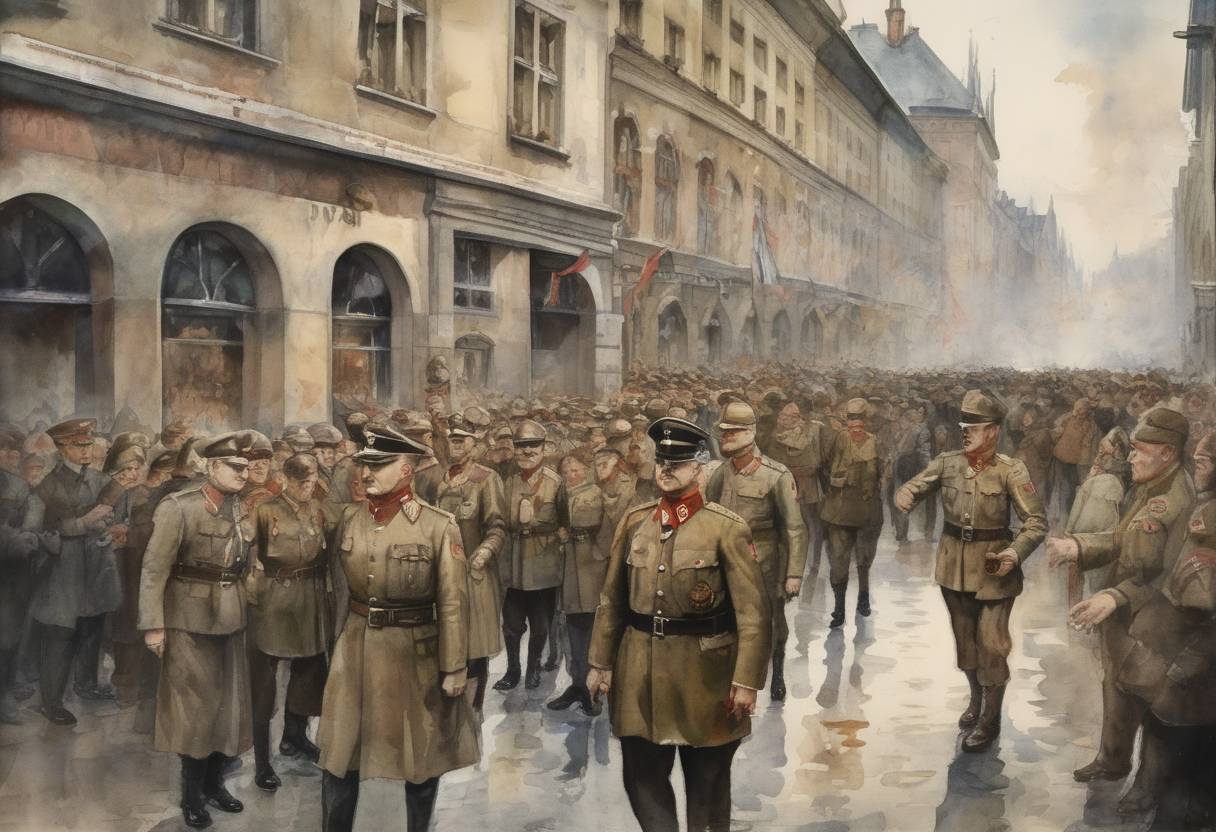
The Beer Hall Putsch, also known as the Munich Putsch, was a failed coup attempt by Adolf Hitler and the National Socialist German Workers’ Party (NSDAP) on November 9, 1923. This event marked a pivotal moment in the early history of the Nazi Party and had significant implications for Germany’s future.
In the early 1920s, Germany was in a state of political and economic turmoil. The Weimar Republic faced hyperinflation, political instability, and widespread dissatisfaction among the populace. Many Germans were disillusioned with the government, which they blamed for the harsh terms of the Treaty of Versailles and the country’s economic woes.
Adolf Hitler, who had become the leader of the NSDAP, sought to capitalize on this discontent. Inspired by Benito Mussolini’s successful March on Rome in 1922, Hitler aimed to overthrow the Weimar government and establish a right-wing nationalist regime.
The coup attempt began on the evening of November 8, 1923, when Hitler and his followers stormed the Bürgerbräukeller, a large beer hall in Munich. At the time, a meeting was being held by Gustav von Kahr, the State Commissioner of Bavaria, along with other Bavarian officials. Hitler, accompanied by armed stormtroopers, interrupted the meeting, declaring a national revolution and demanding the support of the Bavarian government.
Initially, Hitler managed to secure a reluctant agreement from Kahr and other officials, but the situation quickly unraveled. By the morning of November 9, the Bavarian authorities had withdrawn their support, and the putschists found themselves isolated.
Despite the setback, Hitler decided to proceed with a march through Munich, hoping to rally public support. Accompanied by key figures such as General Erich Ludendorff, the marchers aimed to seize key government buildings. However, they were met by a police blockade at the Odeonsplatz.
A brief but intense confrontation ensued, resulting in the deaths of 16 Nazi supporters and 4 police officers. The putsch collapsed, and Hitler fled the scene, only to be arrested two days later.
The failure of the Beer Hall Putsch was a significant setback for Hitler and the Nazi Party. Hitler was tried for treason in early 1924 and sentenced to five years in Landsberg Prison, although he served only nine months. During his imprisonment, he dictated “Mein Kampf,” which outlined his ideology and future plans for Germany.
The putsch’s failure forced the Nazi Party to reconsider its strategy. Instead of attempting another coup, Hitler decided to pursue power through legal means, focusing on building a mass political movement. This shift in strategy eventually led to the Nazis’ rise to power in 1933.
The Beer Hall Putsch is significant for several reasons:
Publicity for Hitler: The trial and subsequent imprisonment provided Hitler with a national platform, increasing his visibility and allowing him to refine his ideas.
Strategic Shift: The failure prompted a strategic shift in Nazi tactics, moving from violent overthrow to gaining power through electoral politics.
Prelude to Power: The event set the stage for the eventual rise of the Nazi Party, which would have profound consequences for Germany and the world.
In summary, the Beer Hall Putsch was a critical moment in the early history of the Nazi Party, illustrating both the volatility of Weimar Germany and the determination of Hitler to achieve his political ambitions.
Source: en.wikipedia.org