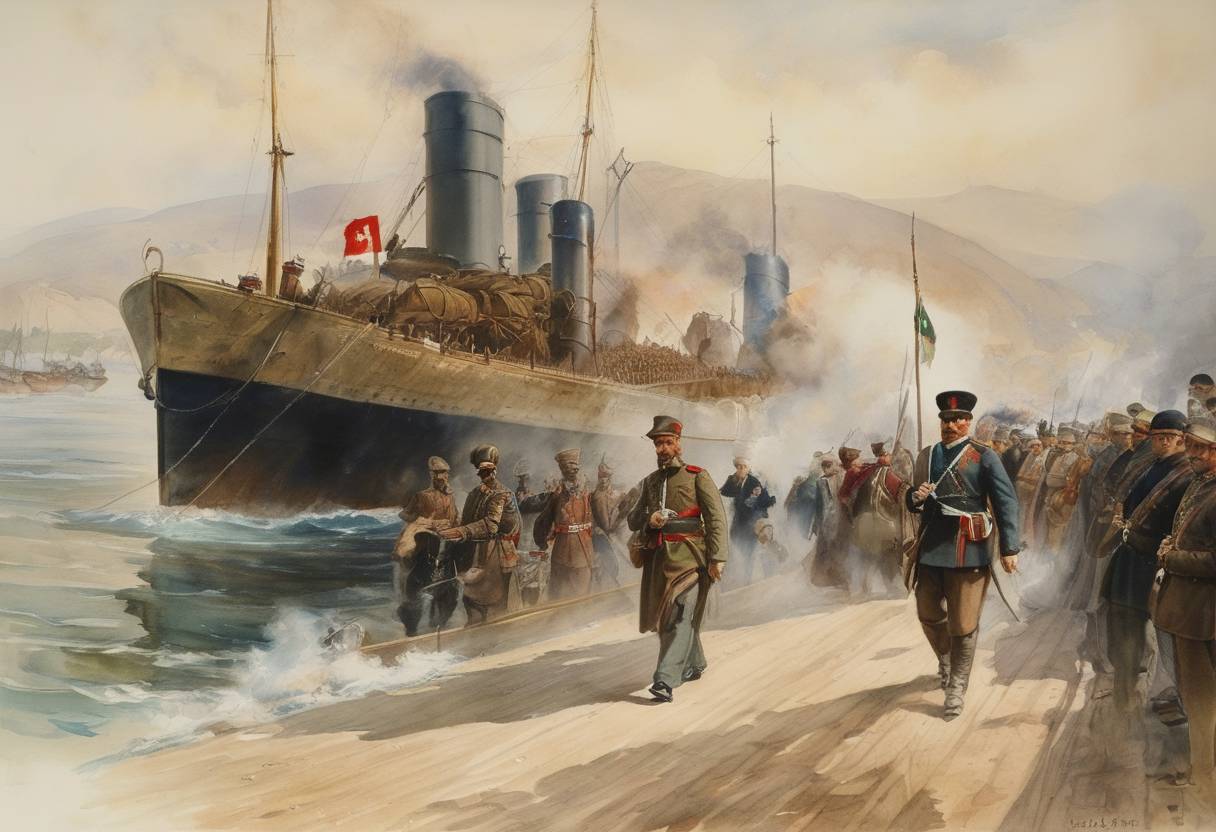
The Entry of the Ottoman Empire into World War I
On November 5, 1914, France and the British Empire formally declared war on the Ottoman Empire, marking a significant expansion in the scope of World War I. This decision was a response to the Ottoman Empire aligning itself with the Central Powers, namely Germany and Austria-Hungary, following a period of tension and military engagements in the preceding months.
Prelude to the Declaration
The Ottoman Empire’s entry into the war was foreshadowed by several key developments. One of the pivotal incidents was the arrival of the German warships SMS Goeben and SMS Breslau in the Dardanelles in August 1914. Although ostensibly transferred into Ottoman control and renamed Yavuz Sultan Selim and Midilli, they retained German crews and command. This symbolized the burgeoning alliance between the Ottoman Empire and Germany.
Moreover, the Ottoman Empire had been seeking a powerful ally that could assist in restructuring its declining state and counteracting the threats posed by neighboring powers, especially Russia. The secret Ottoman-German Alliance signed on August 2, 1914, outlined mutual defense terms, drawing the empire closer into the orbit of the Central Powers.
Trigger Events
The declaration of war followed the Ottoman naval bombardment of Russian ports in the Black Sea on October 29, 1914. This action was perceived as an act of aggression that aligned the Ottomans against the Allied Powers. Following this attack, Russia declared war on the Ottoman Empire on November 2, 1914, creating an immediate conflict zone that expanded eastward.
The Declaration and its Implications
On November 5, Britain and France’s declaration followed swiftly, officially making the Ottoman Empire an enemy in what was increasingly becoming a global conflict. With this declaration, the Middle Eastern theater of World War I opened, as the Allies aimed to attack Ottoman-controlled territories in strategic campaigns.
The entry of the Ottoman Empire into the war had several key consequences:
Gallipoli Campaign: This marked the beginning of British and French attempts to knock the Ottoman Empire out of the war via the Dardanelles, ultimately leading to the Gallipoli Campaign, which ended in a costly stalemate.
Wider Middle Eastern Conflict: Allied powers worked to incite Arab nationalism against Ottoman rule, leading to the Arab Revolt, a significant insurgency in the region supported by figures such as T.E. Lawrence (“Lawrence of Arabia”).
Shift in Global Alliances: The Ottoman Empire’s involvement in the conflict led to partnerships and rivalries that would have lasting effects on the geopolitical landscape of the Middle East, with new national boundaries drawn in the post-war treaties.
The involvement of the Ottoman Empire thus carried profound and lasting repercussions, contributing to both the immediate intensification of World War I and to long-term geopolitical shifts in the Middle East.