King Charles I Dissolves Parliament: The Beginning of the Personal Rule
1629 · London, England
King Charles I of England dissolves Parliament, beginning the eleven-year period known as the Personal Rule.
June 7, 1628
Petition of Right, a major English constitutional document, is granted the Royal Assent by King Charles I.
London, England | Parliament of England
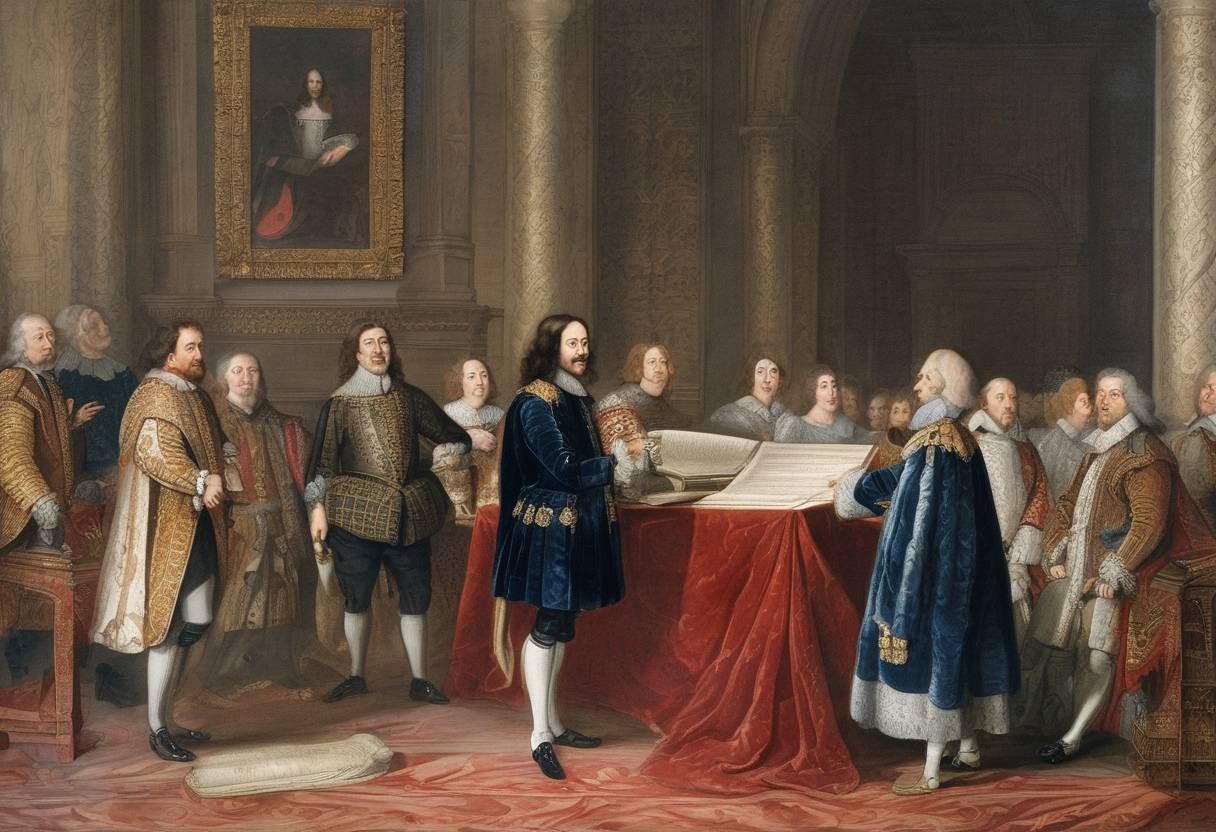
On June 7, 1628, King Charles I of England granted Royal Assent to the Petition of Right, a pivotal document in the constitutional history of England. This event marked a significant development in limiting the powers of the monarchy and establishing a framework for the protection of civil liberties.
In the early 17th century, tensions between the English monarchy and Parliament were rising, primarily due to King Charles I’s financial policies and his use of prerogative power. The king frequently bypassed Parliament to levy taxes and imposed forced loans on his subjects, actions that were seen as abuses of power and contraventions of established English law.
Drafted by Sir Edward Coke and other members of Parliament, the Petition of Right sought to address these grievances by asserting four key principles:
This petition, formulated in the House of Commons, was a signal of resistance against the encroachment on traditional liberties by the crown and was meant to affirm the supremacy of the law over royal prerogative.
Initially, King Charles I resisted the petition, seeking to maintain the absolute authority that his father, James I, had emphasized. However, faced with a lack of financial resources and mounting pressure from Parliament, he eventually conceded and granted his assent on June 7, 1628. Importantly, King Charles I’s acceptance was somewhat grudging as he did not provide the traditional formal endorsement but instead a somewhat ambiguous affirmation, reflecting his reluctance to diminish his powers.
The Petition of Right is regarded as a cornerstone of the constitutional framework that shaped the eventual balance of power between the monarchy and Parliament. It set the groundwork for subsequent legal charters, including the Habeas Corpus Act of 1679 and the Bill of Rights of 1689, which further enshrined the principles of constitutional governance and the rule of law.
In the longer term, the tensions between Charles I and Parliament continued, eventually contributing to the outbreak of the English Civil War in 1642. Nonetheless, the Petition of Right stands as a testament to the resilience of the English legal tradition and its influence on democratic governance worldwide.
Source: www.britannica.com