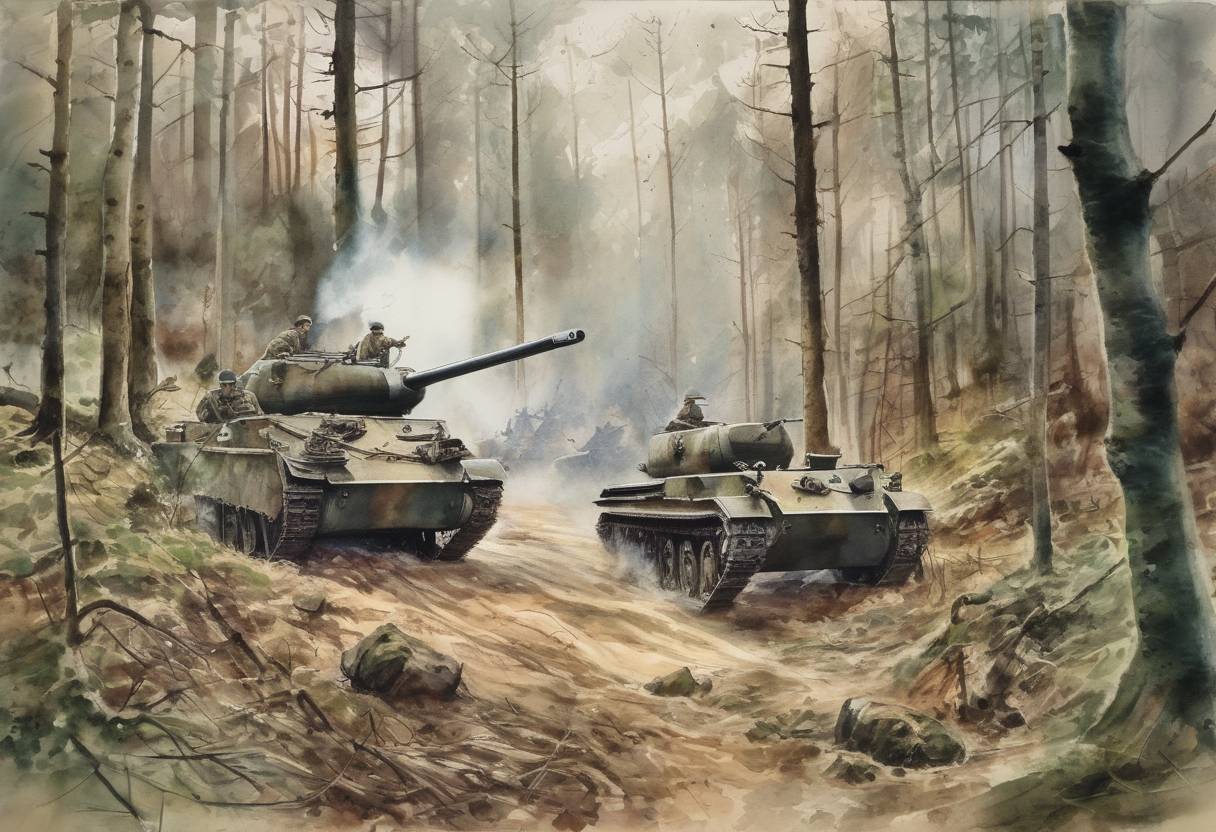
The Battle of Hürtgen Forest
Overview
The Battle of Hürtgen Forest was a prolonged and grueling series of battles fought between American and German forces during World War II. It began on September 19, 1944, and continued until February 1945. The battle took place in the dense Hürtgen Forest, located near the German-Belgian border, and was part of the larger Allied campaign to advance into Germany following the success of the Normandy Invasion.
Context
- Strategic Importance: The Hürtgen Forest was strategically significant as it lay on the path to the Rur River dams, which the Allies needed to control to prevent the Germans from flooding the Rur Valley and slowing the Allied advance into Germany.
- Terrain Challenges: The forest’s dense woods, steep ravines, and poor weather conditions made it a challenging environment for combat, favoring the German defenders who were familiar with the terrain.
Key Events Leading Up to the Battle
- Operation Market Garden: Prior to the battle, the Allies had launched Operation Market Garden in September 1944, an ambitious plan to capture key bridges in the Netherlands. Its partial failure increased the importance of securing the Hürtgen Forest to maintain pressure on German defenses.
- Allied Advance: Following the liberation of Paris in August 1944, the Allies were pushing eastward towards Germany. The Hürtgen Forest became a focal point as they sought to breach the Siegfried Line, Germany’s defensive fortifications.
The Battle
- Initial Engagements: The battle began with the U.S. 9th Infantry Division’s attempt to clear the forest. The dense terrain and well-prepared German defenses led to heavy casualties and slow progress.
- Prolonged Combat: Over the following months, several U.S. divisions, including the 28th and 4th Infantry Divisions, were rotated through the forest, each suffering significant losses.
- German Defense: The German forces, commanded by General Walter Model, effectively utilized the forest’s natural defenses, mines, and fortifications to inflict heavy casualties on the advancing American troops.
Aftermath and Consequences
- Casualties: The battle resulted in approximately 33,000 American casualties and 28,000 German casualties, making it one of the longest and bloodiest battles fought by the U.S. Army in Europe.
- Strategic Outcome: Despite the high cost, the battle did not achieve its primary objective of quickly breaching the Siegfried Line. However, it tied down German forces and resources, indirectly contributing to the success of subsequent Allied operations.
- Legacy: The Battle of Hürtgen Forest is often cited as a cautionary example of the challenges of fighting in difficult terrain and the importance of strategic planning in military operations.
Broader Historical Significance
The Battle of Hürtgen Forest highlighted the complexities of warfare in challenging environments and underscored the determination and resilience of both American and German forces. It served as a prelude to the Battle of the Bulge, which began in December 1944, further shaping the course of the war in Europe.