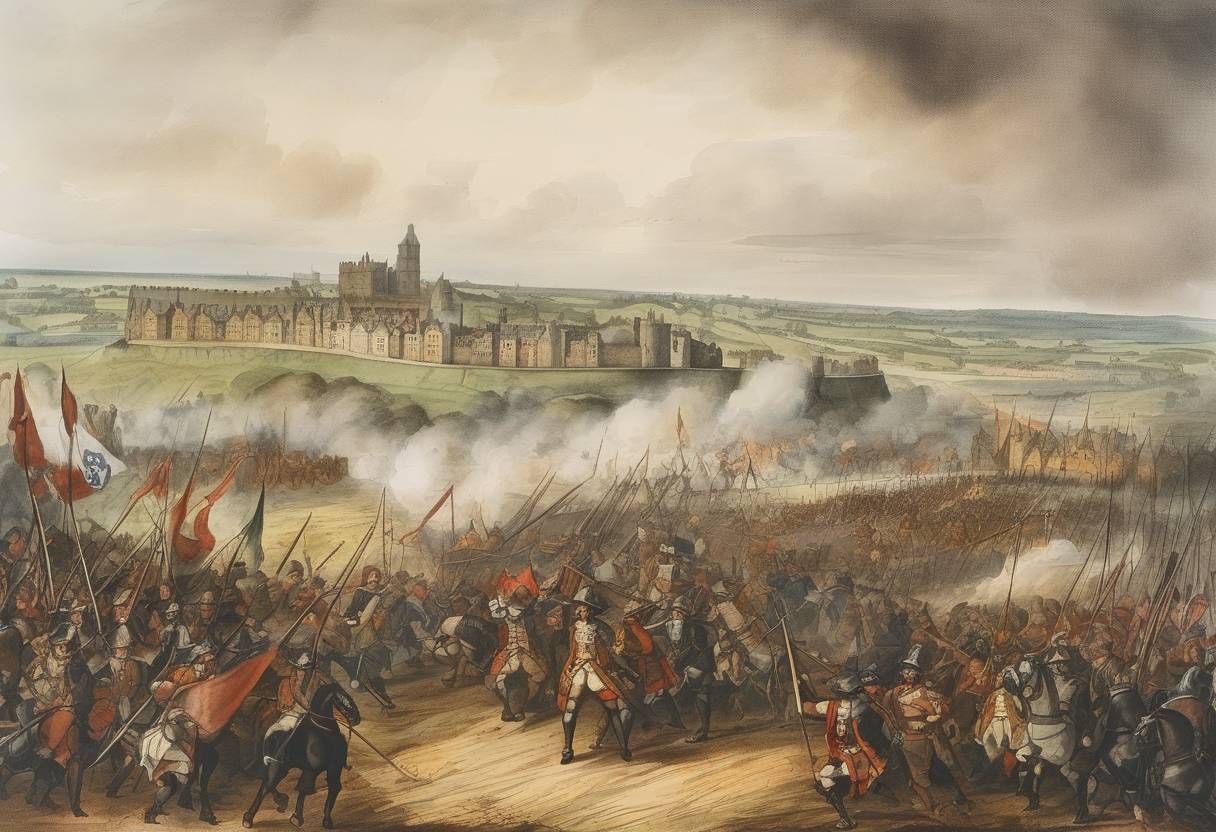
The Battle of Drogheda, a significant event during the Cromwellian conquest of Ireland, actually occurred on September 11, 1649, not November 25, 1650. To address your request for details about the event’s date on which it truly occurred, here is an account:
Background
The Battle of Drogheda was part of the wider campaign during the English Civil Wars when Oliver Cromwell, recently appointed as Lord Lieutenant of Ireland, led the Parliamentarian forces. The objective was to subdue the Royalist strongholds in Ireland and assert Parliamentarian control.
The Siege of Drogheda
- Date and Location: The siege took place on September 11, 1649, in the town of Drogheda, County Louth, Ireland.
- Commanders: The Parliamentarians were led by Oliver Cromwell, while the Royalists were commanded by Sir Arthur Aston.
- Forces: Approximately 12,000 Parliamentarian troops opposed the 3,000 defenders within the fortified town.
Key Events
- Initial Assault: On September 3, 1649, Cromwell’s forces began the siege by encircling Drogheda. They used heavy artillery to breach the town’s walls.
- Final Assault: On September 11, following days of bombardment, Cromwell ordered a decisive assault. His troops overwhelmed the defenders, entering through the breached walls.
- Aftermath of Breach: The incursion led to intense fighting in the streets. Notably, Cromwell ordered no quarter to be given, resulting in widespread massacre of the Royalist troops.
- Casualties: Reports suggest that up to 3,500 people were killed, including soldiers and some civilians. The massacre was intended to serve as a deterrent to other garrisoned towns.
Consequences and Historical Significance
- Psychological Impact: The brutal handling of the siege had a demoralizing effect on other Royalist-held garrisons, often leading to surrenders without a fight.
- Cromwell’s Reputation: The events at Drogheda have been a point of controversy and debate, underscoring Cromwell’s ruthless approach.
- Strategic Success: The capture and subsequent actions facilitated Parliamentarian consolidation in Ireland, significantly contributing to the Cromwellian conquest.
The battle remains a stark representation of the harsh military strategies employed during the war and Cromwell’s contentious legacy in Ireland.