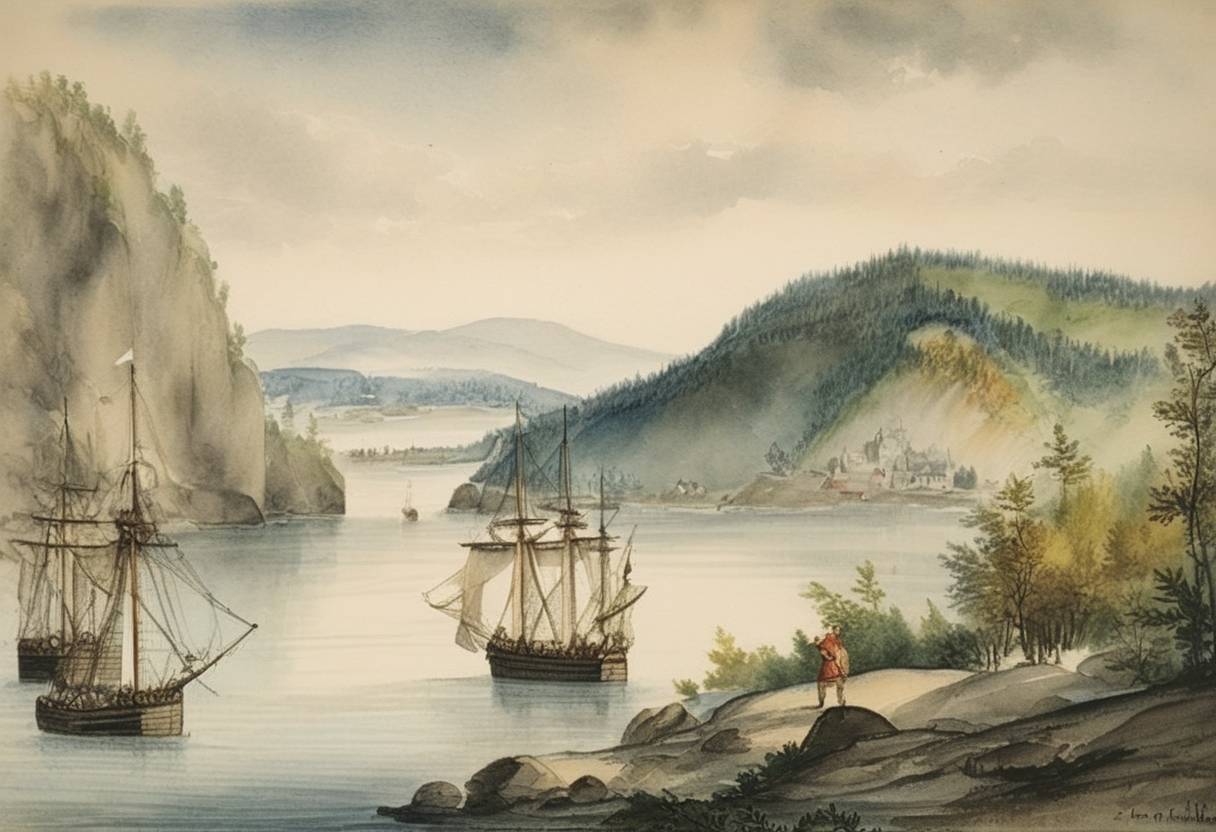
Jacques Cartier’s Third Voyage: Landing near Quebec on August 22, 1541
Background
Jacques Cartier, a French navigator and explorer, is recognized for his three significant voyages to North America under the commission of King Francis I of France. Cartier’s missions sought to explore and establish a French presence in the New World, looking for riches and a passage to Asia.
Third Voyage Objectives
Initiated in 1541, the third voyage aimed to both establish a permanent colony and find the fabled northwest passage to Asia. Cartier, however, was not the expedition’s leader in name; Jean-François de La Rocque de Roberval was appointed by the king to govern and manage the colony. Cartier departed before Roberval, armed with provisions, settlers, and the expectations of establishing a viable settlement.
Landing on August 22, 1541
On August 22, 1541, Cartier and his fleet arrived near present-day Quebec after navigating the treacherous St. Lawrence River. This location was strategically chosen, mindful of the lessons learned from previous voyages where harsh winters and lack of resources had made survival difficult.
The site near Quebec offered strategic advantages, including defensible terrain and proximity to the Iroquois people, with whom Cartier had interacted during earlier journeys. It was crucial to establish fortifications quickly, as Cartier anticipated challenges from both the local populations and the environmental conditions.
Challenges and Outcome
Upon establishing the settlement, Cartier’s expedition faced numerous difficulties, including strained relationships with the Indigenous peoples and harsh winter conditions. Additionally, Cartier’s belief that he had discovered a source of gold and diamonds at Cap-Rouge proved false, with the minerals turning out to be iron pyrite and quartz, leading to disappointment and mistrust.
Despite these efforts, the colonial endeavor struggled. Cartier departed back to France in early June 1542. The larger colony initiative floundered in part due to Roberval’s delayed expedition and other logistical issues, putting an end to this initial French colonization attempt in the region.
Historical Significance
Cartier’s exploratory voyages provided substantial geographical and cultural knowledge of the North American continent. Although his colonization attempts were prematurely unsuccessful, they laid the foundation for future French explorations in the region, contributing to the establishment of New France in the subsequent century.