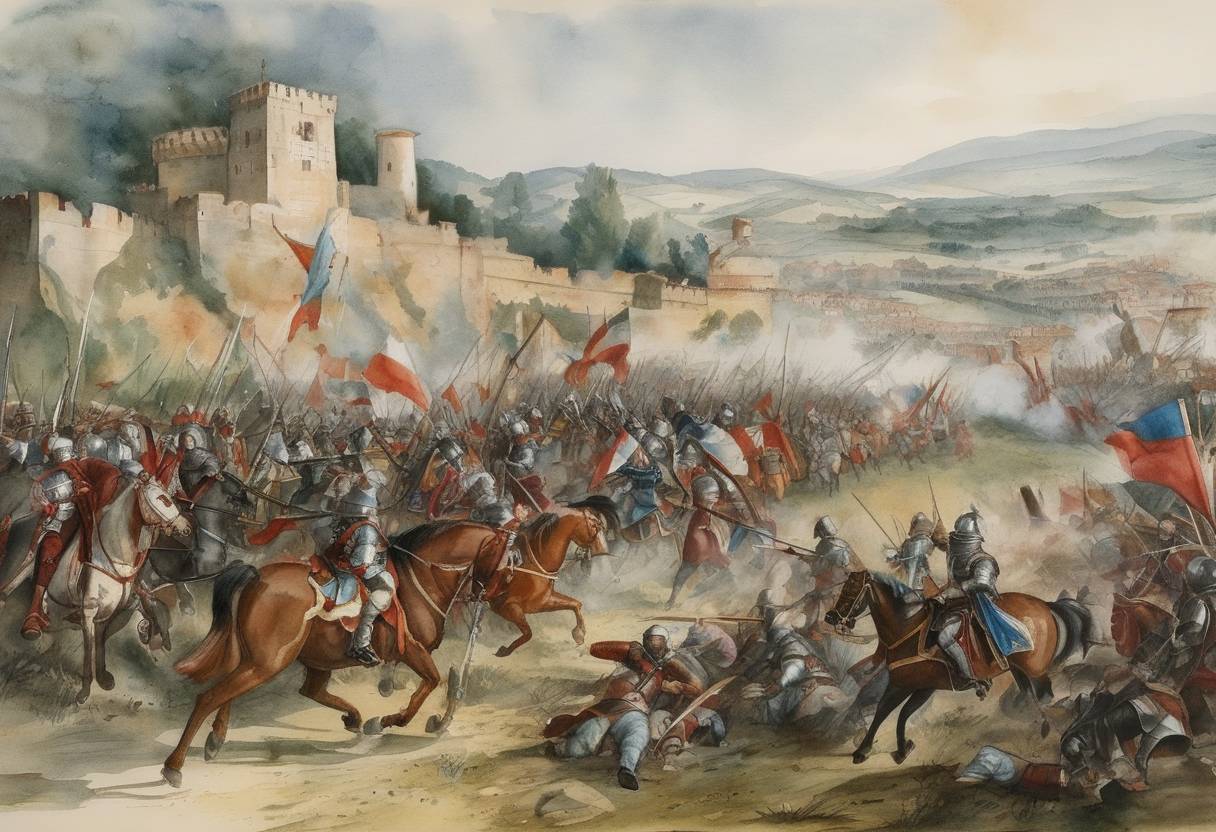
The Battle of Cerignola: A Turning Point in the Italian Wars
On April 28, 1503, during the tumultuous Italian Wars, a pivotal confrontation occurred at the Battle of Cerignola. This battle marked a significant moment in military history as Spanish forces, under the command of Gonzalo Fernández de Córdoba, also known as “El Gran Capitán,” decisively defeated the French army.
Context and Prelude
The Italian Wars were a series of conflicts involving various European powers, primarily fought for control over territories in the Italian Peninsula. By the early 16th century, both Spain and France were significant players vying for dominance in the region. The Kingdom of Naples, a vital strategic location, became a focal point for their military ambitions.
In the lead-up to the battle, the French, led by Louis d’Armagnac, Duke of Nemours, intended to reinforce their hold in southern Italy. Meanwhile, the Spanish sought to expand their influence and counter French advances.
The Battle
The battle took place near the town of Cerignola in southeastern Italy. Gonzalo de Córdoba skillfully utilized innovative tactics and technology that would prove crucial in shaping the outcome:
- Defensive Positioning: The Spanish set up defensive trenches and barricades, employing a tactic that provided a significant defensive advantage.
- Use of Firearms: They effectively incorporated arquebusiers—early firearm users—in their ranks, marking one of the earliest significant successes of gunpowder weaponry in European warfare.
- Tactical Discipline: Córdoba’s ability to maintain strict discipline and coordination among his troops was instrumental in withstanding the French cavalry and infantry assaults.
The French, relying heavily on traditional heavy cavalry and infantry, could not adapt swiftly to these tactical innovations.
Outcome and Consequences
The Spanish victory at Cerignola was decisive. It was reportedly one of the first battles in history won predominantly with firearm technology, highlighting a shift from medieval to more modern warfare practices. The French Duke of Nemours was killed during the battle, and his troops were forced to retreat, marking a downturn in French fortunes in the Italian Wars.
This victory laid the groundwork for Spanish supremacy in Italy, eventually leading to Spanish control over the Kingdom of Naples. The battle was also a testament to the evolving nature of warfare, where traditional military tactics were increasingly supplanted by new technologies and strategic innovations.
Broader Historical Significance
The Battle of Cerignola exemplified the changing dynamics in European military history, particularly the integration of gunpowder weaponry, which would continue to influence warfare in the coming centuries. Additionally, the Spanish success bolstered their position as a dominant European power, further shaping the political landscape of the continent during the Renaissance.