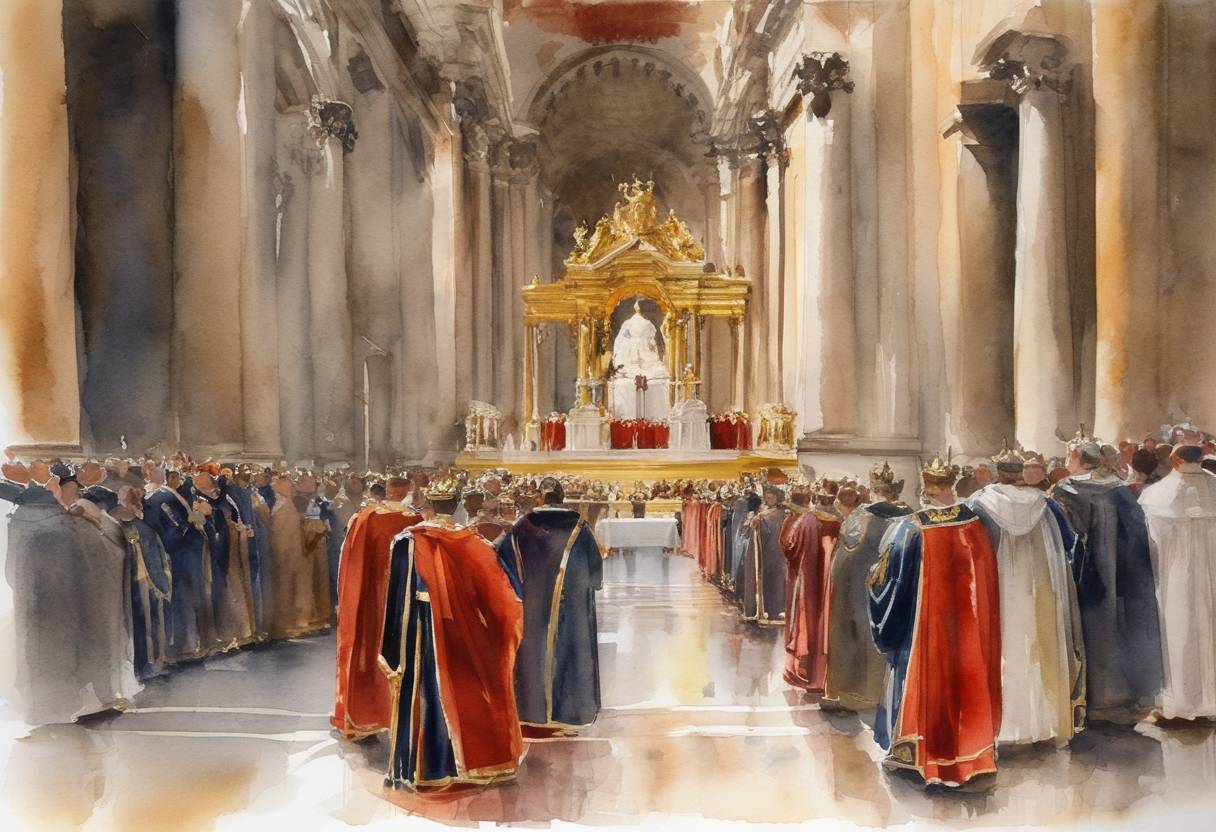
Holy Roman Emperor Henry V’s Coronation by Pope Paschal II
On April 12, 1111, Holy Roman Emperor Henry V was crowned emperor by Pope Paschal II at St. Peter’s Basilica in Rome. This event was an important milestone in the ongoing Investiture Controversy, a significant conflict during the 11th and 12th centuries between the Papacy and European monarchs over the right to appoint church officials, such as bishops and abbots.
Context of the Investiture Controversy
The Investiture Controversy originated from a struggle between secular and ecclesiastical powers in medieval Europe. It essentially revolved around the authority to invest bishops, who held both religious and secular powers, with their office. Monarchs, like those in the Holy Roman Empire, traditionally wielded significant influence over church appointments, which they used to bolster their own power. However, the papacy sought to gain spiritual independence and assert its authority over these appointments to diminish secular interference in church matters.
The Road to Coronation
Henry V ascended to power during a particularly tumultuous period. His predecessor and father, Henry IV, had faced excommunication and rebellion partially due to his involvement in the Investiture Controversy. Despite these divisive family legacies, Henry V aimed to consolidate imperial authority and sought to reconcile relationships with the papacy to secure his hold over the Holy Roman Empire.
The Coronation Event
Henry V’s coronation at St. Peter’s Basilica reflected a temporary reconciliation between the Pope and the Emperor. The event was meticulously planned to represent an accord that seemed to resolve the immediate tensions arising from the controversy. As a symbol of unity and religious sanction, the coronation was attended by high-ranking clerics and nobles, illustrating its political and spiritual significance.
Aftermath and Significance
Despite the ceremonial reconciliation, the coronation did not permanently resolve the Investiture Controversy. A temporary concordat was established, but disputes over investiture continued, leading to periods of instability and further negotiations. Ultimately, the broader Investiture Controversy only reached a definitive resolution with the Concordat of Worms in 1122, which partially satisfied both papal and imperial interests by differentiating between the spiritual and temporal roles of bishops.
Henry V’s coronation by Pope Paschal II is remembered as a key moment that exemplified both the complexities and the temporary compromises of the Investiture Controversy. It highlighted the deep entanglements between ecclesiastical authority and secular power that characterized medieval European politics.