The Russian Federation Gains Independence from the Soviet Union
1991 · Moscow, Russia
The Russian Federation gains independence from the Soviet Union, marking a significant moment in the dissolution of the USSR.
August 16, 1991
Boris Yeltsin declares Russia's independence from the Soviet Union.
Moscow, Russia | Russian Federation
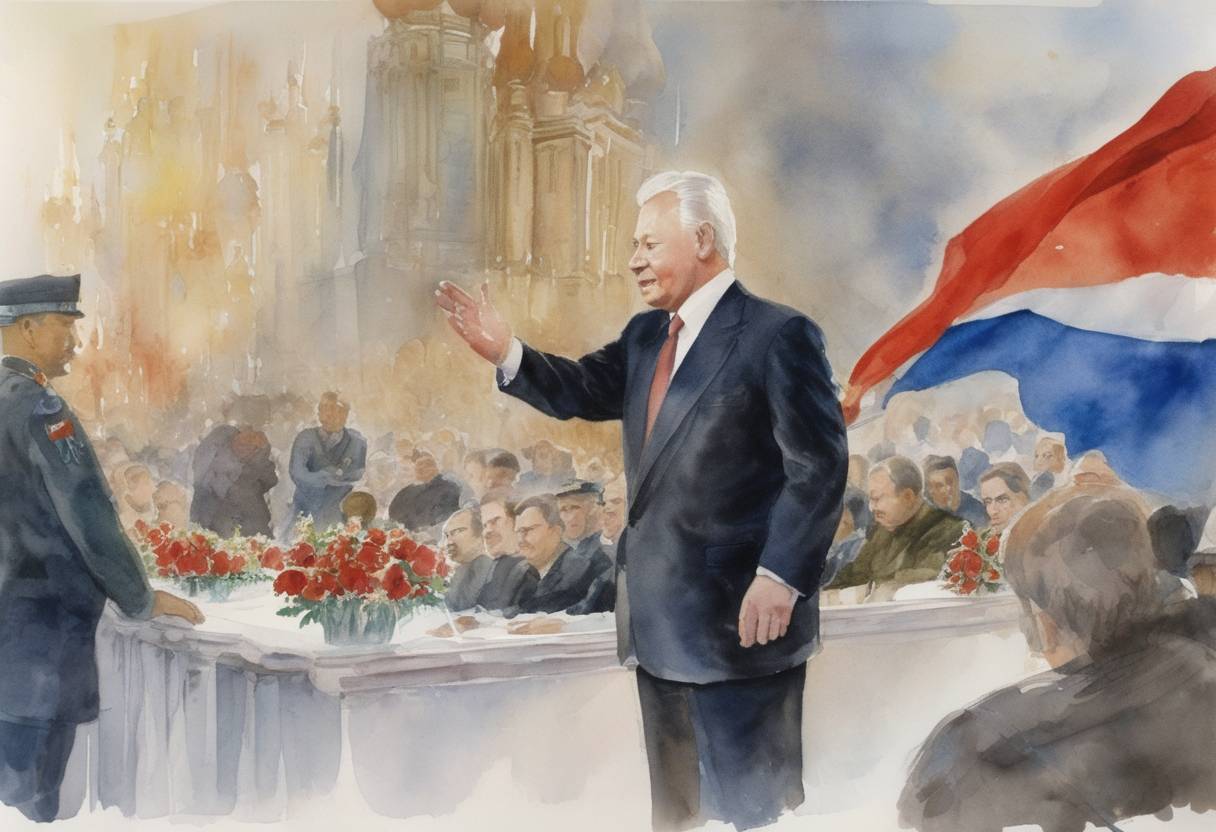
On August 16, 1991, a pivotal moment in Russian and Soviet history unfolded when Boris Yeltsin played a crucial role in the broader movement towards Russian sovereignty. Although August 16 does not directly correspond to a formal declaration of independence for Russia, it is significant in the context of the events leading up to the dissolution of the Soviet Union, specifically associated with mounting tensions and the subsequent coup attempt against Mikhail Gorbachev just days later.
Boris Yeltsin was a prominent political figure in the Soviet Union, advocating for reform and democratic governance. By 1991, he had become the President of the Russian Soviet Federative Socialist Republic (RSFSR), a position that empowered him to push for greater Russian autonomy within the Soviet framework. Throughout the late 1980s and into the early 1990s, a wave of nationalism and demands for greater independence spread across various Soviet republics, including Russia.
On June 12, 1990, the Russian parliament, under Yeltsin’s influence, adopted a “Declaration of State Sovereignty,” which was a critical step in asserting Russian legislative supremacy over Soviet laws within its territory. This declaration set the stage for eventual independence movements across the Soviet Union’s constituent republics.
The atmosphere in August 1991 was charged with political tumult. On August 16, 1991, Russia was amid a crisis that culminated in the August Coup (August 19-21), where Communist hardliners attempted to take control of the Soviet government to prevent the decentralization of power and potential dissolution of the Union. Boris Yeltsin emerged as a key figure during the coup, opposing the putsch and rallying public support, which would eventually help in thwarting the coup and accelerating the decline of Soviet control.
The failure of the August Coup rapidly shifted political dynamics. By December 1991, the formal dissolution of the Soviet Union was completed, and Russia established itself as an independent nation. Yeltsin’s leadership during the coup and his subsequent role in the formation of the Commonwealth of Independent States (CIS) were instrumental in navigating the transition from Soviet rule to an independent Russia.
The declaration and subsequent events dramatically transformed the political landscape of Eastern Europe and the world. Yeltsin’s actions marked the end of an era and the start of a new chapter in Russian history, characterized by significant political, economic, and social changes.
Source: en.wikipedia.org