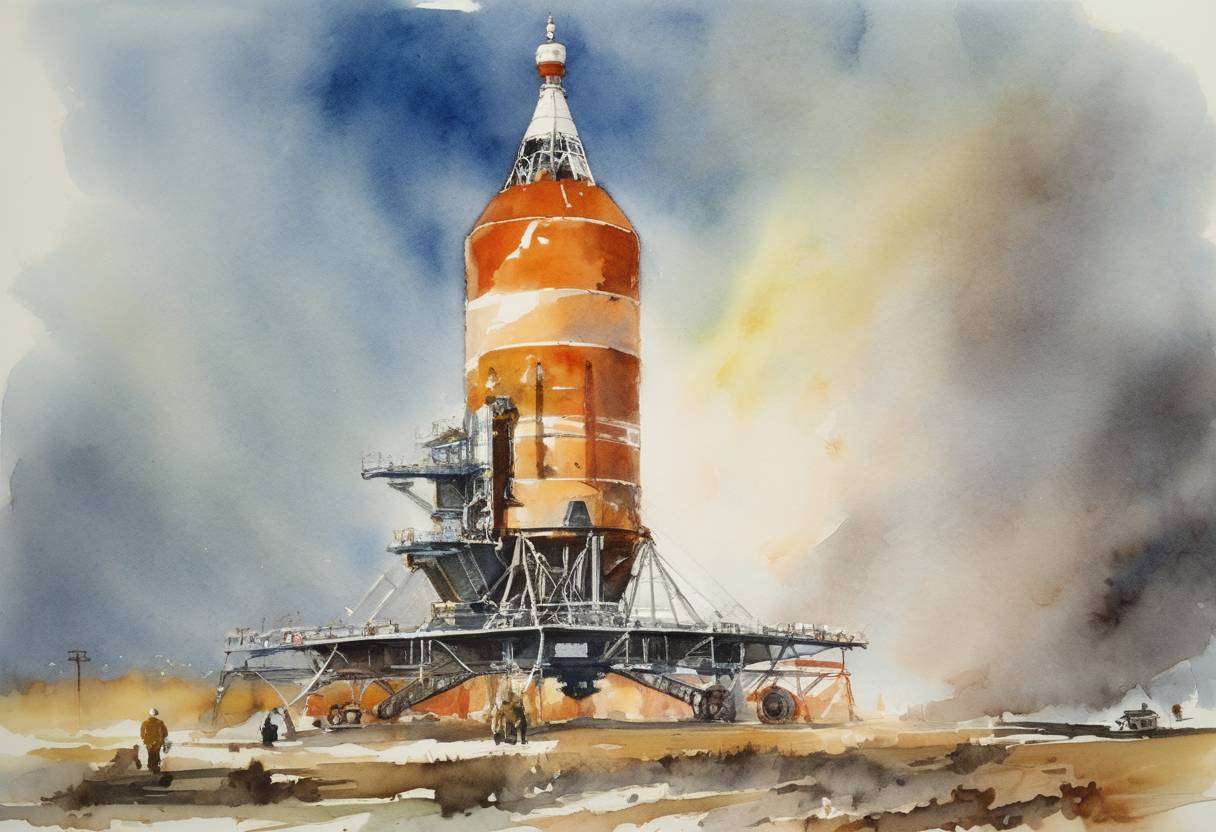
Soyuz 22 Launch and Mission
On September 19, 1976, the Soviet Union launched the Soyuz 22 spacecraft from the Baikonur Cosmodrome. This mission was designed primarily for Earth observation purposes, focusing on the collection of photographic data to aid in preparations for the 1980 Moscow Olympics.
Background
The Soyuz 22 mission was unique as it utilized a Soyuz spacecraft initially built as a backup for the ASTP (Apollo-Soyuz Test Project) in 1975. Instead of being scrapped, it had been repurposed for this specific mission to advance Earth observation techniques.
Objectives
The main goal of Soyuz 22 was to conduct a series of photographic experiments using the “MKF-6” camera, a sophisticated multi-spectral camera system. This equipment allowed the mission to capture images across various spectral bands, helping to assess the Earth’s resources and gather environmental data. With the 1980 Moscow Olympics approaching, the Soviet Union aimed to survey potential sites and improve their mapping and monitoring capabilities.
Crew
The mission was manned by a two-cosmonaut crew:
- Valery Bykovsky, who served as the Commander, was a veteran of two previous space missions.
- Vladimir Aksenov, making his space mission debut, was the Flight Engineer on the mission.
Mission Highlights
- The mission lasted for approximately 7 days in orbit.
- During this time, the cosmonauts conducted extensive photographic surveys.
- The captured data provided valuable insights into land use, agriculture, forestry, and pollution.
Significance and Impact
The Soyuz 22 mission marked an important step forward in the field of satellite-based Earth observation. The mission’s success laid the groundwork for future remote sensing missions and contributed significantly to planning and preparations for the 1980 Moscow Olympics.
Conclusion
Soyuz 22 demonstrated the strategic application of space technology for civil purposes, showcasing the Soviet Union’s commitment to leveraging space capabilities for both national development and international sporting events. The mission highlighted the growing importance of Earth observation in global scientific advancements during the latter part of the 20th century.