The Capture of Pyongyang: The First Sino-Japanese War
1894 · Pyongyang, Korea (present-day North Korea)
The first Sino-Japanese War: Japanese forces captured the port city of Pyongyang from China.
July 25, 1894
The First Sino-Japanese War began, marking the start of a military conflict between the Qing Dynasty of China and the Empire of Japan over influence in Korea.
Seoul, Korea | Imperial Japanese Army
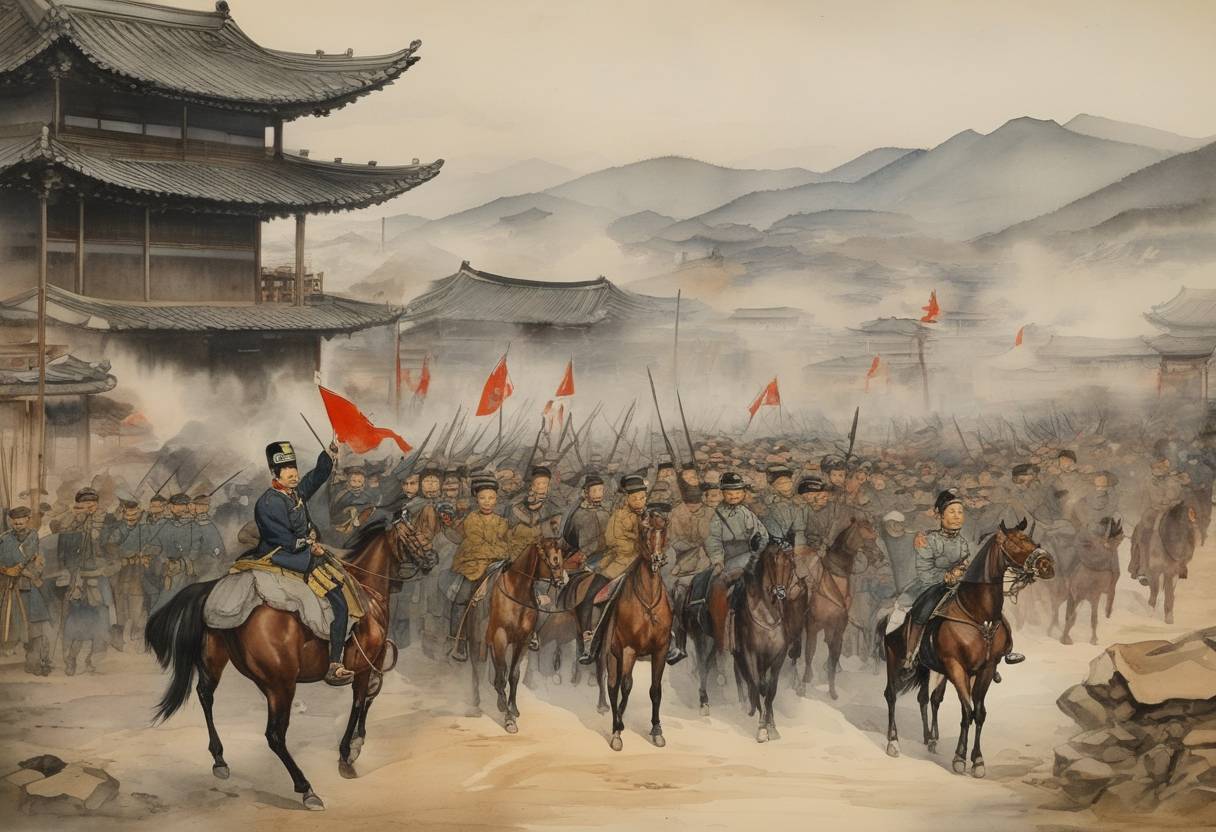
On July 25, 1894, the First Sino-Japanese War officially began, marking the start of a significant military conflict between the Qing Dynasty of China and the Empire of Japan. This war was primarily fought over influence and control in Korea, a strategically important region both nations sought to dominate.
The origins of the conflict stemmed from both China and Japan’s desire to exert their influence over Korea. During the 19th century, Korea was a tributary state of China, but Japan had begun to see Korea as an essential part of its own sphere of influence, particularly for providing strategic security and economic benefits.
Tensions escalated in the years leading up to the war as both countries attempted to assert their dominance over the Korean Peninsula. Key events that heightened animosities included:
Donghak Rebellion: A peasant uprising in Korea in 1894 prompted the Korean king to request Chinese military assistance. This deployment was exploited by Japan, which sent its own troops under the guise of protecting its nationals and interests.
Treaty of Tientsin (1885): This treaty between China and Japan stated that both nations would withdraw their troops from Korea to avoid military conflict; however, it also gave them equal rights to send troops under specific circumstances, setting the stage for future confrontations.
On the key date of July 25, three pivotal military events marked the commencement of active hostilities:
The Battle of Pungdo: This was a naval engagement off the Korean coast near Asan bay where Japanese naval forces decisively defeated the Chinese fleet. This victory ensured Japanese naval dominance in Korea from the outset.
The Attack on the Kowshing: The SS Kowshing, a British-owned vessel chartered by China to transport reinforcements to Korea, was sunk by the Japanese cruiser Naniwa, leading to a significant diplomatic incident and underscoring Japan’s commitment to block Chinese reinforcements.
The onset of the First Sino-Japanese War marked a shift in East Asian power dynamics. The war unfolded over the following months, leading to significant battles such as the Battle of Pyongyang and culminating in Japan’s comprehensive military victory.
The conflict concluded with the Treaty of Shimonoseki in 1895, which forced China to recognize Korea’s independence, ceded Taiwan and parts of Manchuria to Japan, and signaled the emergence of Japan as a significant imperial power. Simultaneously, it exposed and accelerated the decline of the Qing Dynasty, significantly altering the geopolitical landscape of East Asia.
The war’s outcome and Japan’s modernization efforts were watched closely by the international community, influencing the region’s political alignments and tensions that would reverberate well into the 20th century.
Source: en.wikipedia.org