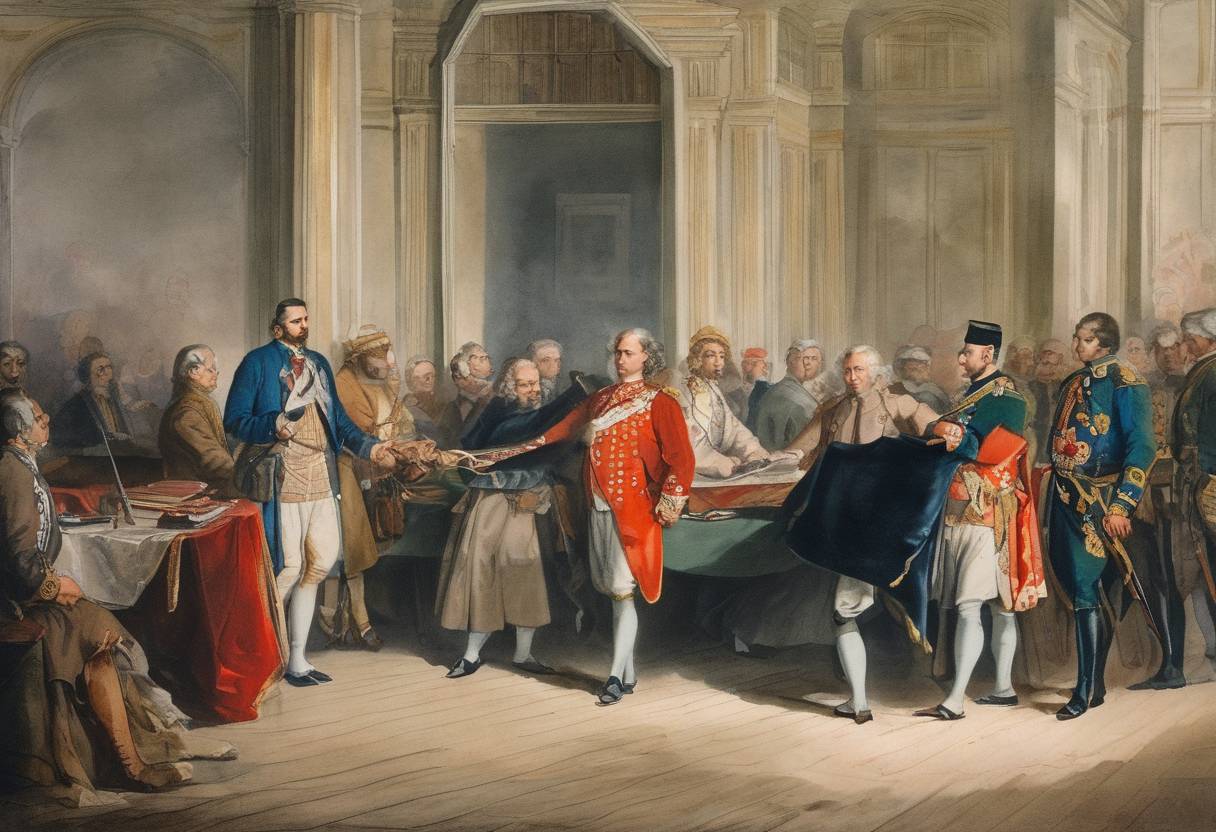
The Treaty of Belgrade: September 18, 1739
The Treaty of Belgrade, signed on September 18, 1739, marked the end of the Austro-Russian–Turkish War (1735–1739). This significant treaty established peace between the Ottoman Empire and the Habsburg Monarchy, reshaping the balance of power in Southeast Europe.
Background
The Austro-Russian–Turkish War was a set of hostilities arising from the ambitions of both the Habsburg Monarchy and the Russian Empire to expand their influence at the expense of the weakening Ottoman Empire. The conflict had seen various battles with varying successes for both the Ottomans and their opponents. As the war progressed, Russia and Austria operated largely in parallel, with Russia achieving some successes and the Austrians facing significant setbacks.
The Treaty and Its Terms
Amidst military struggles and a desire to restore stability, negotiations led to the signing of the Treaty of Belgrade. The central stipulations of the treaty involved significant territorial adjustments:
Austrian Concessions: Austria was compelled to make several territorial concessions. Notably, it returned northern Serbia, including Belgrade, and parts of the Banat of Temeswar to the Ottoman Empire. This was a significant rollback from previous Austrian territorial gains in the region.
Border Establishment: The treaty established the Sava and Danube rivers as the demarcation lines between the Ottoman Empire and the Habsburg Monarchy, which was crucial in defining the boundaries of influence and control in the Balkans.
Diplomatic Relations: The treaty also included clauses to ensure the resumption of peaceful diplomatic relations between the two empires. This would provide a period of relative stability and a shift in focus away from war to internal development for both signatories.
Aftermath and Historical Significance
The Treaty of Belgrade had consequential impacts on the region’s political landscape. For the Habsburg Monarchy, the treaty represented a notable territorial loss and highlighted military vulnerabilities. For the Ottoman Empire, it symbolized one of the last successful diplomatic engagements before the empire’s prolonged decline.
The peace established by the treaty held until the onset of subsequent conflicts, as Russia’s strategic interests continued to clash with Ottoman and Austrian ambitions. Nevertheless, the treaty temporarily stabilized relations in the complex and often turbulent Central and Eastern European theater.
The Treaty of Belgrade, by curbing Austrian expansion and maintaining Ottoman control over the Balkans, effectively delayed Russian advancement towards the Balkan territories, influencing the region’s political developments for the remainder of the 18th century.