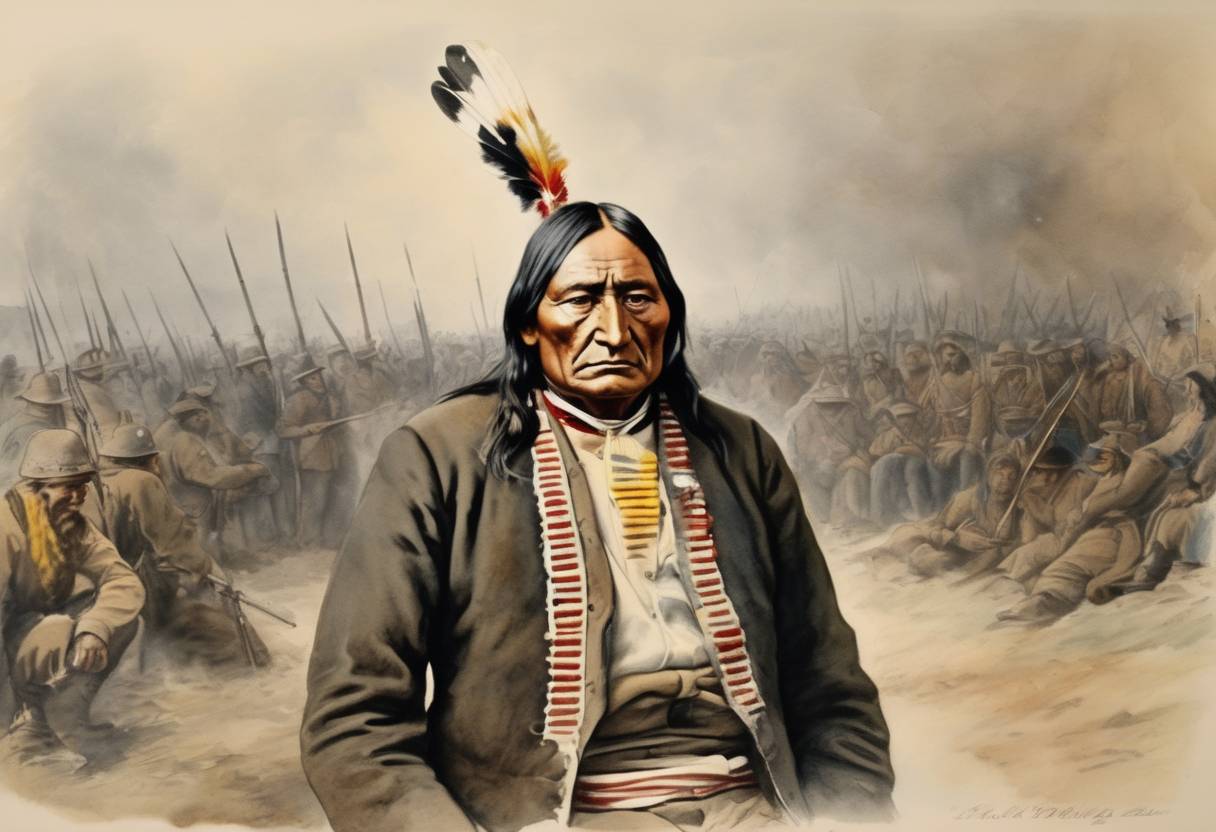
Sitting Bull’s Surrender: July 20, 1881
On July 20, 1881, the renowned Hunkpapa Lakota leader Sitting Bull surrendered to United States federal troops, marking a significant moment in the history of Native American resistance to U.S. government policies. This event symbolized the end of a prolonged struggle by Sitting Bull and his followers against the encroachment of settlers and the U.S. government’s efforts to confine Native American tribes to reservations.
Background
Sitting Bull, born around 1831, emerged as a prominent leader and spiritual figure among the Lakota Sioux. He was known for his staunch resistance to U.S. policies that aimed to displace Native Americans from their ancestral lands. His leadership was pivotal during the Great Sioux War of 1876-77, particularly in the Battle of the Little Bighorn, where his forces, alongside those of Crazy Horse, famously defeated General George Armstrong Custer’s 7th Cavalry.
Following the victory at Little Bighorn, Sitting Bull and his followers faced relentless pursuit by U.S. military forces. The pressure intensified as resources dwindled, and the harsh realities of survival on the run took their toll. In 1877, Sitting Bull led his people into Canada, seeking refuge and hoping to maintain their way of life away from U.S. jurisdiction.
The Surrender
By 1881, the situation had become dire. The Canadian government, under pressure from the United States, was less welcoming, and food shortages plagued Sitting Bull’s band. Realizing the untenable nature of their circumstances, Sitting Bull decided to return to the United States and surrender.
On July 20, 1881, Sitting Bull and approximately 186 of his followers surrendered at Fort Buford in present-day North Dakota. The surrender marked the end of his active resistance against U.S. policies. Sitting Bull was held as a prisoner of war for two years before being allowed to join his people on the Standing Rock Reservation.
Aftermath and Significance
Sitting Bull’s surrender was a poignant moment in the broader context of Native American history. It underscored the relentless expansionist policies of the U.S. government and the devastating impact on indigenous populations. Despite his surrender, Sitting Bull remained a symbol of resistance and cultural pride for the Lakota and other Native American tribes.
In the years following his surrender, Sitting Bull continued to advocate for his people’s rights and cultural preservation. He became involved with Buffalo Bill’s Wild West Show, which, while controversial, provided him a platform to share his culture with a broader audience.
Sitting Bull’s life came to a tragic end on December 15, 1890, when he was killed by Indian agency police on the Standing Rock Reservation during an attempt to arrest him, fearing he would join the Ghost Dance movement, which was seen as a threat by the U.S. government.
Sitting Bull’s legacy endures as a testament to the resilience and enduring spirit of Native American resistance and cultural identity. His surrender on July 20, 1881, remains a significant historical event, reflecting the complex and often painful interactions between Native American tribes and the expanding United States.