Leon Trotsky's Expulsion from the Soviet Communist Party
1927 · Moscow, Soviet Union
Leon Trotsky is expelled from the Soviet Communist Party, marking a significant power shift in the Soviet Union and consolidating Joseph Stalin's control.
January 21, 1924
Vladimir Lenin, the leader of the Bolshevik Revolution and the first head of the Soviet state, died, leading to a power struggle in the Soviet Union.
Gorki, Soviet Union | Soviet Union
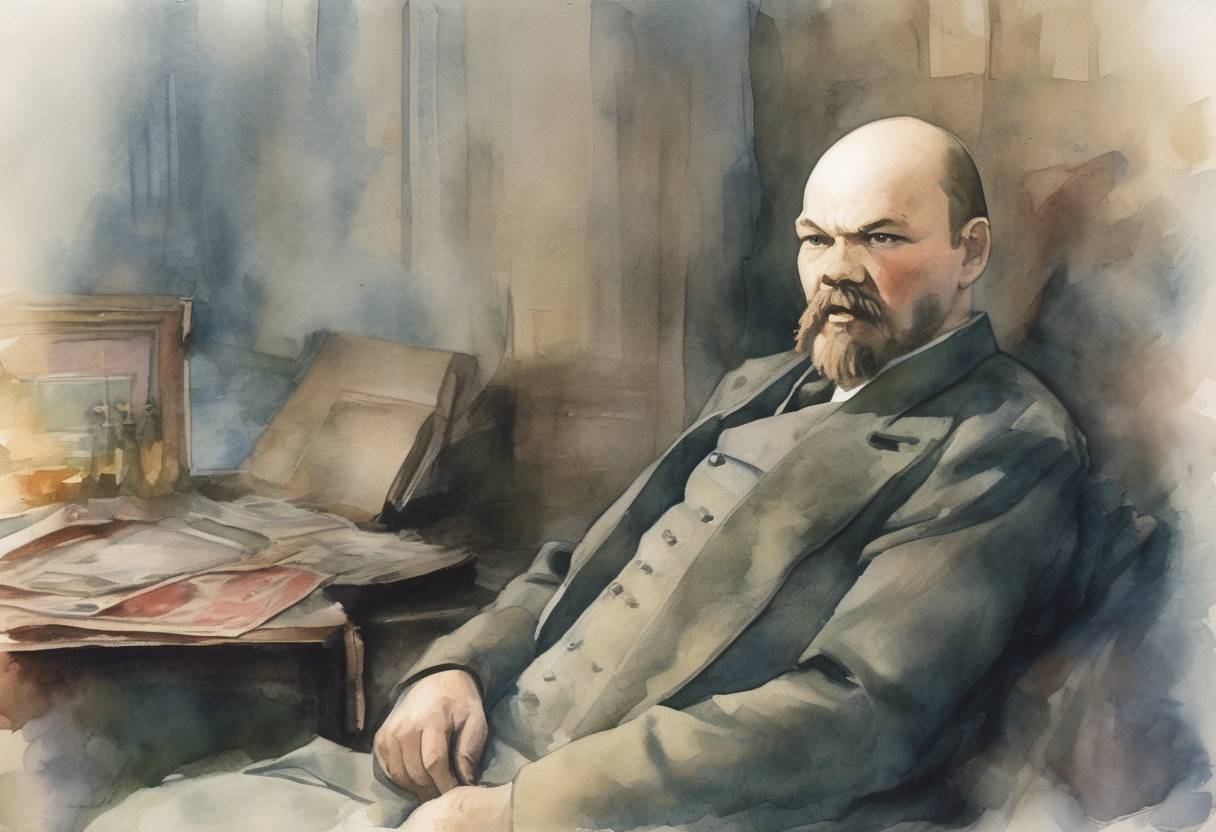
On January 21, 1924, Vladimir Ilyich Lenin, the leader of the Bolshevik Revolution and the first head of the Soviet state, passed away at the age of 53. Lenin’s death marked a significant turning point in Soviet history, leading to a power struggle that would shape the future of the Soviet Union.
Vladimir Lenin was a pivotal figure in the Russian Revolution of 1917, which led to the overthrow of the Provisional Government and the establishment of Bolshevik control. As the head of the Soviet state, Lenin implemented radical changes, including the nationalization of industry and the redistribution of land. His leadership during the Russian Civil War (1917-1922) was crucial in consolidating Bolshevik power.
Lenin’s health began to deteriorate in the early 1920s. He suffered a series of strokes, the first of which occurred in May 1922, significantly impairing his ability to speak and work. Despite his declining health, Lenin remained a central figure in Soviet politics until his death.
Lenin died on January 21, 1924, in Gorki, near Moscow. His death left a power vacuum within the Communist Party and the Soviet government. Lenin’s body was embalmed and placed on public display in a mausoleum in Red Square, Moscow, where it remains to this day.
Lenin’s death initiated a fierce power struggle among the Soviet leadership. The main contenders were:
The struggle for power was marked by political maneuvering and ideological debates. Stalin’s strategic position within the party apparatus allowed him to outmaneuver his rivals. By the late 1920s, Stalin had emerged as the undisputed leader of the Soviet Union, leading to significant shifts in Soviet policies and the eventual establishment of a totalitarian regime.
Lenin’s death and the subsequent power struggle had profound implications for the Soviet Union and the world. Stalin’s rise to power led to the implementation of policies that transformed Soviet society, including forced collectivization and rapid industrialization. These changes came at a tremendous human cost, including widespread famine and political purges.
Lenin’s legacy remains a subject of debate, with some viewing him as a visionary leader who sought to create a socialist utopia, while others criticize his authoritarian methods and the repressive nature of the Soviet state he helped to establish.
In summary, the death of Vladimir Lenin on January 21, 1924, was a pivotal moment in Soviet history, setting the stage for a power struggle that would ultimately lead to Joseph Stalin’s dominance and the shaping of the Soviet Union’s future trajectory.
Source: en.wikipedia.org