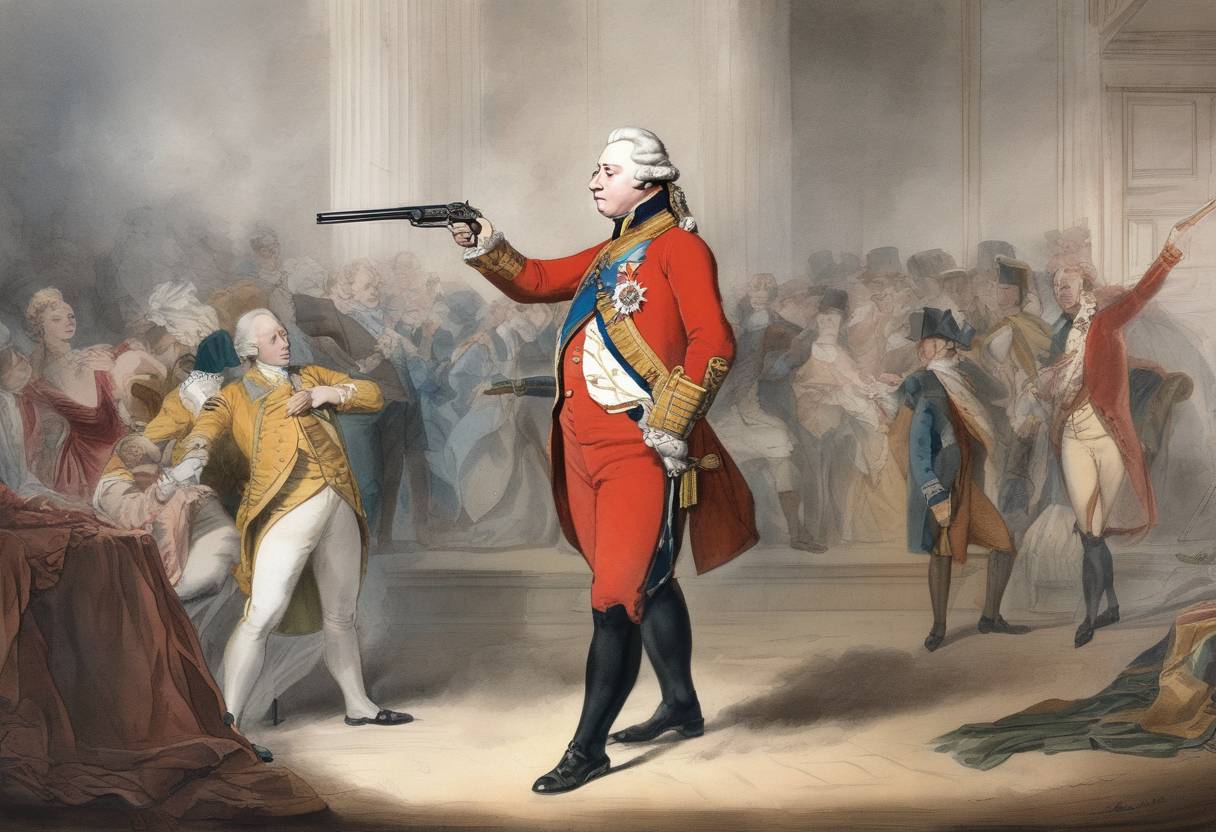
Assassination Attempt on King George III by James Hadfield
On May 15, 1800, King George III of Great Britain survived an assassination attempt by James Hadfield during a theatre performance at the Drury Lane Theatre in London. This event is notable not only for its immediate impact but also for its influence on legal proceedings concerning mental health.
Context Leading Up to the Event
King George III, who reigned from 1760 to 1820, was a monarch whose rule was marked by significant events, including the American Revolutionary War and the Napoleonic Wars. By 1800, the king had already experienced bouts of mental illness, which affected his public perception and political influence.
James Hadfield, the would-be assassin, was a former soldier who had sustained severe head injuries during the Battle of Tourcoing in 1794. These injuries were believed to have contributed to his mental instability. Hadfield’s motivations were reportedly driven by a delusional belief that his actions would bring about the Second Coming of Christ.
The Assassination Attempt
On the evening of May 15, 1800, King George III attended a performance at the Drury Lane Theatre. During the performance, Hadfield fired a pistol at the king from the audience. Fortunately, the shot missed, and King George III remained unharmed. The king reportedly showed remarkable composure, continuing to watch the play and reassuring the audience by stating, “The show must go on.”
Hadfield was quickly apprehended by the audience and theater staff. His arrest led to a trial that would have significant legal implications.
Aftermath and Legal Significance
James Hadfield’s trial was a landmark case in the history of English law. His defense was based on the argument of insanity, which was a relatively novel concept in legal proceedings at the time. The defense successfully argued that Hadfield was not guilty by reason of insanity, leading to his acquittal. Instead of being released, Hadfield was detained indefinitely in a mental institution, setting a precedent for how the legal system would handle cases involving mental illness.
This case contributed to the development of the “insanity defense” in English law, influencing future legal standards and practices regarding mental health and criminal responsibility.
Broader Historical Significance
The assassination attempt on King George III highlighted the vulnerabilities of public figures and the potential threats posed by individuals suffering from mental illness. It also underscored the need for legal systems to adapt and address the complexities of mental health in the context of criminal behavior.
Overall, the event is remembered not only for its immediate drama but also for its lasting impact on legal history and the treatment of mental illness within the judicial system.