Autochrome Lumière Patent - January 19, 1898
1898 · Paris, France
Auguste and Louis Lumière, considered among the earliest filmmakers in history, patent their color photography process, which they called Autochrome Lumière.
March 22, 1895
Auguste and Louis Lumière held the first private screening of projected motion pictures at their salon in Paris, France.
Paris, France | Lumière Brothers
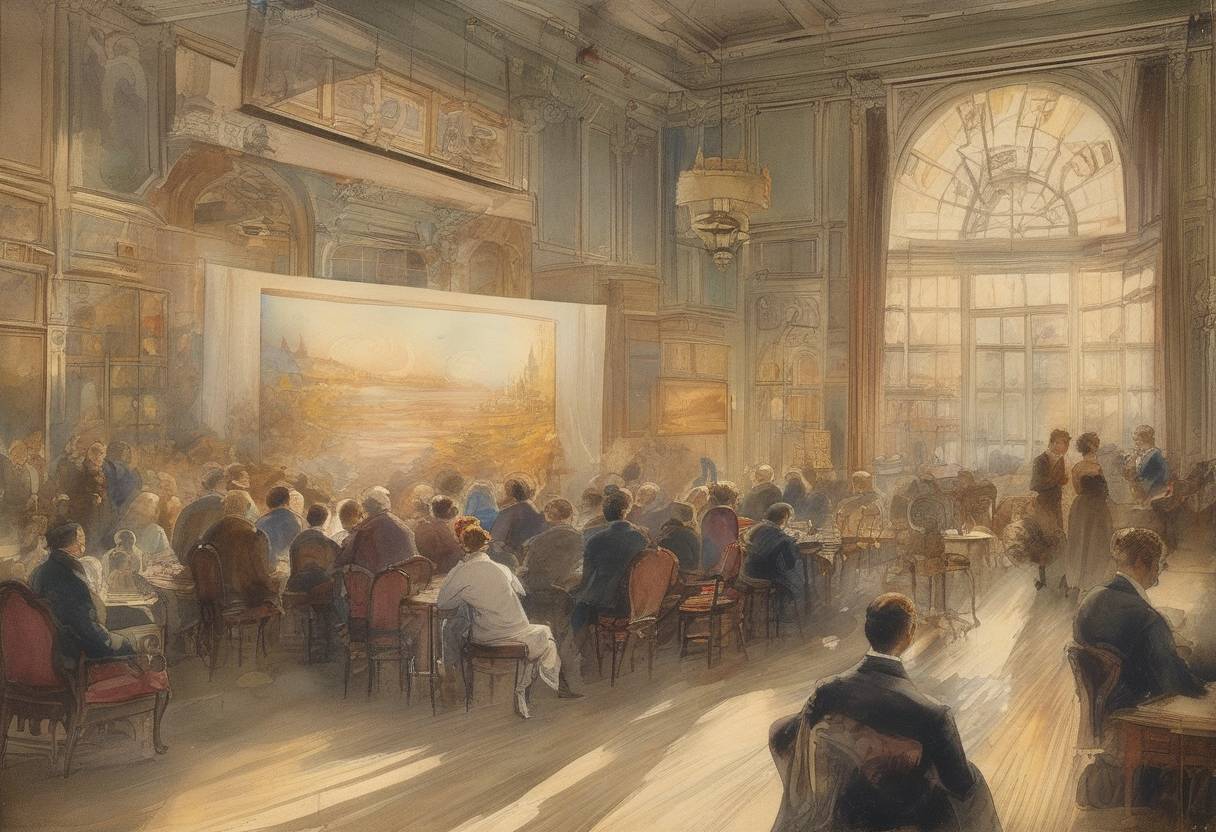
On March 22, 1895, Auguste and Louis Lumière, two pioneering French inventors and filmmakers, held the first private screening of projected motion pictures at their salon in Paris, France. This event marked a significant milestone in the history of cinema, laying the groundwork for the development of the film industry.
The Lumière brothers were born into a family with a strong background in photography. Their father, Antoine Lumière, owned a successful photographic business, which provided the brothers with early exposure to the world of visual technology. Building on this foundation, the Lumières began experimenting with moving images in the early 1890s.
Central to their success was the invention of the Cinématographe, a revolutionary device that functioned as a camera, projector, and printer. Unlike Thomas Edison’s Kinetoscope, which only allowed individual viewing through a peephole, the Cinématographe enabled the projection of images onto a screen, making it possible for an audience to share the viewing experience.
The private screening on March 22, 1895, took place at the Lumière factory in Lyon, where the brothers showcased their invention to a select group of family and friends. The films shown were short, simple scenes of everyday life, including “La Sortie de l’Usine Lumière à Lyon” (Workers Leaving the Lumière Factory), which is often regarded as the first true motion picture.
This private screening was a precursor to the first public screening, which occurred later that year on December 28, 1895, at the Grand Café in Paris. The public screening is widely considered the birth of cinema as a commercial entertainment medium.
The Lumière brothers’ innovations in film technology and their approach to capturing real-life events had a profound impact on the development of cinema. Their work paved the way for future filmmakers and established the foundation for the narrative and documentary films that followed.
Following their initial success, the Lumière brothers continued to produce films and improve their technology. However, by 1905, they had largely withdrawn from filmmaking, believing that “cinema is an invention without any future.” Despite this, their early contributions remain pivotal in the history of motion pictures.
In conclusion, the Lumière brothers’ first private screening on March 22, 1895, was a landmark event that heralded the advent of cinema as a shared cultural experience, influencing countless filmmakers and shaping the future of visual storytelling.
Source: www.britannica.com