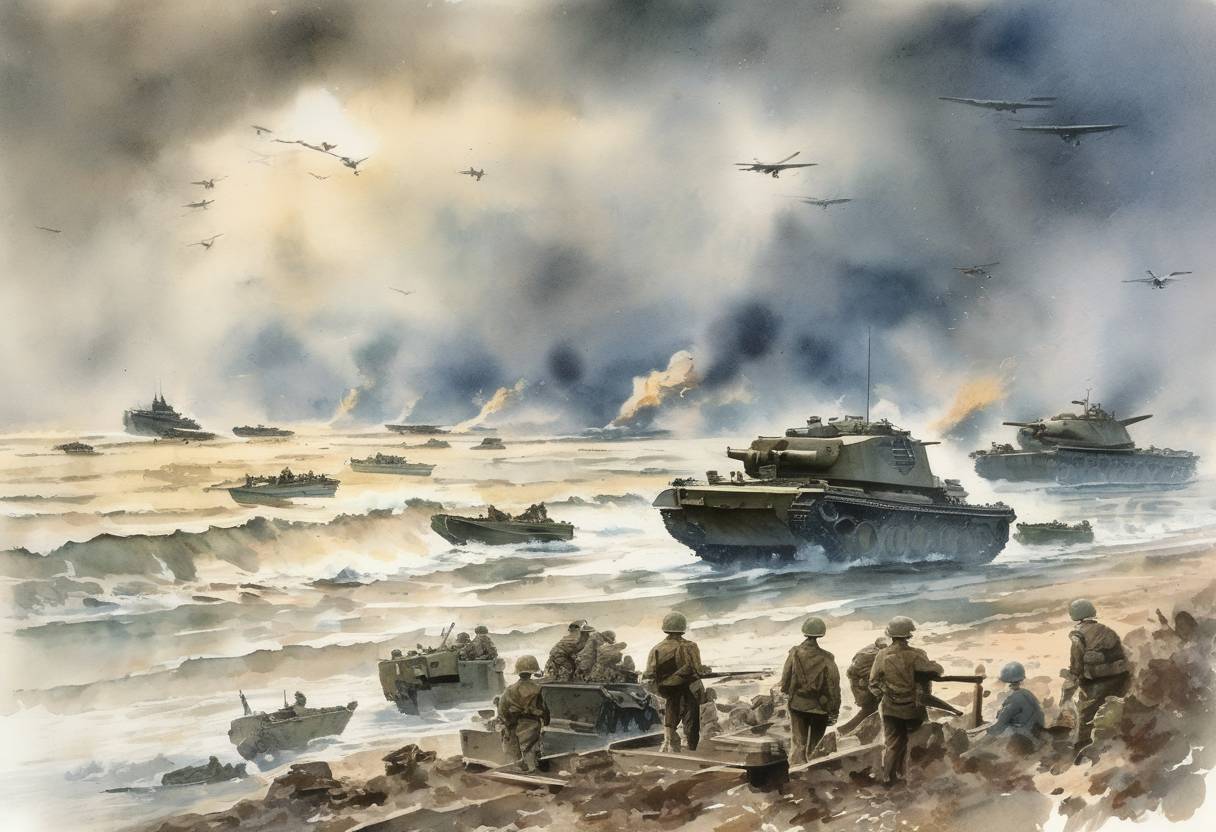
D-Day: The Normandy Invasion - June 6, 1944
On June 6, 1944, one of the most significant military operations of World War II took place: the Allied invasion of Nazi-occupied France, commonly known as D-Day. This operation, codenamed Operation Overlord, marked the beginning of the end for Nazi Germany as it opened a new front in Western Europe.
Background
The planning for D-Day began in earnest after the Tehran Conference in November 1943, where Allied leaders Franklin D. Roosevelt, Winston Churchill, and Joseph Stalin agreed on the necessity of a second front in Europe to alleviate pressure on Soviet forces in the East. The operation was meticulously planned by the Allied Expeditionary Force under the command of General Dwight D. Eisenhower.
The Invasion
Objectives
The primary objective of D-Day was to establish a secure foothold in Normandy, from which the Allies could launch further operations to liberate Western Europe from Nazi control. The invasion involved land, air, and sea forces from the United States, the United Kingdom, Canada, and several other Allied nations.
The Beaches
The Normandy coast was divided into five sectors, each assigned to different Allied forces:
- Utah Beach: Assigned to the U.S. 4th Infantry Division.
- Omaha Beach: The most heavily defended, assigned to the U.S. 1st and 29th Infantry Divisions.
- Gold Beach: Assigned to the British 50th Infantry Division.
- Juno Beach: Assigned to the Canadian 3rd Infantry Division.
- Sword Beach: Assigned to the British 3rd Infantry Division.
Execution
The invasion began in the early hours of June 6, 1944, with airborne operations aimed at securing key bridges and roadways inland. This was followed by a massive amphibious assault involving over 156,000 troops, supported by thousands of ships and aircraft.
Despite facing fierce resistance, particularly at Omaha Beach, the Allies succeeded in securing all five beachheads by the end of the day. The success of the landings was due in part to the extensive deception operations, such as Operation Bodyguard, which misled the Germans about the invasion’s timing and location.
Aftermath and Significance
The successful landings at Normandy marked the beginning of a sustained Allied campaign to liberate Western Europe. Within a week, over 326,000 troops, 54,000 vehicles, and 104,000 tons of supplies had been landed. The Normandy invasion paved the way for the liberation of Paris in August 1944 and contributed significantly to the eventual defeat of Nazi Germany in May 1945.
D-Day remains a testament to the bravery and sacrifice of the Allied forces and is remembered as a pivotal moment in the struggle for freedom and democracy during World War II.