The Voluntary Abdication of Roman Emperors Diocletian and Maximian on May 1, 305
305 · Nicomedia, Roman Empire
Roman Emperors Diocletian and Maximian retire from office, marking the first voluntary abdication of Roman emperors in history.
April 1, 0286
Emperor Diocletian appoints Maximian as Caesar, marking the beginning of the Tetrarchy, a system of rule by four emperors in the Roman Empire.
Mediolanum, Roman Empire | Roman Empire
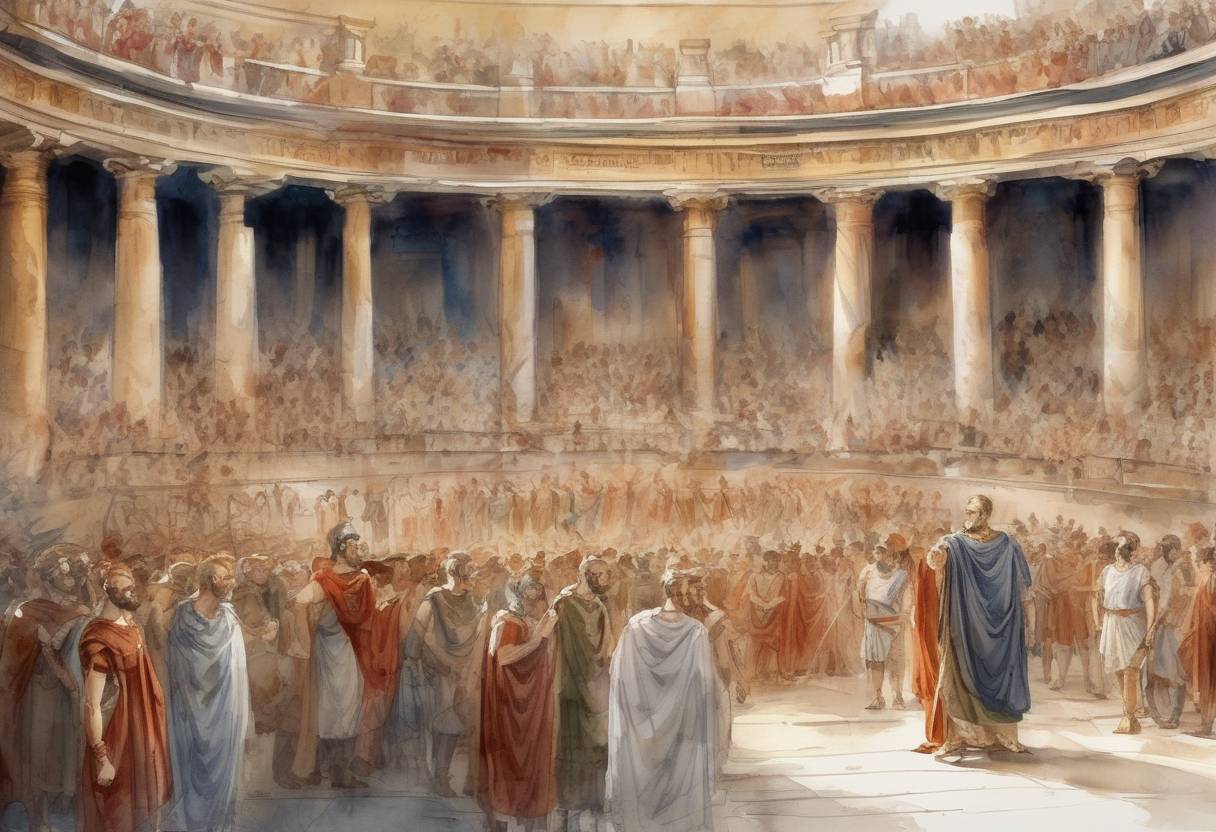
On April 1, 286, a significant event unfolded in the Roman Empire that would reshape its governance structure: Emperor Diocletian appointed Maximian as Caesar. This appointment marked the inception of the Tetrarchy, a novel system of rule by four emperors, designed to bring stability and order to an empire beset by internal strife and external threats.
The Roman Empire in the late 3rd century was plagued by a series of crises, including political instability, economic troubles, and military threats from both internal usurpers and external invaders. The period, often referred to as the “Crisis of the Third Century,” saw numerous emperors rise and fall in rapid succession, leading to a fragmented and weakened state.
Diocletian, who became emperor in 284, recognized the need for a more efficient and stable system of governance to address these challenges. His solution was to share imperial power, thereby ensuring more effective control over the vast territories of the Roman Empire.
The Tetrarchy, meaning “rule of four,” was Diocletian’s innovative response to the empire’s problems. It divided the empire into two main parts, the Eastern and Western Roman Empires, each governed by an Augustus (senior emperor) and a Caesar (junior emperor). This system was intended to provide a clear line of succession and to enable rapid and coordinated responses to threats.
The appointment of Maximian as Caesar was a strategic move. Maximian was a trusted military leader and ally of Diocletian, and his elevation was meant to strengthen the Western Empire’s defenses and administration.
The establishment of the Tetrarchy brought a period of relative stability and efficiency to the Roman Empire. It allowed for more localized governance and quicker military responses to threats. The system also helped to curb the power struggles that had previously plagued the empire by clearly delineating lines of succession.
However, the Tetrarchy was not without its challenges. The division of power sometimes led to conflicts between the co-emperors, and the system ultimately proved unsustainable in the long term. After Diocletian and Maximian retired in 305, the Tetrarchy began to unravel, leading to renewed civil wars and the eventual rise of Constantine the Great, who would reunify the empire under a single ruler.
The appointment of Maximian as Caesar on April 1, 286, was a pivotal moment in Roman history. It marked the beginning of the Tetrarchy, an ambitious attempt to stabilize and govern the vast Roman Empire more effectively. While the system had its flaws and was short-lived, it represented a significant evolution in the administrative and political structure of the empire, influencing the course of Roman history in the years to come.
Source: en.wikipedia.org