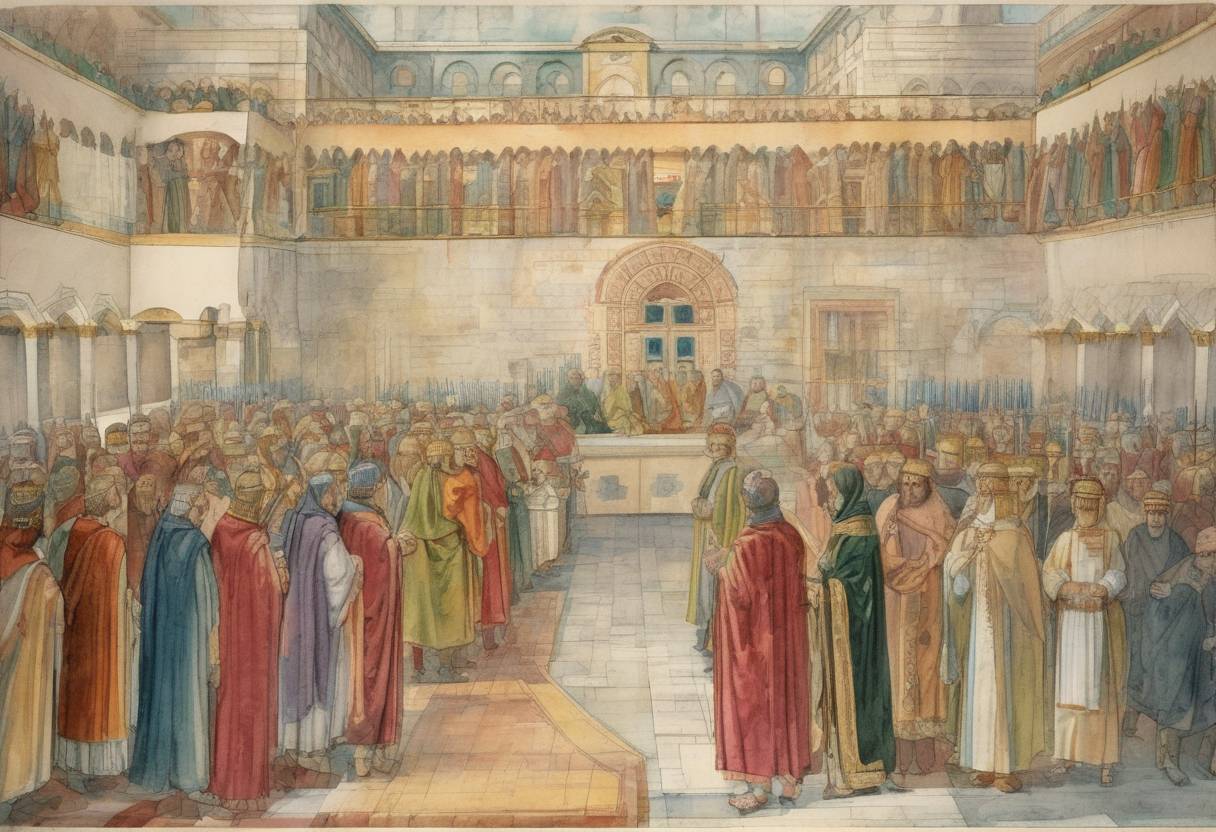
The Second Council of Constantinople
Overview
The Second Council of Constantinople, the fifth ecumenical council of the Christian Church, commenced on May 5, 553, under the presidency of the Byzantine Emperor Justinian I. This council was convened to address ongoing theological disputes concerning the nature of Christ and to condemn specific writings and teachings considered heretical.
Historical Context
Background
- Theological Controversies: The council was primarily concerned with the Christological controversies that had persisted since the Council of Chalcedon in 451. The debates centered around the nature of Christ, specifically the relationship between His divine and human natures.
- Monophysitism: A significant issue was the Monophysite controversy, which posited that Christ had only one nature, either divine or a synthesis of divine and human. This view was in opposition to the Chalcedonian definition, which upheld that Christ had two natures, fully divine and fully human, in one person.
Pre-Council Developments
- The Three Chapters: Prior to the council, Justinian I issued an edict condemning the “Three Chapters,” which were writings by certain theologians (Theodore of Mopsuestia, Theodoret of Cyrus, and Ibas of Edessa) that were perceived as Nestorian or sympathetic to Nestorianism, a doctrine emphasizing the disunion between Christ’s human and divine natures.
- Political and Religious Motivations: Justinian sought to reconcile the Chalcedonian Christians with the Monophysites and to strengthen the unity of the empire. His efforts were both theological and political, aiming to consolidate his rule and stabilize the religious landscape.
Key Events of the Council
- Condemnation of the Three Chapters: The council ultimately condemned the Three Chapters, aligning with Justinian’s earlier edict. This decision was intended to appease the Monophysite factions by demonstrating a commitment to addressing their concerns.
- Reaffirmation of Chalcedon: Despite the condemnation, the council reaffirmed the Chalcedonian definition of Christ’s dual nature, maintaining the theological stance established in 451.
Aftermath and Consequences
- Impact on the Church: The council’s decisions were met with mixed reactions. While it succeeded in some areas of reconciliation, it also led to further schisms, particularly in the Western Church, where the condemnation of the Three Chapters was controversial.
- Long-term Effects: The council’s outcomes contributed to the ongoing theological debates within Christianity and influenced the development of Christological doctrines. It also highlighted the complex interplay between theology and imperial politics in the Byzantine Empire.
Broader Historical Significance
The Second Council of Constantinople played a crucial role in shaping the theological landscape of Christianity during the Byzantine era. It underscored the challenges of maintaining doctrinal unity in a diverse and politically complex empire. The council’s decisions had lasting implications for the relationship between Eastern and Western branches of Christianity and set a precedent for future ecumenical councils in addressing theological disputes.