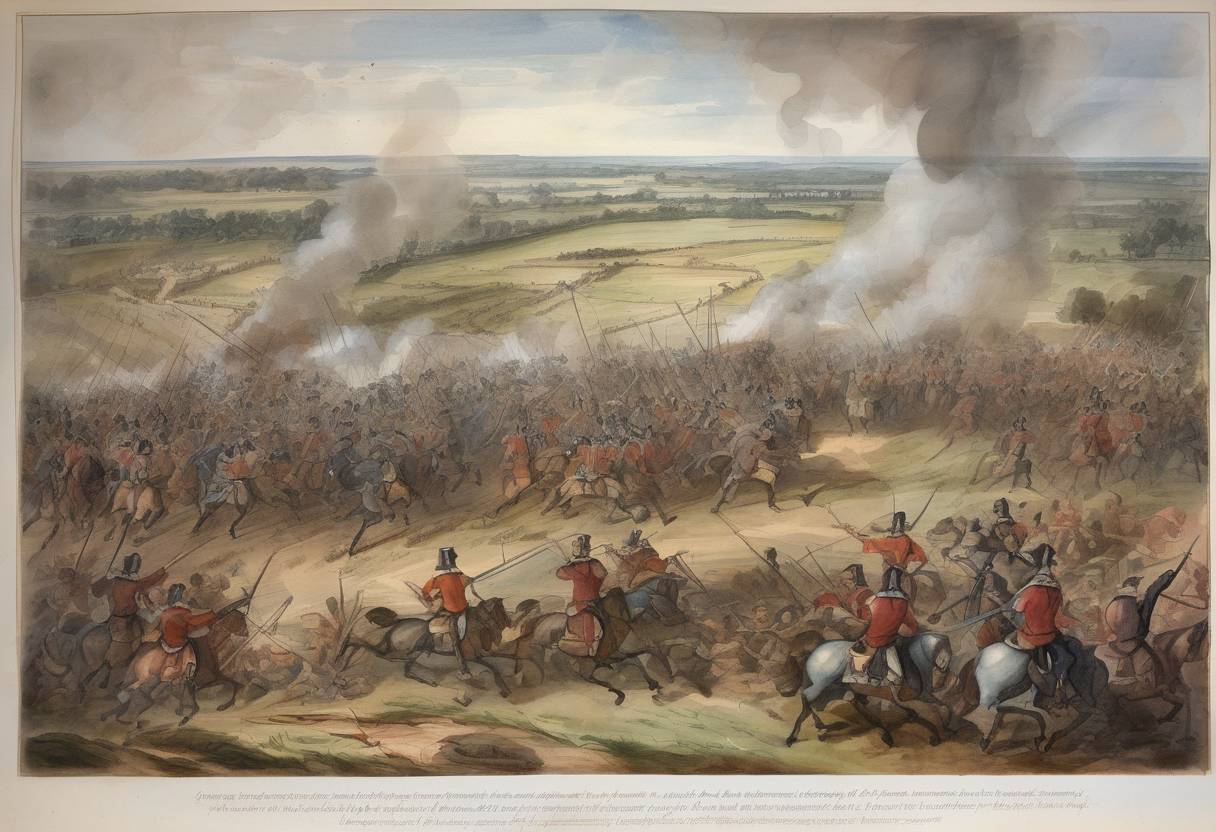
The Battle of Rowton Heath
Date and Context
The Battle of Rowton Heath took place on September 24, 1645, during the English Civil War, not on November 21, 1644. This battle was a significant engagement between the Royalists, loyal to King Charles I, and the Parliamentarians, who opposed his rule. The conflict was part of the broader struggle between the monarchy and Parliament over governance and religious freedoms in England.
- King Charles I: The monarch leading the Royalist forces, seeking to relieve the siege of Chester.
- Sir Marmaduke Langdale: Commanded the Royalist cavalry.
- Sir William Brereton: Led the Parliamentarian forces in the region.
- Major-General Sydnam Poyntz: Commanded the Parliamentarian cavalry that played a crucial role in the battle.
Lead-Up to the Battle
By 1645, the Royalists were increasingly on the defensive. The Parliamentarians had gained significant ground, and the Royalist stronghold of Chester was under siege. King Charles I aimed to relieve Chester, which was vital for maintaining communication with Royalist forces in Ireland.
The Battle
The battle unfolded near Chester, at Rowton Heath, as King Charles I attempted to break the siege. The Royalists, under Sir Marmaduke Langdale, engaged the Parliamentarian forces led by Major-General Sydnam Poyntz. Despite initial success, the Royalists were outmaneuvered and overwhelmed by the Parliamentarian cavalry.
Outcome
The battle resulted in a decisive victory for the Parliamentarians. The Royalists suffered significant casualties, and King Charles I was forced to retreat, failing to lift the siege of Chester. This defeat further weakened Royalist positions in the region.
Aftermath and Significance
- Strategic Impact: The loss at Rowton Heath was a severe blow to the Royalist cause, contributing to the eventual fall of Chester in February 1646.
- Broader Consequences: The defeat marked a turning point, as Parliamentarian forces continued to gain the upper hand, leading to the eventual capture of King Charles I and the end of the First English Civil War in 1646.
- Historical Significance: The battle exemplified the strategic importance of cavalry and the effectiveness of the New Model Army, which played a crucial role in the Parliamentarian victory.
The Battle of Rowton Heath is remembered as a pivotal moment in the English Civil War, illustrating the shifting tides in favor of the Parliamentarians and setting the stage for the eventual downfall of the Royalist cause.