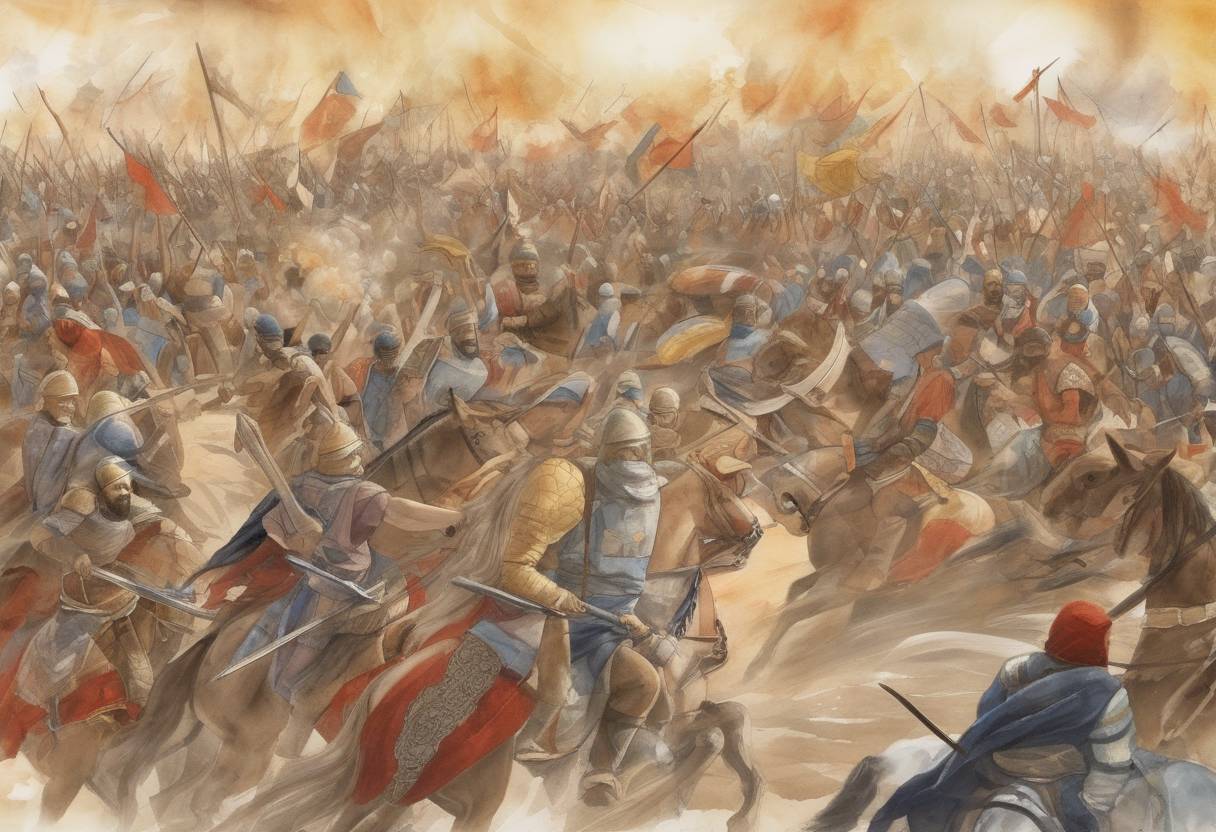
The Battle of al-Qadisiyyah Begins
Overview
The Battle of al-Qadisiyyah, which began on April 4, 636, was a crucial military engagement between the Sassanid Empire and the Rashidun Caliphate. This battle played a significant role in the Muslim conquest of Persia, marking a turning point in the Islamic expansion and the decline of the Sassanid Empire.
Context
The Sassanid Empire
- Background: The Sassanid Empire, established in 224 CE, was one of the leading powers in the region, known for its sophisticated culture and military prowess.
- Challenges: By the 7th century, the empire was weakened by internal strife, economic difficulties, and continuous wars with the Byzantine Empire.
The Rashidun Caliphate
- Expansion: Following the death of Prophet Muhammad in 632 CE, the Rashidun Caliphate embarked on a series of military campaigns to expand Islamic rule.
- Leadership: Under the leadership of Caliph Umar ibn al-Khattab, the caliphate sought to capitalize on the Sassanid Empire’s vulnerabilities.
The Battle
Prelude
- Strategic Importance: Al-Qadisiyyah, located near the Euphrates River, was strategically significant as it served as a gateway to the heart of the Sassanid Empire.
- Forces: The Rashidun army, led by Sa’d ibn Abi Waqqas, was composed of approximately 30,000 troops. The Sassanid forces, commanded by General Rostam Farrokhzad, were larger but less cohesive due to internal divisions.
Key Events
- Initial Skirmishes: The battle commenced with a series of skirmishes and negotiations, as both sides sought to gain an advantage.
- Main Engagement: The fighting intensified over several days, with both sides experiencing heavy casualties. The use of war elephants by the Sassanids initially posed a challenge to the Muslim forces.
- Turning Point: The tide turned in favor of the Rashidun army when they managed to neutralize the elephants and exploit the Sassanid army’s disarray.
Aftermath
Consequences
- Sassanid Defeat: The defeat at al-Qadisiyyah was catastrophic for the Sassanid Empire, leading to the loss of their capital, Ctesiphon, shortly thereafter.
- Islamic Expansion: The victory paved the way for the Rashidun Caliphate to extend its influence over Persia, leading to the eventual fall of the Sassanid Empire in 651 CE.
Historical Significance
- Cultural Impact: The battle facilitated the spread of Islam and the integration of Persian culture into the Islamic world, influencing art, science, and governance.
- Legacy: The Battle of al-Qadisiyyah remains a symbol of Islamic military prowess and is often cited in discussions of early Islamic history and conquests.
In summary, the Battle of al-Qadisiyyah was a decisive conflict that not only marked the decline of the Sassanid Empire but also significantly contributed to the expansion of the Islamic world, shaping the historical trajectory of the region for centuries to come.