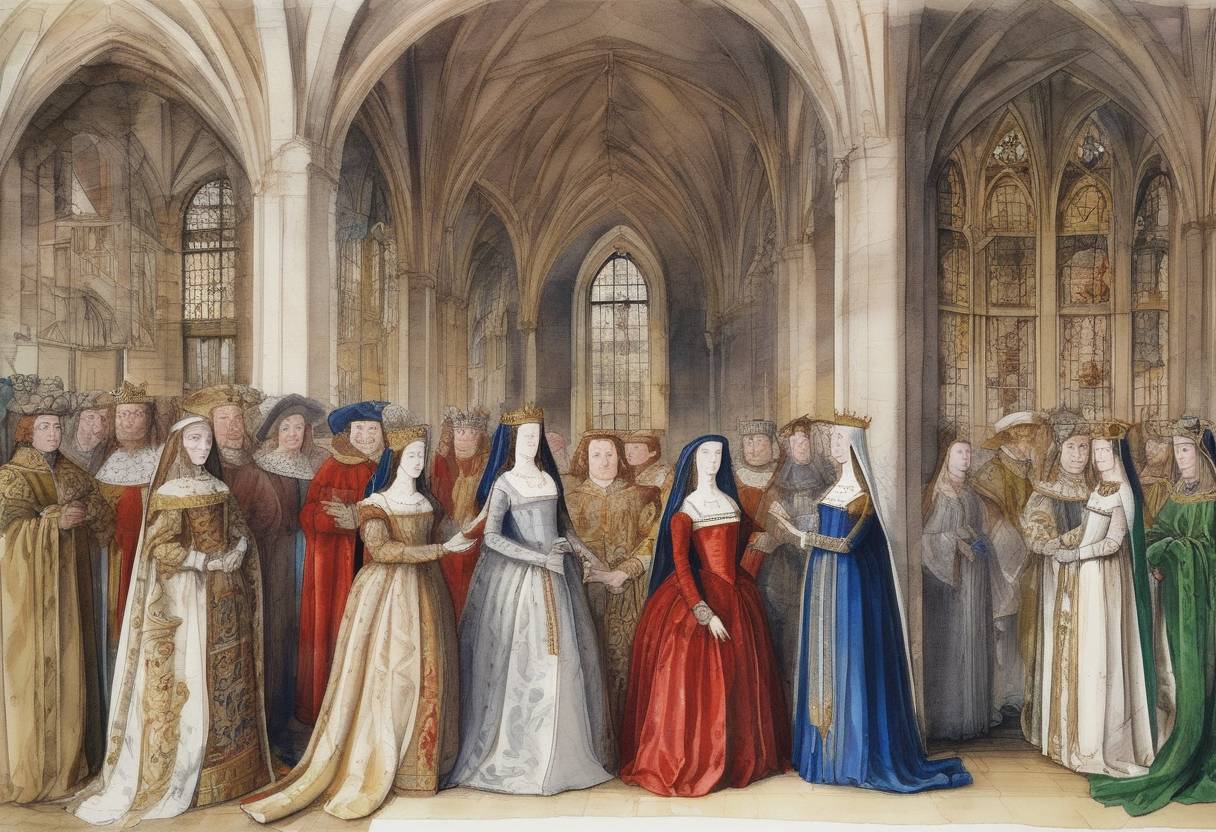
Anne of Brittany’s Announcement to Marry Charles VIII of France
On January 4, 1490, Anne of Brittany, the Duchess of Brittany, announced her intention to marry Charles VIII of France. This decision marked a pivotal moment in the history of France and Brittany, eventually leading to the unification of the two regions.
Historical Context
Anne of Brittany was born in 1477 and became the Duchess of Brittany in 1488 after the death of her father, Francis II, Duke of Brittany. At the time, Brittany was an independent duchy, and its strategic location made it a valuable asset in the power dynamics of Western Europe. The duchy was under pressure from France, which sought to consolidate its territories and strengthen its influence.
The political landscape of late 15th-century Europe was characterized by alliances and marriages that often served as tools for territorial expansion and consolidation. Anne’s marriage was no exception, as it was a crucial factor in the struggle for control over Brittany.
Key Events Leading to the Announcement
Treaty of Sablé (1488): Following the defeat of Brittany by France in the Battle of Saint-Aubin-du-Cormier, the Treaty of Sablé was signed. This treaty limited Brittany’s autonomy and required Anne to seek the French king’s approval for her marriage.
Marriage Negotiations: Anne was initially betrothed to Maximilian I of Austria, Holy Roman Emperor, in 1490. However, this union was not recognized by France, which saw it as a threat to its interests.
French Pressure: Charles VIII of France, eager to secure Brittany, exerted diplomatic and military pressure on Anne. The French king’s determination to marry Anne was part of a broader strategy to integrate Brittany into the French kingdom.
The Announcement and Its Consequences
Anne’s announcement on January 4, 1490, that she would marry Charles VIII was a turning point. The marriage took place on December 6, 1491, in Langeais, effectively bringing Brittany under French control. This union was significant for several reasons:
Political Unification: The marriage marked the beginning of the end of Brittany’s independence, as it was gradually integrated into the French kingdom. This unification was formalized in 1532 under the reign of Francis I of France.
Cultural Impact: The union of Brittany and France led to the blending of Breton and French cultures, influencing language, art, and customs in the region.
Dynastic Implications: The marriage strengthened the French monarchy’s territorial claims and set a precedent for future territorial expansions through dynastic unions.
Aftermath
Anne of Brittany’s marriage to Charles VIII had long-lasting effects on the political landscape of France. After Charles VIII’s death in 1498, Anne married his successor, Louis XII, further solidifying the ties between Brittany and France. Her efforts to maintain Breton autonomy within the French kingdom were notable, as she worked to preserve Breton rights and privileges.
In summary, Anne of Brittany’s announcement and subsequent marriage to Charles VIII were crucial in the historical process that led to the unification of Brittany and France, shaping the future of both regions.