Homer Plessy's Arrest and the Plessy v. Ferguson Case
1892 · New Orleans, United States
Homer Plessy was arrested for refusing to leave a whites-only car on a train in New Orleans, leading to the landmark Plessy v. Ferguson Supreme Court case.
November 13, 1956
The Supreme Court of the United States declares Alabama laws requiring segregated buses illegal, ending the Montgomery Bus Boycott.
Washington D.C., United States | Supreme Court of the United States
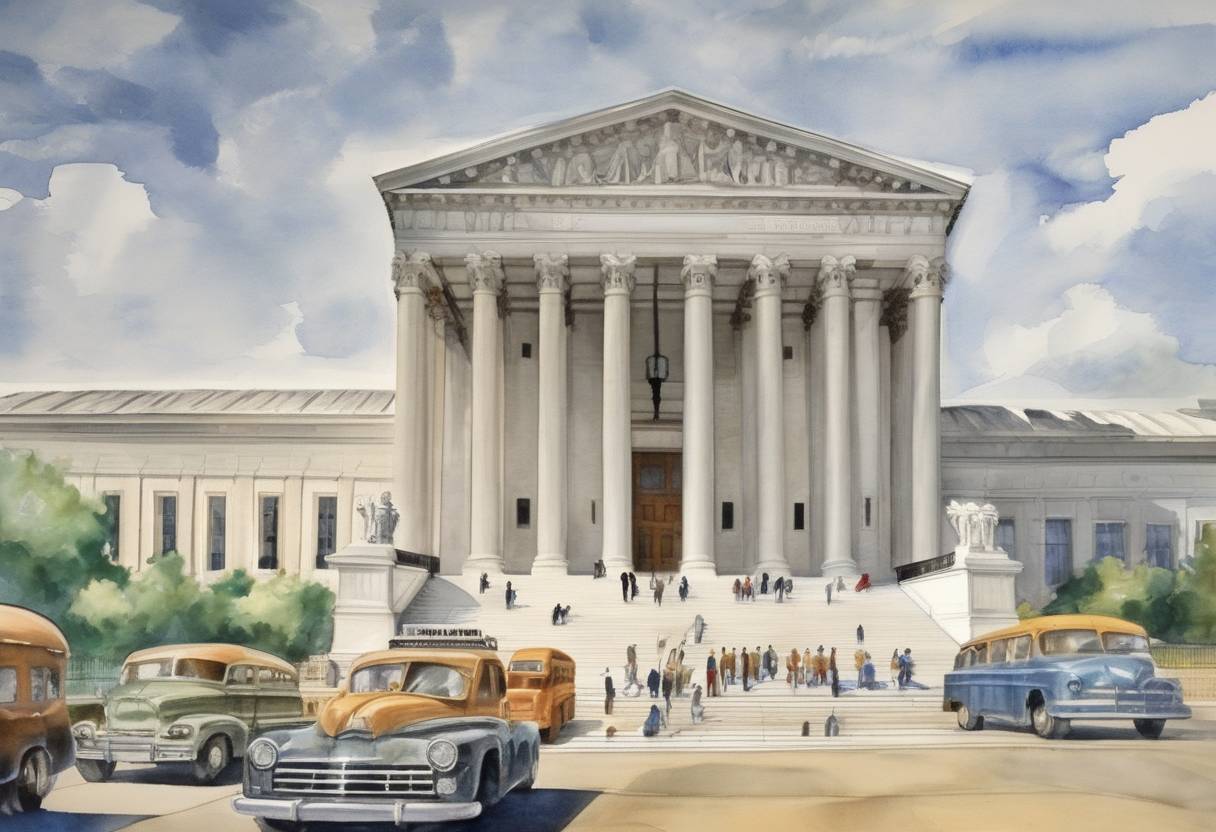
On November 13, 1956, the Supreme Court of the United States delivered a landmark decision in the case of Browder v. Gayle, declaring Alabama’s laws mandating segregated buses unconstitutional. This ruling effectively ended the Montgomery Bus Boycott, a pivotal event in the American Civil Rights Movement.
The Montgomery Bus Boycott began on December 5, 1955, following the arrest of Rosa Parks on December 1, 1955, for refusing to give up her seat to a white passenger on a Montgomery city bus. This act of defiance became a catalyst for the African American community in Montgomery, Alabama, to organize a boycott of the city’s bus system. The boycott was led by prominent figures such as Dr. Martin Luther King Jr., who emerged as a key leader in the Civil Rights Movement, and the Montgomery Improvement Association (MIA).
The boycott lasted for over a year, during which African Americans in Montgomery refused to use the city buses, opting instead for carpools, walking, or other means of transportation. The boycott significantly impacted the bus system’s finances and drew national attention to the issue of racial segregation in the South.
The legal challenge to bus segregation was brought forth by a group of African American women, including Aurelia Browder, Susie McDonald, Claudette Colvin, and Mary Louise Smith, who had experienced discrimination on Montgomery buses. Their case, Browder v. Gayle, argued that bus segregation violated the 14th Amendment’s Equal Protection Clause.
On November 13, 1956, the Supreme Court upheld a lower court’s decision, ruling that the segregation laws were unconstitutional. This decision was based on the precedent set by Brown v. Board of Education (1954), which declared that “separate but equal” facilities were inherently unequal in the context of public education.
The Supreme Court’s decision marked a significant victory for the Civil Rights Movement. On December 20, 1956, the court order was served to Montgomery city officials, and the boycott officially ended the following day, December 21, 1956, when African Americans returned to the buses, sitting wherever they chose.
The success of the Montgomery Bus Boycott demonstrated the power of nonviolent protest and mass mobilization. It also helped to galvanize further civil rights actions across the United States, setting the stage for future campaigns and legislation aimed at dismantling racial segregation and discrimination.
The ruling and the boycott highlighted the effectiveness of legal challenges combined with grassroots activism, serving as a blueprint for subsequent civil rights efforts. The event remains a symbol of the struggle for equality and justice in American history.
Source: en.wikipedia.org