The Second Battle of Kosovo: October 17, 1448
1448 · Kosovo Polje, Ottoman Empire
The Second Battle of Kosovo began between the Ottoman Empire and a coalition of Hungarian and Wallachian forces, resulting in an Ottoman victory.
November 10, 1444
The Battle of Varna took place, where the Ottoman Empire, led by Sultan Murad II, defeated the Polish-Hungarian army under King Władysław III of Poland and Hungary.
Varna, Bulgaria | Ottoman Empire
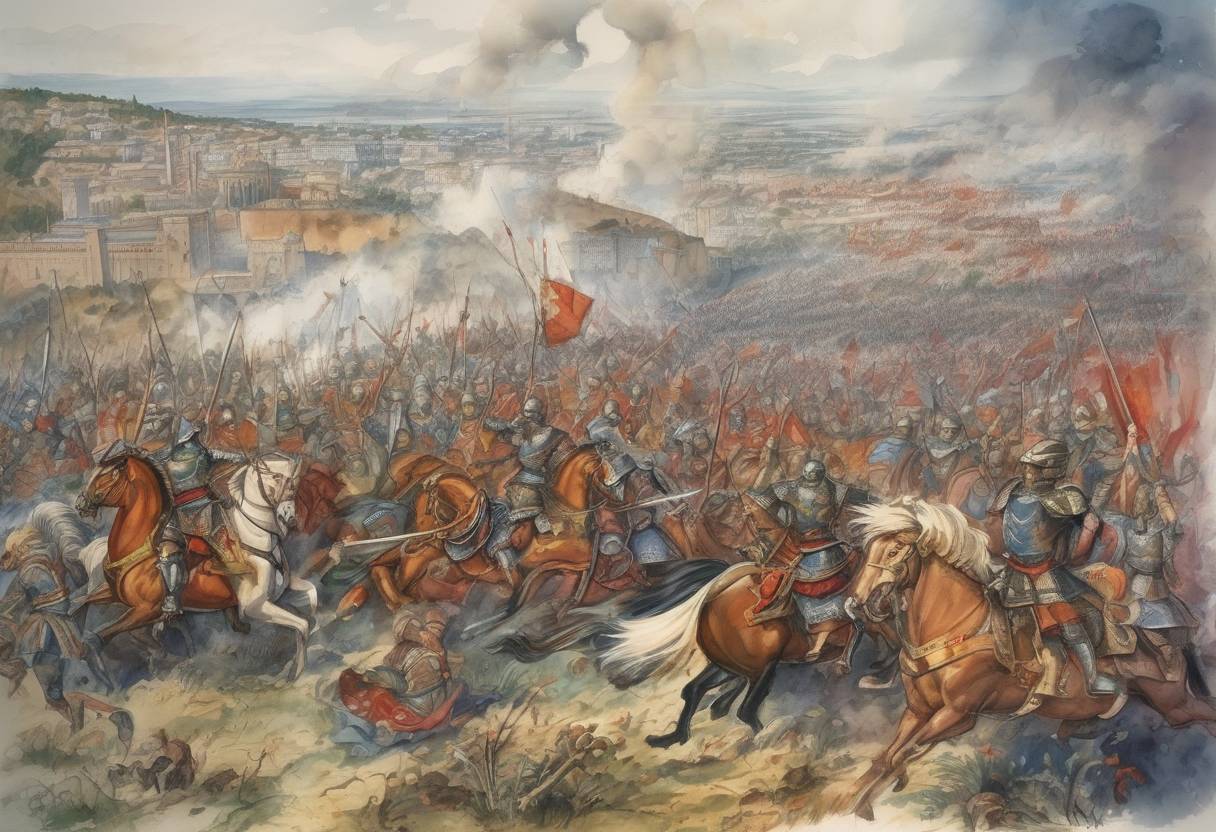
The Battle of Varna was a significant military engagement that took place on November 10, 1444, near the city of Varna in present-day Bulgaria. This battle was a crucial confrontation between the forces of the Ottoman Empire, led by Sultan Murad II, and a coalition army primarily composed of Polish and Hungarian troops under the command of King Władysław III of Poland and Hungary.
The battle was part of the larger conflict known as the Crusade of Varna, which was an effort by European powers to halt the expansion of the Ottoman Empire into the Balkans. The crusade was initiated following the signing of the Peace of Szeged in 1444, which was intended to be a ten-year truce between the Kingdom of Hungary and the Ottoman Empire. However, encouraged by Pope Eugene IV and other European leaders, King Władysław III decided to break the truce and launch a crusade against the Ottomans.
The crusading forces were a diverse coalition, including Polish, Hungarian, Wallachian, and other European troops. The campaign aimed to capitalize on the perceived weakness of the Ottoman Empire, as Sultan Murad II had temporarily abdicated in favor of his son, Mehmed II. However, Murad returned to lead his forces upon learning of the Christian advance.
The battle took place on the plains near Varna, with the Christian forces numbering around 20,000 men, facing an Ottoman army of approximately 60,000. Despite being outnumbered, the Christian forces initially held their ground, thanks to their strategic positioning and the element of surprise.
However, the tide turned when King Władysław III, in a bold but reckless move, led a cavalry charge directly at the Ottoman center, aiming to capture or kill Sultan Murad II. This maneuver resulted in Władysław’s death, causing chaos and demoralization among the Christian troops. The Ottoman forces, seizing the opportunity, launched a counterattack that decisively defeated the crusaders.
The death of King Władysław III, who became known as Władysław of Varna, marked a significant turning point. His demise left Hungary and Poland without a king, leading to political instability in the region. The defeat at Varna effectively ended the Crusade of Varna and solidified Ottoman control over the Balkans.
The battle demonstrated the military prowess of the Ottoman Empire and underscored the challenges faced by European powers in their attempts to curb Ottoman expansion. It also highlighted the complexities of European politics, where internal divisions and conflicting interests often undermined collective efforts against common threats.
In the broader historical context, the Battle of Varna was a precursor to further Ottoman advances into Europe, setting the stage for future conflicts such as the Fall of Constantinople in 1453 and the subsequent Ottoman incursions into Central Europe.
The Battle of Varna remains a poignant reminder of the shifting power dynamics in 15th-century Europe and the enduring impact of the Ottoman Empire on the continent’s history.
Source: en.wikipedia.org