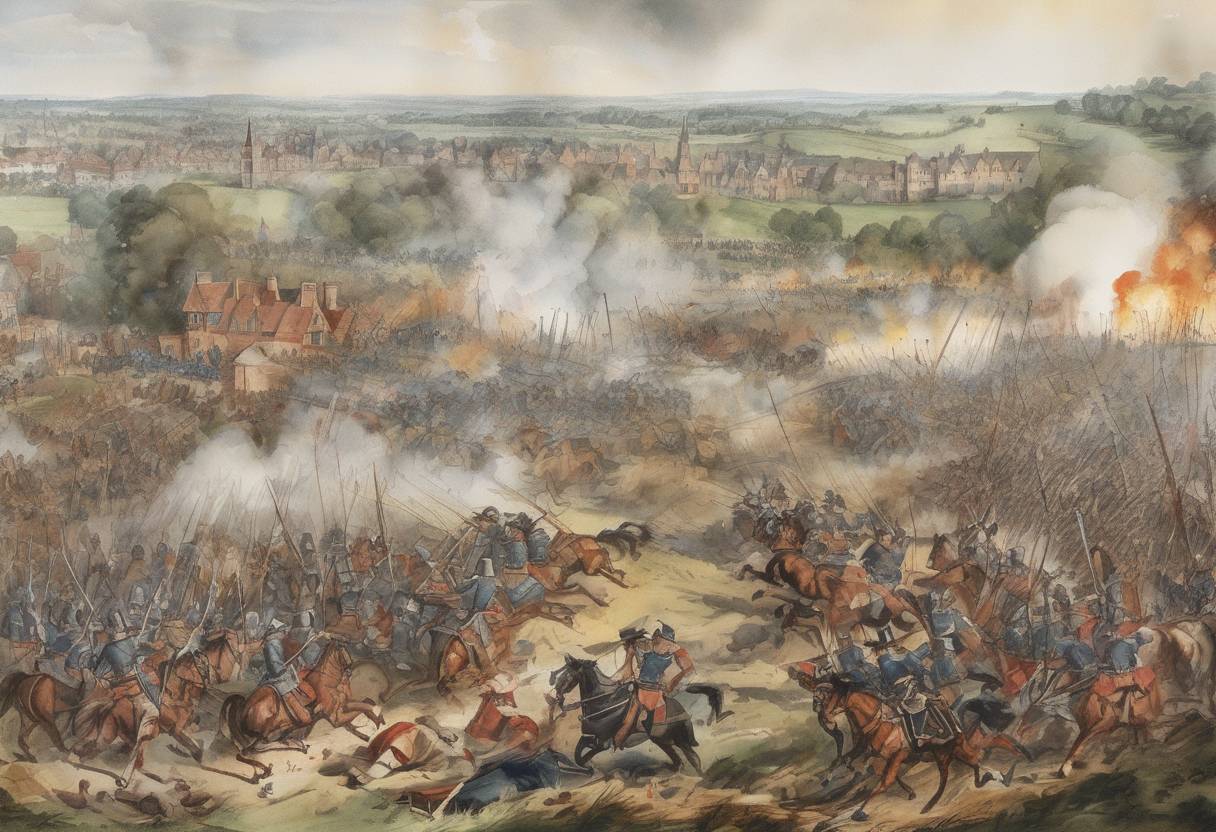
The Battle of Worcester: September 3, 1651
The Battle of Worcester, fought on September 3, 1651, was the final and decisive engagement of the English Civil War. This battle marked the end of the conflict between the Royalists, loyal to King Charles II, and the Parliamentarians, led by Oliver Cromwell. The outcome solidified the power of the Parliamentarian regime and led to significant political changes in England.
Context and Prelude
The English Civil War, which began in 1642, was a series of armed conflicts and political machinations between Parliamentarians (“Roundheads”) and Royalists (“Cavaliers”). The war stemmed from disputes over how England should be governed and issues of religious freedom.
- Charles I’s Execution: The conflict intensified with the execution of King Charles I in 1649, which led to the establishment of the Commonwealth of England under the leadership of Oliver Cromwell.
- Royalist Resurgence: Despite the execution, Royalist forces remained active. Charles II, son of the executed king, sought to reclaim the throne. He garnered support from Scotland, where he was crowned King of Scots in 1651.
The Battle
- Location: The battle took place in Worcester, a city in the West Midlands of England.
- Forces: Oliver Cromwell commanded a well-disciplined and experienced Parliamentarian army of approximately 28,000 men. In contrast, Charles II led a smaller, less organized Royalist force of about 16,000, composed of English, Scottish, and Irish troops.
- Strategy: Cromwell’s strategy involved a pincer movement to encircle and overwhelm the Royalist forces. He utilized the River Severn and River Teme to his advantage, cutting off escape routes and supply lines.
Key Events
- Initial Engagements: The battle began with skirmishes on the outskirts of Worcester. Cromwell’s forces quickly gained the upper hand due to their superior numbers and tactical positioning.
- Decisive Assault: The Parliamentarians launched a coordinated assault on the city, breaching its defenses. The Royalists, despite their valiant efforts, were unable to hold their positions.
- Charles II’s Escape: As the Royalist lines crumbled, Charles II narrowly escaped capture. He famously fled to France, marking the beginning of his nine-year exile.
Aftermath and Significance
- End of the Civil War: The defeat at Worcester effectively ended the Royalist cause in England. The Parliamentarians consolidated their control over the country.
- Cromwell’s Dominance: Oliver Cromwell emerged as the dominant political and military leader in England. He would later become Lord Protector, ruling until his death in 1658.
- Impact on the Monarchy: The monarchy was abolished, and England was declared a republic, known as the Commonwealth of England. This period of republican rule lasted until the Restoration of the monarchy in 1660.
The Battle of Worcester was a pivotal moment in British history, shaping the future of the nation and influencing the development of modern parliamentary democracy.