The Siege of Jerusalem: October 2, 1187
1187 · Jerusalem, Kingdom of Jerusalem
The Siege of Jerusalem ended with the city being captured by Saladin, the Sultan of Egypt and Syria, marking a significant event in the Crusades.
November 25, 1177
The Battle of Montgisard occurs, where Baldwin IV of Jerusalem defeats Saladin.
Montgisard, Kingdom of Jerusalem
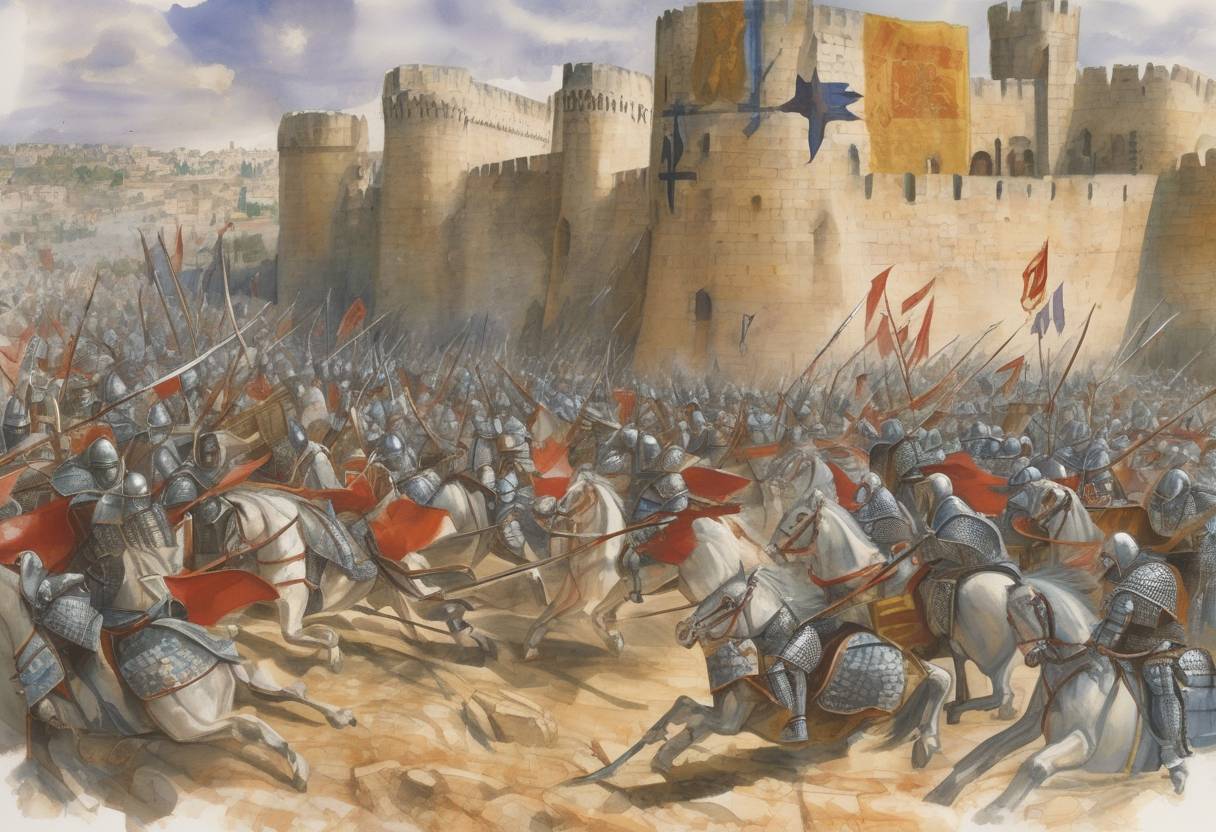
The Battle of Montgisard, fought on November 25, 1177, stands as a remarkable episode in the history of the Crusades, showcasing the resilience and strategic acumen of the Kingdom of Jerusalem under the leadership of Baldwin IV, known as the “Leper King.” This battle was a significant confrontation between the Crusader states and the forces of Saladin, the Sultan of Egypt and Syria, who was one of the most formidable Muslim leaders of the time.
In the late 12th century, the Crusader states were under constant threat from Muslim forces seeking to reclaim territories in the Holy Land. Saladin, who had unified Egypt and Syria, was determined to eliminate the Crusader presence. In 1177, Saladin launched an ambitious campaign to invade the Kingdom of Jerusalem, aiming to capture its capital and weaken the Crusader hold on the region.
Baldwin IV, despite suffering from leprosy, was a determined and capable ruler. At the time of Saladin’s invasion, Baldwin’s forces were relatively small and scattered. The Crusaders were also dealing with internal divisions and lacked the resources to mount a large-scale defense.
Saladin’s army, estimated to be around 26,000 strong, advanced towards Jerusalem with confidence, expecting little resistance. Baldwin IV, however, managed to gather a force of approximately 500 knights and a few thousand infantry, including Templar knights led by Odo de St Amand.
The two forces met near Montgisard, close to Ramla. Despite being heavily outnumbered, Baldwin IV executed a bold and unexpected attack. The Crusader army launched a surprise assault on Saladin’s forces, catching them off guard. The terrain played to the advantage of the Crusaders, and the element of surprise was crucial in their success.
Baldwin IV, despite his illness, personally led the charge, inspiring his troops with his bravery. The battle was fierce, and the Crusaders managed to break through Saladin’s lines, causing chaos and confusion among the Muslim forces. Saladin’s army was routed, and he narrowly escaped with a small contingent of his troops.
The Battle of Montgisard was a stunning victory for the Kingdom of Jerusalem. It temporarily halted Saladin’s advance and bolstered the morale of the Crusaders. Baldwin IV’s leadership and the unexpected triumph became legendary, enhancing his reputation as a capable and courageous king despite his debilitating illness.
For Saladin, the defeat was a setback, but it did not deter his long-term ambitions. He would eventually regroup and continue his campaigns against the Crusader states, culminating in the decisive Battle of Hattin in 1187, which led to the fall of Jerusalem.
The Battle of Montgisard is remembered as a testament to the determination and resilience of the Crusader states in the face of overwhelming odds. It highlights the complexities of the Crusades, where moments of triumph and defeat were closely intertwined in the ongoing struggle for control of the Holy Land.
Source: en.wikipedia.org